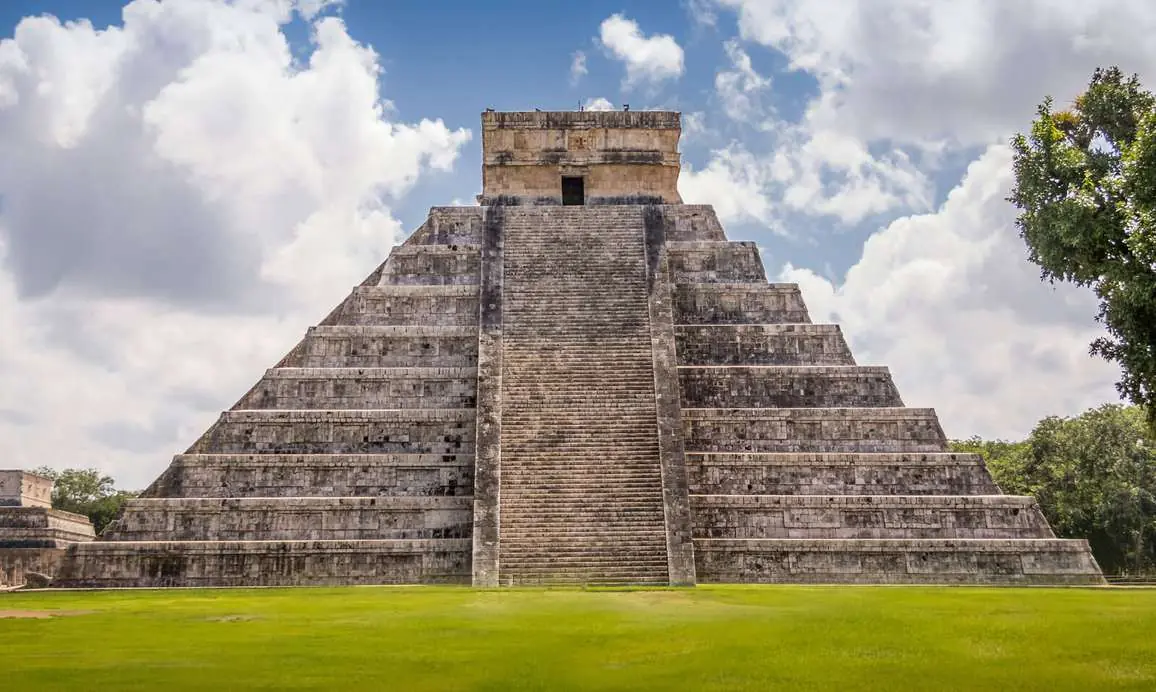
Best Month to Visit Chichen Itza: Weather, Crowds & Seasons
There is no single best month to visit Chichen Itza, and any page that names one without asking what you care about is skipping the real answer: the weather and the crowds peak in different months. The finest weather of the year, in February, is also one of the busiest months. The quietest month of 2025, October, sits in the middle of the rainy season. And the busiest month of 2025 was July, in the middle of the rainy season, which is why "low season means empty" is the first myth this page retires. What follows is the whole calendar, month by month, on two named datasets, INAH's monthly visitor totals for 2025 and the Japan Meteorological Agency's climate normals for Valladolid, the nearest station town, so you can pick the month that serves your priority instead of someone else's.
A note on who is writing this: we run a shared Chichen Itza tour, and this page covers the calendar for everyone, including travellers who will never book it. We are a new operator with a short record. Every crowd figure below is INAH's, every climate figure is the JMA's Valladolid normals or EcoColors' attributed averages, and where a number does not exist in a trustworthy source, a quietest-day count, a seasonal discount rate, this page prints the gap rather than fill it. Our own price, for the record, does not move with the calendar at all: section 10 states it plainly.
The Short Answer, by Priority
"Best month" is four different questions wearing one phrase. Answer the one that is actually yours:
| Your priority | The month | Why, in one line |
|---|---|---|
| Fewest crowds | October, then September | The two lowest INAH totals of 2025 (128,270 and 131,702). The price is rain and, for September, the hurricane peak. |
| Best weather | February | The driest month in the Valladolid normals at 22 mm of rain, with a mean of 24.6°C, and busy for exactly that reason. |
| The balance | November | The dry season is returning (62 mm), the heat has eased off the peak, and the crowds have not yet reached the winter level. |
| Heat-tolerant, crowd-averse | May | The hottest month of the year, and one of its quietest, at 141,413 visitors in 2025. Heat is the admission price for space. |
| Families tied to school holidays | Early December, early March | The dry-season shoulders just outside the spikes: before the Christmas window opens on 18 December, and before the equinox week in March. |
Every verdict above is unpacked with its evidence in the sections below, the full 12-month table next, then the seasons, the heat, the crowds, and the dated 2027 windows. If your dates are already fixed, skip to the month itself: the table is the page's centre of gravity.
Weather and Crowds, Month by Month
One row per month, three facts per row, each from its named source: the mean temperature and rainfall are the Japan Meteorological Agency's ClimatView normals for Valladolid; the visitor total is INAH's count for that month in 2025; and the feel of the month is stated in words, following EcoColors' Valladolid long-term averages, which put daytime highs across the year between roughly 29°C and 35°C and lows between roughly 18°C and 23°C. No other climate series is blended in anywhere on this page.
| Month | The feel, in words | Mean temp / rainfall (JMA, Valladolid) | Visitors in 2025 (INAH) | The trade-off |
|---|---|---|---|---|
| January | The coolest, most settled month of the year | 23.6°C / 52 mm | 201,543 | Cool and mostly dry, and busy, with winter escapes and the tail of the New Year window. |
| February | Mild, with the driest air of the year | 24.6°C / 22 mm, the driest month | 214,106 | The best all-round weather of the year, and one of its busiest months. Weather is what everyone comes for. |
| March | Warming, still dry | 26.0°C / 56 mm | 202,284 | Dry and bright, but the month bends around two spikes: the spring equinox and the spring-break weeks. |
| April | Hot and dry, building toward the peak | 28.2°C / 49 mm | 221,377 | The second-busiest month of 2025, with the heat already near its worst. In 2027, with Easter in March, April should run calmer than usual after its first days. |
| May | The hottest month of the year | 29.1°C, the highest mean / 95 mm | 141,413 | The trade-off month: peak heat, light crowds. Section 4 is devoted to it. |
| June | Hot, with the rains arriving in earnest | 28.5°C / 200 mm | 161,011 | Rainfall jumps fivefold from April. Hurricane season opens on 1 June: section 7 covers what that honestly means. |
| July | Hot, with wet-season afternoons | 28.3°C / 163 mm | 224,436, the busiest month of 2025 | The paradox month: rainy season, and still the fullest the site got all year, on Mexican summer holidays. |
| August | Hot and wet, the deep rainy season | 28.3°C / 179 mm | 179,214 | Still a holiday month, still a wet one, busier than the season's reputation and wetter than its crowds suggest. |
| September | Warm and at its wettest | 27.9°C / 224 mm, the wettest month | 131,702, second-quietest of 2025 | The sharpest trade-off on the calendar: maximum rain and hurricane exposure, near-minimum crowds. |
| October | Warm, still wet, slowly easing | 26.6°C / 167 mm | 128,270, the quietest month of 2025 | The emptiest month of the year. What you are buying the space with is the tail of the rains. |
| November | Heat easing, the air drying | 24.8°C / 62 mm | 193,778 | The balance month: the dry season returning, temperatures back to comfortable, crowds moderate rather than peak. |
| December | Cool and dry, the winter pattern set | 24.2°C / 58 mm | 182,900 | Two different months in one: a calm, pleasant first half, then the Christmas–New Year spike from 18 December. |
Sources for this table: visitor totals are INAH's monthly figures for 2025, as reported from INAH's dataset, the twelve months sum to 2,182,034, matching INAH's independently published 2025 total of about 2.18 million. Monthly totals describe a whole month; they are not queue times, and a quiet month still contains busy Sundays and holidays. Climate figures are the Japan Meteorological Agency's ClimatView normals for Valladolid: the source does not state its reference period, and this page prints them with that gap labelled rather than guess one. EcoColors' Valladolid long-term averages (updated 30 October 2026) agree with the JMA series in shape and are the source of the high–low pattern quoted above. One early signal for the current year: January 2026 drew about 227,000 visitors (EcoColors, reporting INAH via Yucatán Magazine), the busiest month of 2026 so far.
Month-by-month advice only helps once the fixed facts are set, the Chichen Itza visitor guide holds the hours and entry details that do not change with the season.
Dry Season vs Rainy Season: What the Labels Actually Mean
The working split, in one line: the dry season runs roughly November to April and the rainy season roughly June to October, with May the disputed shoulder: some sources run the dry season through May, and this page publishes that disagreement rather than pick a side, because May's own numbers argue both ways (the year's highest mean temperature, and rainfall, at 95 mm, still well below June's 200 mm).
What "rainy season" means in practice is the part the label usually hides. It does not mean rain from dawn to dusk. The pattern travellers actually meet, and the one the guides behind this page describe consistently, is mornings that are often clear, with rain building in the afternoon: a hot, bright start, cloud by early afternoon, and a downpour that can be heavy and usually passes. A rainy-season visit feels like this: the ruins in strong morning light, the swim at Cenote Ik Kil while the sky decides, and a wet hour somewhere in the afternoon that you shelter through rather than a day you lose. Washouts happen, section 7 records a real rain closure, but they are the exception the season is remembered by, not its everyday weather.
The dry season's honest description is the mirror image: settled days, low rainfall (February's 22 mm is the floor of the year), the coolest mornings of the calendar, and the crowds that predictably follow good weather. Neither season is the "right" one. The dry season sells certainty at the price of company; the rainy season sells space at the price of a forecast you have to respect. The within-day half of that planning, which hours to be where once you are here, belongs to the best time to arrive page; this page owns the calendar, and the calendar's verdict is that the two seasons are a trade, not a ranking.
Shorter winter days and summer heat both change the same equation, how long to spend at the ruins is the other half of the month decision.
The Heat Months: April and May
If one cost on this calendar is paid in the body rather than in company, it is heat, and its peak is precise: May carries the highest monthly mean temperature of the year, 29.1°C, in the JMA Valladolid normals, with April just behind at 28.2°C. EcoColors' Valladolid long-term averages put April–May average highs at around 35°C (95°F), the figure this site uses wherever the heat peak needs a number, attributed here as everywhere. On open ground with little shade, that is a different visit from February's: the plaza at midday in May is the hardest version of Chichen Itza there is.
And yet May is the month this page refuses to write off, because the same table that gives it the heat gives it 141,413 visitors in 2025, one of the quietest totals of the year. May is the calendar's cleanest exchange: if you can take the heat, the site gives you space in return, on dry-season's-end ground before the June rains arrive in earnest. The tactics that make the exchange work are within-day ones, the first hour after the 8:00 AM opening, the shaded rotation, the swim placed after the ruins, and they are set out on the best time to arrive page, which owns the clock. The kit half of the same preparation, what to wear to Chichen Itza in the heat months, has its own page. This page owns only the verdict: April and May are the heat months, May is their peak, and for the heat-tolerant it is a bargain rather than a warning.
When Is Chichen Itza Most Crowded?
Start with the correction, because the internet's standing answer is wrong on the most recent full year of data: December is not the busiest month. In INAH's 2025 totals the busiest month was July, at 224,436 visitors, followed by April at 221,377 and February at 214,106. The quietest was October, at 128,270, with September just above it. The full year, in one chart:
INAH monthly visitor totals for 2025, the same figures as the table in section 2. Monthly totals are not queue times: they cannot tell you how long any given morning's entrance line was, and this page never presents them as if they could.
Why the year bends this way is mechanics, not mystery. The peaks are built by holidays, on both sides of the border: Mexican school recesses fill July and the Christmas window from inside the country; US and Canadian winter escapes fill January and February from outside it; Holy Week and the equinox load March or April depending on where Easter falls. That is also why the peaks move: a month's total is last year's holiday calendar wearing a number. Inside every month, one weekly rhythm holds regardless, Sunday is the busiest day of the week, because entry is free for Mexican nationals and residents that day, stated here in words because that is all any trustworthy source supports. How Sunday interacts with the hours of the day is covered on the best time to arrive page; the dated 2027 spikes are the next section.
Dates to Avoid in 2027
Months are averages; trips happen on dates. These are the windows EcoColors' 2027 calendar (updated October 2026), cross-checked against Mexico's SEP school calendar, marks as the year's crowd spikes, each with the mechanism that builds it, so you can judge the ones near your own dates rather than take a list on faith:
- 19 December 2026 – 6 January 2027: the Christmas–New Year window, overlapping the Mexican winter school recess (21 December 2026 – 5 January 2027, SEP). The year's longest spike.
- 30 January – 1 February 2027: the Constitution Day long weekend.
- 13–15 March 2027: the Benito Juárez long weekend, landing one week before the equinox, in the same crowded fortnight.
- 20–28 March 2027: the year's worst crowd window: the spring equinox on Saturday 20 March runs straight into Holy Week (21–28 March, Easter Sunday 28 March), with the SEP spring recess opening on 22 March and Ontario's mid-winter break (15–19 March) feeding the same days from Canada.
- 22–23 September 2027: the autumn equinox operation: a real spike, and a smaller one than spring's. Section 11 gives both equinoxes their passage.
- 13–15 November 2027: the Revolution Day long weekend, inside an otherwise well-balanced month.
- 18–31 December 2027: the Christmas window opens again; early December, before it, is a different and much calmer trip.
Two honest qualifications. First, "avoid" means expect the year's fullest site, travellers whose dates are fixed inside a window still get their visit, and the within-day tactics on the best time to arrive page matter most exactly then. Second, one famous crowd source has no date to print: US spring break has no single week, it spreads across March and into April by school district, so any page that warns you off one exact "spring break week" is inventing a precision the calendar does not have.
Visiting in Hurricane Season: The Real Risk, Priced Honestly
The formal frame first: the Atlantic hurricane season runs from 1 June to 30 November, with its climatological peak around 10 September (NOAA's National Hurricane Center). Chichen Itza sits about 120 km inland, and that distance is the site's main protection: storms that make landfall on the coast reach the ruins weakened, rain and wind, not a coastal strike. That is the honest shape of the risk, and it cuts both ways: weaker is not nothing.
Because the closure risk is real, and this page proves it with the record rather than assert it. INAH can and does close the site: in the settled recent case file, the site was closed from 19–31 May 2026 during a protest, and again on 2–3 June 2026 for rain, which is also why no honest page, this one included, will tell you the site is open every day of the year. Ordinary rain does not close it; "rain automatically closes the site" is as false as "it never closes". The depth on how closures and refunds work sits on the cancellations, rain and site closures page; this page carries the calendar fact and the traveller's practical answer to it.
The traveller's protection is a booking term, not a forecast. On our tour, cancellation is free up to 48 hours before the tour, with the 30% advance refunded in full, so a closure, a storm warning or a changed forecast on your date costs you a plan, not your money. That term is ours, stated for our tour only; it is never generalised here into a claim about other operators. If you travel in hurricane season with anyone, the question to ask them is the same one: what happens to my money if the site closes on my day?
The Cenote Does Not Change
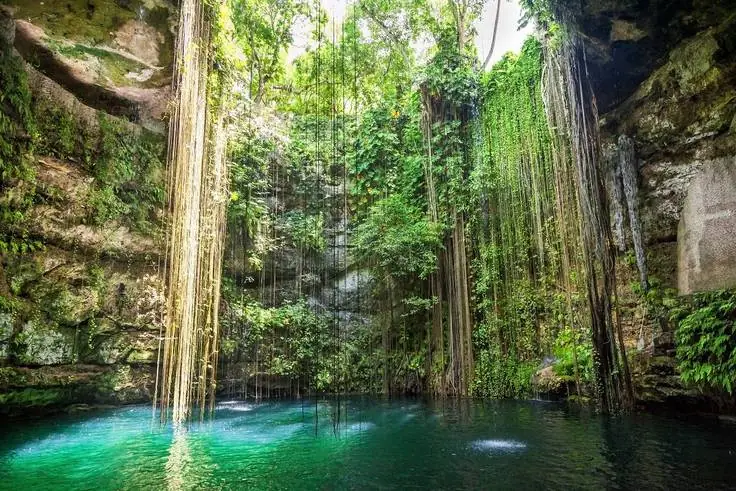
Cenote Ik Kil, about 3 km from the ruins. The calendar rearranges the ruins above ground; down here, the season barely registers.
Every other section of this page is about something the calendar moves. This one is about the thing it does not: Cenote Ik Kil's water stays at about 24–26°C (75–79°F) all year, in January as in July, on multiple sources' consistent account. The cenote sits below ground, open to the sky through its round mouth but sheltered from the season moving across the plateau, no winter chill in the water, no summer warmth either. The swim is, in the plainest sense, season-proof.
That constancy is practically useful, because it simplifies the year's planning to a single variable: what changes by month is the ruins, their heat, their rain, their crowds, and the ruins are what the rest of this page exists to schedule. The swim will be the same swim whenever you come. Choose your month for the stones, and let Ik Kil look after itself. The full cenote depth, the water, the rules, the facilities, lives on the Chichen Itza and cenote tour page.
Best Months for US and Canadian Travellers
Most of this site's readers fly in from the United States and Canada, and their calendars bend the year in specific ways worth naming directly.
The winter escape (December–February). The classic trip, out of the northern winter into the dry season, is also the calendar's most contested: the finest weather of the year, shared with everyone who had the same idea. Inside the window, the craft is in the dates: early December before the 18th, and February outside its long weekends, are the same weather with measurably less company. January 2026 drew about 227,000 visitors (EcoColors, reporting INAH via Yucatán Magazine), winter demand is not easing.
Spring break (March–April). There is no single US spring-break week, it spreads by district across March and into April, so the honest planning unit is the window, not the week. Canada contributes one dated piece: Ontario's mid-winter break runs 15–19 March 2027, feeding directly into the equinox and Holy Week collision of 20–28 March, the worst window of 2027, and the one North American families with fixed March dates should plan around hardest, or choose with open eyes.
Summer families (June–August). School holidays fix these dates, so the service this page can do summer travellers is honesty about the paradox: July was the busiest month of 2025, carried by Mexican summer holidays, in the middle of the rainy season. A July trip is a good trip, mornings are often clear, the cenote is unchanged, but it is not the empty low-season bargain it is sometimes sold as. August is the same weather with somewhat less company.
Thanksgiving and early December. The quiet achiever of the North American calendar: the US Thanksgiving week and the first half of December sit inside the returning dry season, after the autumn rains and before the Christmas window opens on 18 December. For travellers whose year has one flexible week, this page's own pick for them is the one in section 1, November's balance, running into early December's calm.
Is Chichen Itza Cheaper in the Low Season?
Our price, stated once and plainly: $130 per adult and $115 per child (up to age 12), in every month of the year. There is no low-season discount on this tour, no rainy-season rate, no high-season surcharge, and this page will never imply one, here or anywhere else on the site. If a quieter month saves you money, it will not be on this line of your budget.
What does move with the season is the trip around the tour. As seasonal travel guides describe the market, hotels and flights are often priced lower in the quieter months, stated here in words, attributed to that general market reporting, because no verified price series for the corridor exists in this page's research and none will be charted or quoted. You will also find competitor pages advertising precise rainy-season discount rates; the research behind this page found those figures unsourced, and they are not repeated here even to argue with. The settled fee facts, including the 697 MXN entrance fee that our price already includes, live on the tickets and entrance fee page.
So the honest answer to the cheapest-month question is a split one: the trip is often cheaper in the quiet months; the tour costs what it costs in all twelve. Plan the saving where it actually exists.
The Equinoxes as Calendar Spikes
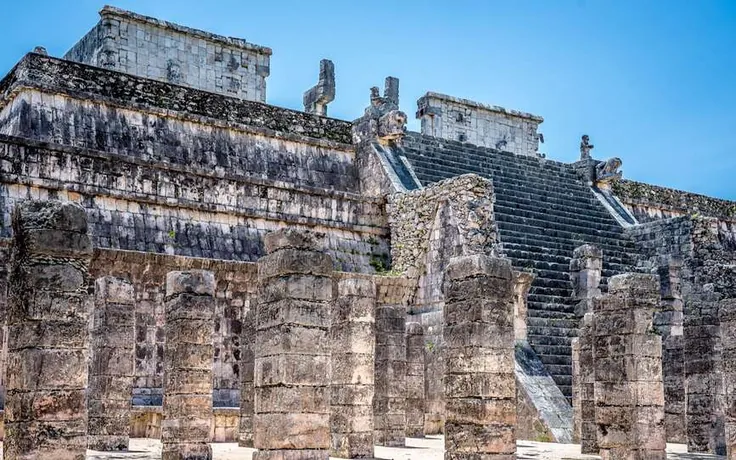
The Temple of the Warriors group. On equinox days the whole site, not just El Castillo's staircase, runs at the year's fullest.
Twice a year the calendar stops being a curve and becomes a spike. At the equinoxes, the afternoon light on El Castillo's northern staircase forms the famous serpent effect, and the site fills for it: the spring equinox falls on Saturday 20 March 2027 and the autumn equinox operation runs 22–23 September 2027. Spring is the major event by an order of magnitude, the 2025 spring operation (20–23 March) drew 32,872 visitors and the March 2026 operation drew 24,791, both reported from INAH figures, and in 2027 spring carries the extra load set out in section 6: Holy Week begins the day after the equinox itself.
The autumn dates are the connoisseur's version of the same phenomenon: the same light on the same staircase, a smaller operation, inside the quietest stretch of the year, bought, like everything in September, with the wettest month's weather. This section is passage depth by design: the phenomenon itself, the special operations on the day and how to plan around them belong to the Chichen Itza equinox guide, and the tour built on reaching the site at its 8:00 AM opening on the ordinary days around these spikes is the early access tour. Here, the equinoxes are recorded for what this page owns: two dates that bend their months out of shape.
Sources and Data Periods
This page stands on three named sources, used at the grade each one earns, and it is worth two minutes, because the calendar genre is full of numbers with no home:
- INAH monthly visitor totals for 2025, as reported from INAH's dataset: the twelve monthly figures in section 2, summing to 2,182,034 and matching INAH's independently published 2025 total of about 2.18 million. Used for crowd comparisons between months, never as queue times, never as daily counts. The January 2026 figure (about 227,000) comes via EcoColors, reporting INAH via Yucatán Magazine.
- Japan Meteorological Agency ClimatView normals for Valladolid: the monthly mean temperatures and rainfall in the table. The source does not state its reference period, that gap is printed wherever the series is used, and no second climate series is blended in to cover it.
- EcoColors' Chichen Itza guides (updated 30 October 2026): the Valladolid long-term high–low pattern, the April–May average high of around 35°C, the 2027 windows to avoid (cross-checked against Mexico's SEP school calendar: winter recess 21 December 2026 – 5 January 2027; spring recess 22 March – 3 April 2027), and the attributed equinox operation figures. NOAA's National Hurricane Center is the source of the hurricane season's dates and its climatological peak around 10 September.
What was not used, and why: a second set of 2024 visitor figures exists in two versions (INAH's and the tourism council's) that disagree with each other, neither is published here. Seasonal discount percentages, crowd-drop percentages and rain-chance percentages circulating on competitor pages and in AI answers were unsourced wherever this page's research found them, and none appears here: the only percentage on this page is our own booking advance. Climate figures from sources that name no station were rejected on the same principle, Valladolid's series, with its period gap labelled, is the only one carried.
The Tour, in Any Month You Choose
Whenever the calendar says your month is, our shared tour runs the same day at the same price: pickup from your own hotel or point, Chichen Itza with the 697 MXN entrance fee included, a swim at Cenote Ik Kil, and a stop in Valladolid, then back to your pickup point. It costs $130 per adult and $115 per child (children up to age 12), in January, in July, in October, identically, as section 10 states. Booking is by WhatsApp: your written confirmation comes first and restates the whole position, date, party, pickup point, total price, the advance and balance split, and the cancellation position for your date, and only then is the 30% advance paid to reserve, with the balance on the day of the tour. Cancellation is free up to 48 hours before the tour, with the advance refunded in full, the term that matters most in the storm months, as section 7 sets out. Your exact pickup time is confirmed on WhatsApp the night before.
One slot this page leaves honestly open: it makes no claim about an operating calendar, no statement about which months or dates tours run, because that is a fact only we can settle and it is not settled here. What is settled is everything above, and what your written confirmation will restate for your specific date before any money moves. We are a new operator with a short record; that is stated rather than dressed up. The tour from each pickup city is set out on its own page: the tour from Cancun and the tour from Tulum, with the Playa del Carmen, Riviera Maya and Merida pages linked from there. If you are travelling independently, the calendar above is yours either way, the calculator simply prices the alternative exactly.
Price it for your party
The button below composes a WhatsApp message with this party and pickup city already written in.
Book on WhatsAppBest Month to Visit Chichen Itza: Questions
What is the best month to visit Chichen Itza?
There is no single best month, because the weather and the crowds peak in different months. November is the best balance: the dry season is returning and the crowds are still moderate. February has the best all-round weather of the year but is one of the busiest months of 2025. October had the fewest visitors of any month in 2025. The right answer depends on your priority, fewest crowds, best weather, the balance between them, or the school holidays your family is tied to.
What is the best time of year to visit Chichen Itza?
For most travellers, the dry season, roughly November to April, when rainfall is at its lowest and the days are at their most settled. Inside that window, November balances weather and crowds best, and February has the finest weather of the year. The rainy season, roughly June to October, is not a write-off: mornings are often clear before afternoon rain, and October was the quietest month of 2025. What the calendar never offers is the best weather and the smallest crowds in the same month.
What is the least crowded month at Chichen Itza?
October. INAH's monthly visitor totals for 2025 put October lowest at 128,270 visitors, with September second-lowest at 131,702. The trade is the weather: October sits inside the rainy season and the Atlantic hurricane season. One caution applies to every crowd figure on this page: monthly totals describe the month as a whole, they are not queue times, and even a quiet month has busy days, especially Sundays and holidays.
Is Chichen Itza worth visiting in the rainy season?
Yes, for most travellers. The rainy season, roughly June to October, usually means clear mornings and rain that builds in the afternoon, not days washed out from dawn. The ruins stay open in ordinary rain; closures are the exception, and this page records the real recent ones. Cenote Ik Kil's water stays at about 24–26°C all year, so the swim is unaffected. The one warning the season genuinely earns: July, in the middle of it, was the busiest month of 2025, rainy does not mean empty.
What is the hottest month at Chichen Itza?
May. The Japan Meteorological Agency's climate normals for Valladolid give May the highest monthly mean temperature of the year, 29.1°C, and EcoColors' Valladolid long-term averages put April–May average highs at around 35°C (95°F). May's compensation is its crowds: at 141,413 visitors in 2025 it was one of the quietest months of the year. If heat is your hard limit, the winter months are the comfortable end of the calendar; if you can take the heat, May trades it for space.
When is hurricane season at Chichen Itza?
The Atlantic hurricane season runs from 1 June to 30 November, with its climatological peak around 10 September (NOAA's National Hurricane Center). Chichen Itza sits about 120 km inland, so storms reach it weakened, but wind and rain can still close the site, and INAH closed it on 2–3 June 2026 for rain. The traveller's protection on our tour is a booking term, stated plainly: free cancellation up to 48 hours before the tour, with the advance refunded in full.
Is September a bad month to visit Chichen Itza?
It is the sharpest trade-off on the calendar, not simply a bad month. September was the wettest month in the Valladolid normals at 224 mm of rain and holds the hurricane season's climatological peak around 10 September, and it was also the second-quietest month of 2025, with 131,702 visitors. Mornings are often clear before the afternoon rain. Go in September for the space, price in the storm exposure honestly, and keep a cancellation term that protects your date.
Is Chichen Itza cheaper in the low season?
Not with us. Our shared tour costs $130 per adult and $115 per child in every month of the year, there is no low-season discount and no high-season surcharge, and any page implying this tour gets cheaper in the quiet months is wrong. What does move with the season, as seasonal travel guides describe it, is the wider trip: hotels and flights are often priced lower in the quieter months. The saving, where it exists, is in the trip around the tour, never in the tour itself.
When is the equinox at Chichen Itza in 2027?
Twice. The spring equinox falls on Saturday 20 March 2027, and the autumn equinox operation runs 22–23 September 2027. Spring is the big one: the 2025 spring operation (20–23 March) drew 32,872 visitors and the March 2026 operation drew 24,791, both reported from INAH figures. In 2027 the spring date runs straight into Holy Week, which begins the next day, late March 2027 is the year's worst crowd window, and the autumn dates are the calmer way to see the serpent.
Does the cenote water get cold in winter?
No. Cenote Ik Kil's water stays at about 24–26°C (75–79°F) all year, in winter as in summer, the cenote sits below ground, sheltered from the season moving across the ruins above it. What changes by month is the air temperature, the rain and the crowds at the ruins. The swim is the one part of the day the calendar does not touch, which is why this page plans the year around the stones, not the water.
¿Cuál es la mejor época para visitar Chichén Itzá?
No hay un solo mes perfecto, porque el clima y las multitudes alcanzan su punto máximo en meses distintos. Noviembre ofrece el mejor equilibrio: regresa la estación seca y las multitudes aún son moderadas. Febrero tiene el mejor clima del año, pero es un mes concurrido. Octubre fue el mes con menos visitantes en 2025, según los totales mensuales del INAH, aunque cae en la estación lluviosa. La estación seca va, en términos generales, de noviembre a abril, y la lluviosa de junio a octubre.
What is the worst month to visit Chichen Itza?
It depends on what you are avoiding, and any single answer without that qualifier is a ranking trick. For crowds, the worst window of 2027 is late March: the spring equinox on Saturday 20 March runs straight into Holy Week. For rain and storm exposure, September is the hardest month, the wettest in the normals and the hurricane peak. For heat, May is the peak. For most travellers, the month to genuinely avoid is the one whose cost is the one they cannot pay.
Check Your Month on WhatsApp
You now have the whole calendar: November's balance, February's weather, October's space, July's paradox, and the late-March 2027 window to step around. If your month is chosen, or if you want a second pair of eyes on the dates you have, send us your month, your party and your pickup city, and you will get the written confirmation first: price, pickup point, advance and balance, cancellation position, before any money moves. Your exact pickup time is confirmed on WhatsApp the night before.
$130 per adult · $115 per child to age 12 · 697 MXN entrance fee included · the same price in every month · free cancellation up to 48 hours before the tour.