Chichen Itza with Kids: The Family Guide
Is Chichen Itza worth it with children? Yes, if you plan for the day it actually is: early, hot, largely open to the sun, and long, with a cold green swim in the middle of it. This page gives you the age-by-age truth, the real family maths, including one child gate rule the sources flatly contradict, shown here as a contradiction, and the parts nobody can honestly promise you, marked as not promised.
Quick answers: on our shared tour, children pay $115 each up to age 12, with the 697 MXN ruins fee inside the price, so the gate question below never reaches your wallet on the tour. Going independently, a family meets a child gate rule the sources contradict; we print all three versions honestly in the costs section rather than pick one. And at Ik Kil, the child price is set by height, not age, measured at the gate.
Two disclosures, up front. We are a new operator with a short record. And everything on this page that is advice is labelled Our advice: facts carry their sources, advice carries its label, and the two are never blended.
Everything family-specific on this page sits on top of the ordinary visit facts: hours, entry and layout are in the Chichen Itza visitor guide.
The Short Answer by Age
Every age can visit Chichen Itza. What changes with age is who the day is hard on. Here is the verdict strip: the four sections after it argue each line.
Heat, sparse shade, a 10–14-hour day and a schedule that does not pause for naps. The hardest band, for the parents.
The engagement age: the echo clap, the step count, the ballgame story and the swim carry the day. Stamina is the limiter.
The ruins themselves start to land, and this band still pays the tour's $115 child price, which ends at 12.
Adult price everywhere that matters: $130 on the tour, 697 MXN at the gate. The visit itself only gets better.
Our advice If you have one child under 5 and one over 7, plan the day for the younger one: the older will enjoy whatever the younger can manage, and not the other way round.
Under 5: The Honest Picture
Start with the three facts that decide this age band. The site is largely open, and the shade is real but sparse: one first-hand account of visiting with a baby describes the tree groves as "few and far between." The day around the ruins is 10–14 hours door to door, with an early pickup and a fixed group schedule that does not pause for naps. And the heat is not a detail: it is the medium the whole day happens in.
The one published baby account we found is worth hearing precisely, because it cuts against the obvious conclusion: the parents found the day manageable, because the baby was too young to be bored. Fed, shaded and carried, an infant mostly experiences a long, warm outing. Their warning was aimed one band up: older toddlers are the hard sell: old enough to be bored and hot, too young for the stories that carry older children, and too heavy to carry all day without it costing the adults.
Our advice Think hard before booking this age band, and go in with open eyes if you do. The families who make it work do three things: a carrier rather than a stroller for the ruins block, a plan that treats the Ik Kil swim as the day's anchor rather than a bonus, and a willingness to cut the ruins block short: see the buildings nearest the entrance properly instead of marching a melting toddler to all of them. A nap will happen where it happens: on the bus, in arms, in shade. It will not happen to a timetable.
Ages 5 to 8: The Engagement Sweet Spot
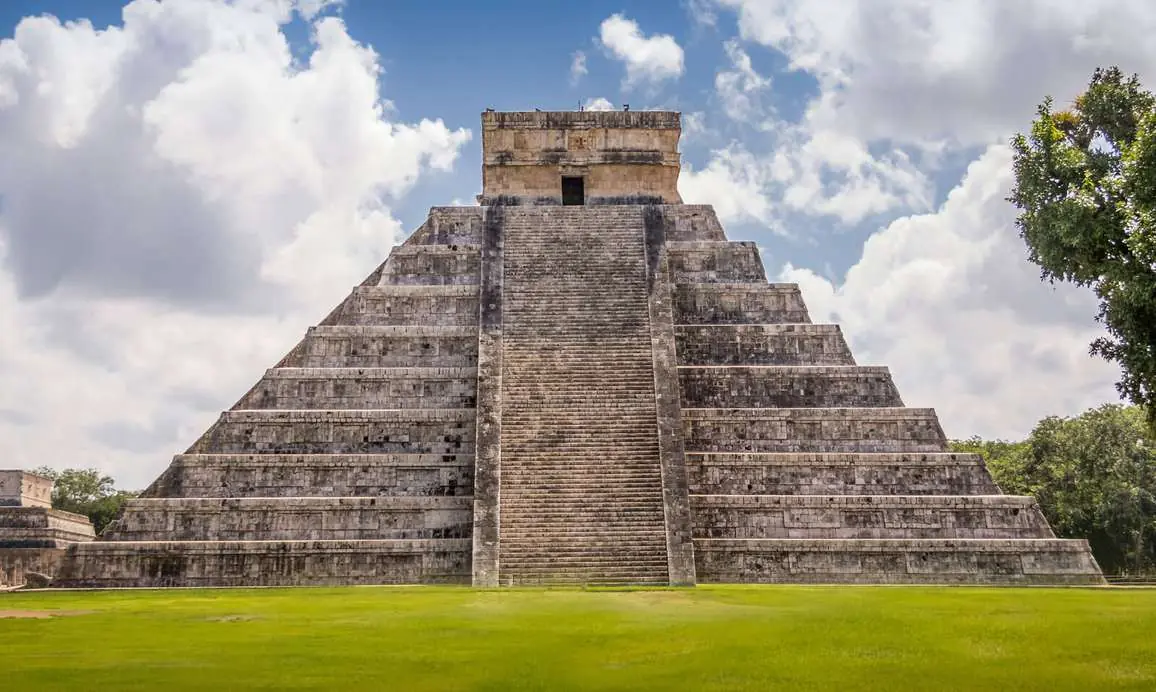
This is the band family reporting loves, and the reason is that Chichen Itza is full of things you do with your body rather than look at. A child of six cannot be told about acoustics, but she can clap her hands in front of El Castillo and hear the chirp come back. She can count steps, hunt for serpent heads and Chaac masks in the carvings, and hear the ballgame as a story. The full set of hooks is in the Keeping Them Engaged section below; at this age, they are not decoration on the visit: they are the visit.
What limits this band is not interest, it is walking stamina in heat. Family sources put time on site with children at roughly 1.5–3 hours, and the younger end of this band lives at the shorter end of that range. The swim in the middle of the tour day is perfectly placed for them: it is the reset that makes the afternoon possible.
Our advice Give a 5-to-8-year-old a job. Count things, spot things, be the family's official clapper at the pyramid and the echo-tester at the Ball Court. A child with a mission walks twice as far as a child being shown things.
Ages 9 to 12: Where the Ruins Themselves Land
Somewhere in this band, the visit changes character. A ten-year-old can hold the actual ideas: that the pyramid is a calendar you can count, that the observatory tracked Venus, that the ballgame carving shows what it shows, and can be trusted with the honest version of the Sacred Cenote conversation (there is a script for it further down). School history starts to connect: many children in this band have met the Maya in a classroom and arrive with questions of their own.
This is also the last band that pays child prices. On our tour, the child price is $115 up to age 12, with the ruins fee included, a family with an 11- or 12-year-old is getting the full archaeology-age visit at the child rate, which is the best value combination this page can offer you. At the gate independently, and at Ik Kil, the picture is more complicated: the costs section below lays it out without tidying it.
Our advice Let this band read or watch something about the Maya before the trip, even twenty minutes. Children who arrive with one fact of their own spend the day testing it against the stones, which is the best engagement there is.
Ages 13 and Up: Adult Prices, Full Visit
Short section, because the news is simple: from 13, your child is an adult everywhere that matters for money. On the tour, that is $130 instead of $115. At the gate independently, the full 697 MXN. At Ik Kil, anyone 1.40 m or taller already pays the adult rate regardless of age, so most teenagers were there already.
The visit itself only improves: a teenager can take the whole site at adult depth, including the harder history, and the long day stops being a logistics problem and becomes just a long day. Budget them as an adult from the start and there are no surprises in any column of the costs table.
The Physical Day: Time, Shade and Rest
Plan this day in time, not distance: no sourced total walking distance for the site exists, so this page prints none. What exists is INAH's route map, which allows roughly 2 hours for the long route through the main buildings. Family sources report roughly 1.5–3 hours on site with children, published here as what it is, a reporting range, with younger children at the short end. The fuller timing breakdown is on How Long Do You Need at Chichen Itza.
Shade: the ceremonial centre is open grass and limestone. There are trees, and families use them, but between the buildings your child is in full sun, which is why the hat and water advice on this page is repeated rather than mentioned once. Rest happens where INAH's visitor facilities are: the entrance area, the restrooms and the museum. There is no indoor, air-conditioned pause in the middle of the ruins; the genuine resets in a tour day are the bus and the swim.
Our advice Walk the day backwards from the swim. Whatever energy your child has is best spent on the first hour at the ruins; after that, shorten the loop without guilt: the Ball Court and El Castillo seen properly beat six buildings marched past a tired child.
Strollers: What the Paths Actually Allow
The question every under-5 parent asks, "is it stroller friendly?", only has an honest answer with the surfaces attached, so here they are. The main paths are wide and flat in stretches, and a large-wheeled stroller manages the main loop: several first-hand family reports did exactly that. But the ground is uneven limestone and gravel, small wheels judder and catch, and the moment you leave the main loop: steps up to platforms, rougher stretches between building groups: the stroller becomes luggage you are carrying rather than transport your child is riding in.
Family advice sources are genuinely split, and the split maps onto wheel size: Trips With Tykes advises skipping the stroller; other first-hand reports managed fine with big wheels. Both are describing the same paths with different equipment.
The qualified verdict: a large-wheeled stroller works on the main loop; a carrier is better overall, for stairs, for rough sections, and for a child who will nap against you in the shade. What this page will not print is the unqualified phrase "stroller-friendly," because the parents who believed it with a small-wheeled travel stroller had a miserable hour. Note this is the family-practical view only; step-free access and accessibility in full are a separate question, covered in full by our Chichen Itza accessibility guide.
The Swim at Ik Kil with Children
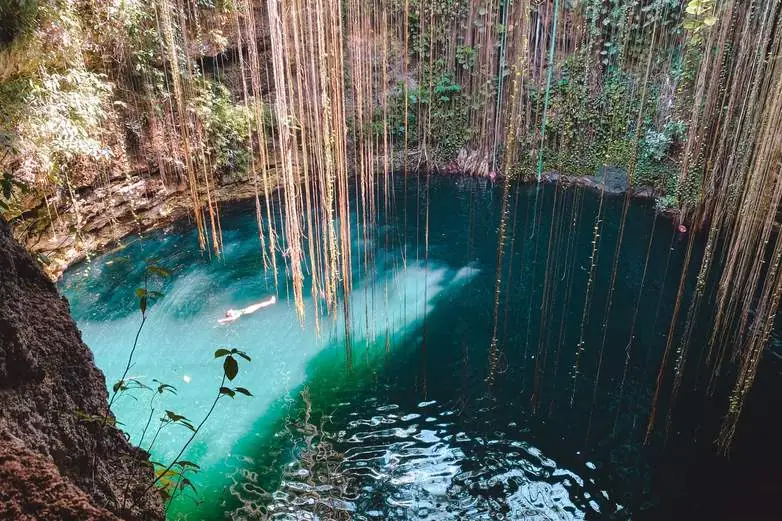
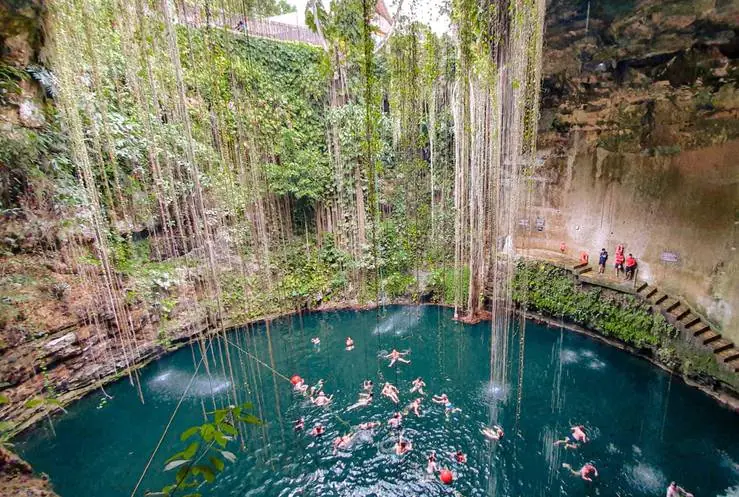
Ik Kil is the part of the day children remember, and the part that needs a parent's clear eyes, because this cenote was not built for small swimmers. The settled facts, applied to children (the full venue guide is our Cenote Ik Kil guide):
- There is no shallow end. The water is reported at 40–50 m deep. There is nowhere for a child to stand, and no separate children's area.
- A life jacket is included in admission, and for children, treat it as part of the swim, not an option to weigh up on the day.
- Children are priced by height, measured at the gate: under 1.20 m enters free; 1.20–1.40 m pays the 150 MXN child rate; 1.40 m and over pays the 240 MXN adult rate. A tall 9-year-old pays the adult rate, that is the venue's rule, not a mistake to argue with.
- The stone stairs down are steep and can be wet (family reporting): one hand for the rail, one for the child, nothing carried loose.
- The water is 24–26 °C, refreshing for adults, genuinely cold-feeling for small children after the Yucatán heat. Short, repeated dips suit little ones better than one long swim.
Two things this page does not claim, because no venue source supports them: it does not promise lifeguards, and it states no minimum swimming age and no accompaniment rule: none was published by the venue that we could find. If either matters to your decision, ask us on WhatsApp and we will tell you what we can verify rather than what would sound reassuring.
Our advice Decide before you arrive whether your child swims. A non-swimmer in a life jacket, held by a confident adult, can love Ik Kil; a child pressured at the platform edge will remember the pressure, not the cenote. Watching from above, dry and unhurried, is a legitimate choice: the view down through the vines is the famous photograph.
What a Family Actually Pays
First the settled figure, because everything hangs off it: an adult entering Chichen Itza independently pays 697 MXN: 105 MXN to INAH plus 592 MXN to CULTUR. That total is verified in every source. The child figure is where the sources fall apart, and this page prints the disagreement instead of laundering it into a single confident number.
| At the gate, independently | On this tour | |
|---|---|---|
| Adult | 697 MXN (105 INAH + 592 CULTUR), verified everywhere | $130, with the 697 MXN fee included |
| Foreign child | SOURCES CONFLICT 105 MXN in Google's fee table and both AI consultations; "free under 13" on a competitor's fee page, which also prints 105 MXN on the same page | $115 to age 12, fee included: the dispute never reaches you |
| The free-under-13 rule | Real, but qualified: the INAH listing gives free entry to under-13s for Mexican nationals ("menores de 13 años (nacionales)"), with Mexican students and teachers free on Sundays with current ID. It is not a general "kids under 13 free" rule | Not applicable: no gate transaction |
| Cenote Ik Kil | By height, measured at the gate: under 1.20 m free · 1.20–1.40 m 150 MXN · 1.40 m+ 240 MXN. Buffet 530 MXN adult / 280 MXN child (child buffet sold at the ticket office only) | The Ik Kil swim is a tour stop; venue admission terms are as listed |
| Cenote Zací, Valladolid | 150 MXN adult / 75 MXN child (ages 4–12), if your family adds it during the Valladolid stop | An independent extra at passage depth; see the Valladolid guide |
Why we print a conflict instead of an answer: INAH's own zone page lists only the $105 general fee and states no child rule at all, so the one source that could settle this does not. Until it does, the honest sentence is the one above, and the practical resolution for tour families is that the gate dispute does not change what you pay: on this tour the fee is inside the per-person price. Independent families should budget the 105 MXN figure per child and treat anything less at the window as a pleasant surprise, and full gate detail lives on Tickets & Fees.
A worked family example: two adults and two children under 12 from Cancun pay $490 in total on this tour, $260 + $230, with every ruins fee inside it. The 30% advance to reserve is $147; the $343 balance is paid on the day. The calculator below runs your own combination.
Keeping Them Engaged: The Hooks That Actually Work
No invented games and no worksheets: every hook below is a settled fact about the site itself, which is why children believe them. There is no official kids' programme at Chichen Itza; these moments are the programme.
Clap at El Castillo
Stand in front of the pyramid's staircase and clap once, sharply. The echo that comes back is a descending chirp, measured physics, produced by the staircase itself. Children do it twenty times. Let them.
Count the 365 steps
El Castillo's stairways in their restored configuration add up to 365, one for each day of the solar year. Counting the flights and doing the sum at the top of the plaza turns a pyramid into a calendar a child can check.
Tell the ballgame as a story
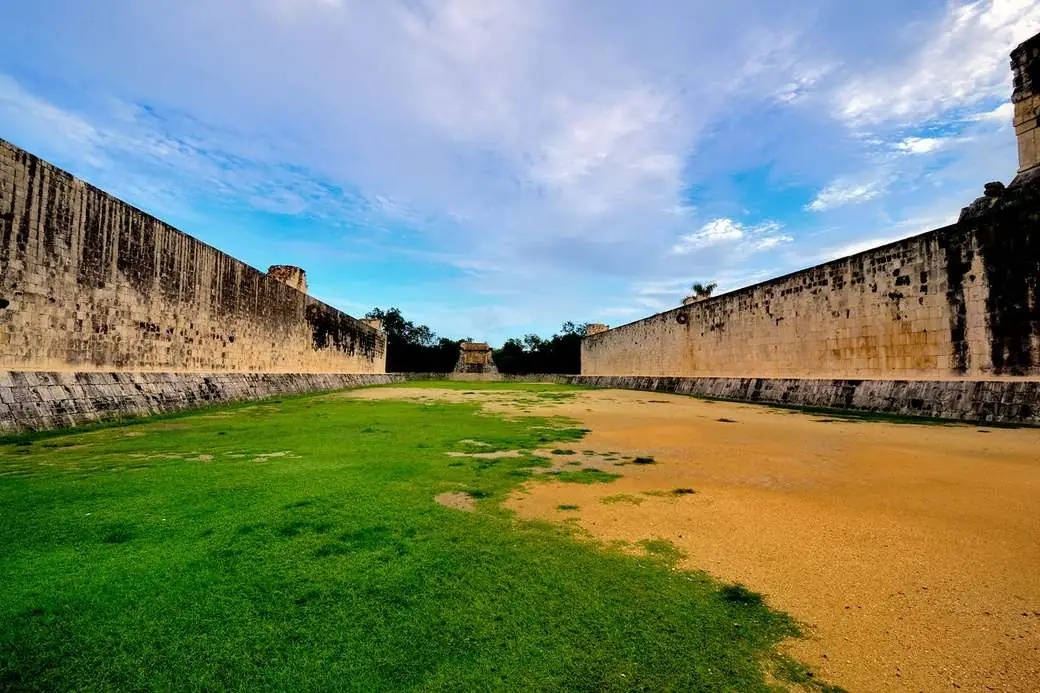
The Great Ball Court is the largest in Mesoamerica, and its game was played with a heavy rubber ball and no hands. Tell it as a story, and honestly: the court carving shows a decapitated player. Children handle the fact better than adults expect; it is presented at child depth in the Sacred Cenote section below.
Spot Chaac and the serpents
Set a spotting list: Chaac rain-god masks with their long curled noses, serpent heads at the bases of staircases, warriors in the colonnade carvings. First to five wins. The Temple of the Warriors is the richest hunting ground.
Test the echo at the Ball Court
The Ball Court produces a real flutter echo: claps multiply down its length. The famous claim of exactly "seven echoes" is travelling lore, labelled as lore: have your kids count for themselves and reach their own number.
End with the swim
On the tour day, Ik Kil comes after the ruins, which means the whole ruins block can be paced against a promise: buildings now, cold green water next. It is the oldest engagement trick there is, and it works because the swim is real.
Talking About the Sacred Cenote with Your Child
Your child will see the Sacred Cenote, and a guide, ours or anyone's, will mention offerings and sacrifice within their hearing. This is the one conversation on the day worth rehearsing, and the honest version is also the age-appropriate one: long ago, the Maya placed precious things into this water as gifts to their gods: gold, jade, pottery, and the evidence shows that people were placed in the water too. That is what the archaeology supports. There are no verified counts of how many, and no honest page can give your child a number: any source that does is inventing it.
What seems to work with children is framing it inside their own logic rather than around the gore: this was a sacred place, the offerings were the most valuable things these families owned, and the Maya believed the cenote was a doorway to the world of the gods and the rain. Children ask blunt questions ("did it hurt?", "were they children?") and honest, calm, short answers serve them better than either evasion or detail: remains of men, women and children have been documented, and "we don't know exactly why each person was chosen" is a true and complete answer to most follow-ups.
The full evidence, graded claim by claim, what the cenote dredging found, what the famous 2024 DNA study actually studied (a chultún, not the cenote), and which popular claims fail, is on our Maya Ritual & Sacrifice page, written for adults deciding what their family should hear.
The Long Day, and What Breaks First
The number to plan around is 10–14 hours door to door. From Cancun the road alone is roughly 180 km, about 2.5 hours each way; pickups are early, and your exact pickup time is confirmed on WhatsApp the night before. No version of this day is short, and a page that soft-pedals that is setting your family up to discover it at hour nine.
Our advice What breaks first is rarely the walking: it is the combination, in this usual order: heat before thirst is noticed, hunger between scheduled stops, and boredom in the second hour of ruins. The retreat plan is built into the day if you use it: shade and water at the first sign of flagging, not the third; snacks from your own bag between stops (see the next section); the swim treated as a genuine reset, with dry clothes afterwards; and explicit permission, given by you, to yourself, in advance, to leave the ruins block early. The tour still works. A family that leaves the ruins at 80% and swims happy beats a family that completes the route with a child in meltdown, every time.
The night before matters more than the morning: bags packed, swim things on top, children asleep at a sane hour, and the pickup time checked when it arrives on WhatsApp. Early pickups are the settled model on this tour: exact times are never printed on a page, because they depend on your hotel and your date.
Food, Water and Snacks for Children
The child slice of the food picture is simple: carry snacks and more water than feels reasonable, because the gaps between a tour day's stops are exactly where children run out. Water before the ruins block and again straight after it; snacks that survive heat and a bus ride; nothing whose melting or crushing creates a second problem. The full packing depth, sun, water and food for the whole family, lives on What to Wear & Bring, and the site's own rules are on the Site Rules page.
Two venue facts, stated exactly as far as they go. Ik Kil has a buffet: 530 MXN per adult and 280 MXN per child, with the child buffet sold at the ticket office only. And Valladolid, the tour's town stop, is a real food town with options at every budget, covered at passage depth in the Valladolid guide linked from the costs table.
About the tour's own lunch: this page does not describe one, because the lunch arrangement is not stated in this guide: it is one of the open slots in the next section. Plan snacks as if lunch were uncertain, and confirm the lunch arrangement on WhatsApp when you book; whatever is confirmed there, in writing, is what applies to your date.
What We Don't State Yet: Minimum Age, Babies and Child Seats
Most tour pages fill these three questions with confident inventions. This one leaves them open, because the operator has not set them in this guide, and a confident wrong answer about your baby is worse than an honest gap.
- Minimum age: not stated anywhere in this guide. We publish no minimum age for children on this tour, and you should not rely on one from any page that does not operate the tour.
- Infant policy: not stated, including whether infants ride free, on a lap, or at the child price. Other operators' infant rules are theirs, not ours, and none is borrowed here.
- Child seats: not stated. If a child seat is a condition of your family travelling, that is a booking question, not a detail to assume either way.
Our advice Ask all three on WhatsApp before you book, and get the answers in your written confirmation. That is not a dodge: it is the only version of these answers that will be true for your date, and the questions are listed here so you know to ask them.
The Tour, Priced for a Family
Our shared tour is built for exactly the day this page describes: Chichen Itza in the morning, a swim at Cenote Ik Kil in the middle, and time in Valladolid, with hotel pickup from your own point in Cancun, Tulum, Playa del Carmen, the Riviera Maya or Merida, and your exact pickup time confirmed on WhatsApp the night before.
- $130 per adult · $115 per child (child price to age 12). Two adults = $260; two adults and two children = $490.
- The 697 MXN Chichen Itza entrance fee is included: the disputed child gate figure never becomes your problem.
- 30% advance to reserve: no-shows block seats for ready customers; the balance is paid on the day of the tour.
- Free cancellation up to 48 hours before the tour: cancel 48+ hours ahead and the advance is refunded in full; inside 48 hours the advance is kept.
- Minimum age, infant policy and child seats are not stated: ask on WhatsApp and get the answers in your written confirmation (see the open-slots section above).
- New operator with a short record, stated here as plainly as in the hero.
City detail: from Cancun · from Tulum · from Playa del Carmen · from the Riviera Maya · from Merida
Price your family day
Shared tour · fee included · 30% reserves your seats
The button composes your message, including your children's ages, so the minimum-age and child-seat questions get answered for your family in the written confirmation. Your pickup time is sent the night before.
Frequently Asked Questions
Check Your Date on WhatsApp
Tell us your date, your pickup city and your children's ages. We confirm availability and your exact pickup point on WhatsApp, take the 30% advance to reserve your seats, and send your pickup time the night before. Free cancellation up to 48 hours before the tour.
Bringing a child under 5, or need a child seat? Ask in the same message: the answers will be in your written confirmation, not assumed.
Booking opens on WhatsApp
Shared Chichen Itza tour: Chichen Itza + Cenote Ik Kil + Valladolid. $130 per adult, $115 per child to age 12, entrance fee included.
Message us on WhatsAppOne tap opens a pre-filled message with your calculator choices. No payment is taken on this page.