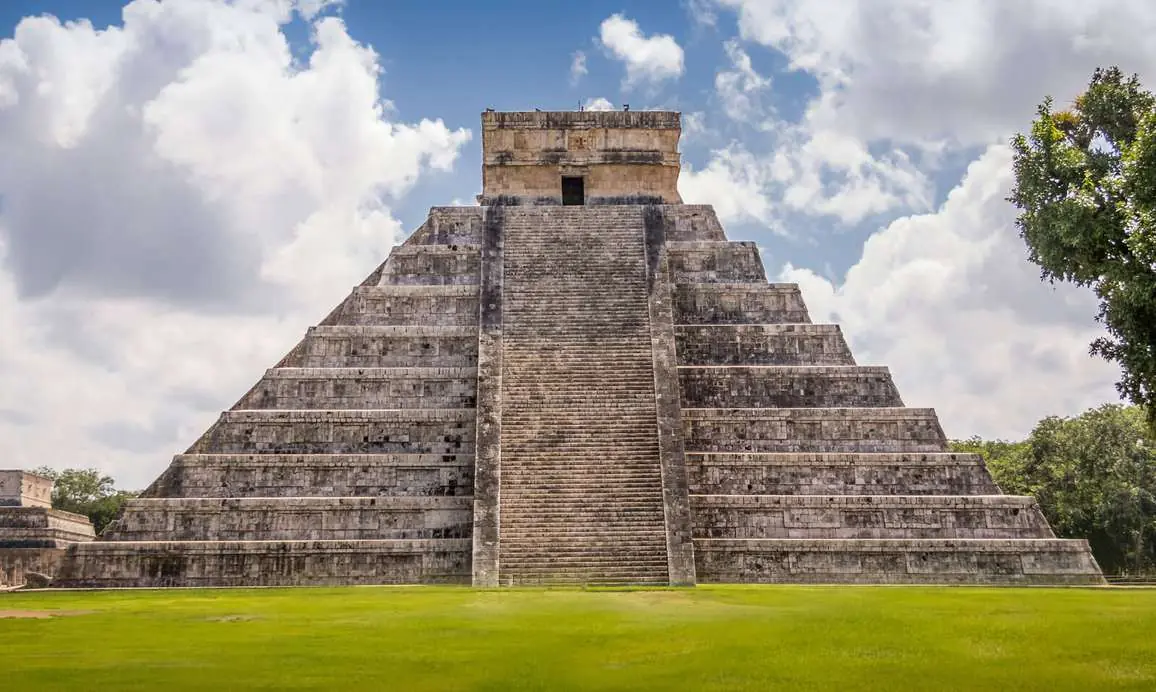
Best Time to Arrive at Chichen Itza: Morning vs Midday vs Afternoon
A day at Chichen Itza has two good windows and one bad stretch. The first good window is the first hour after the 8:00 AM opening, before the tour buses arrive. The second is the thinning afternoon after about 3:00 PM. Between them sits the stretch to avoid: 11:00 AM to 2:00 PM, the busiest and hottest hours of the day. Everything on this page is graded in words, because no honest source counts the crowds by the hour, pages that print hourly visitor numbers, queue times or temperatures by the hour are inventing them, and this page says so wherever the temptation appears.
A note on who is writing this: we run a shared Chichen Itza tour, and this page covers the clock for everyone, including travellers who will never book it. We are a new operator with a short record. Where a claim below comes from a named source, it says so; where it is guides' shared experience, it is labelled an indicative pattern; and where no trustworthy figure exists: hourly crowd counts, queue times, temperatures by the hour, this page prints the gap rather than fill it.
The Day at a Glance: The Hour-by-Hour Pattern in Words
One table for the whole day, because the arrival decision is a comparison, and the comparison only works if every row is graded the same honest way. Read the table as what it is: an indicative pattern based on guides' experience (the label EcoColors, the strongest source behind it, puts on its own crowd charts), cross-checked against Google's Popular Times for weekday mornings. It is a shape, not a measurement. No row carries a visitor count, because no trustworthy source publishes one.
| Window | Crowds | Heat | Light | The verdict |
|---|---|---|---|---|
| 8:00–9:00 AM | The quietest hour of the day, the site has just opened and the coaches have not left their bases yet | The coolest stretch, in words, no per-hour temperatures exist in any trustworthy source | Soft morning light; the photo consensus window | The best window Be at the entrance for the 8:00 opening. |
| 9:00–10:00 AM | Building, independent travellers arrive; still comparatively calm | Warming, but manageable across the whole site | Still kind on the stone; shadows shortening | A good arrival You miss the emptiest hour, not the calm. |
| ~10:00–10:30 AM | The tour-bus wave, the coach groups arrive and the main plaza fills | Hot by now on the open ground | Hardening toward the midday glare | Arrive knowing the tactic Head for the far structures first, they fill last. |
| 11:00 AM–2:00 PM | The busiest stretch of the day, multi-guide agreement | The hottest stretch, little shade on the plaza; April–May highs average ~35°C / 95°F (EcoColors, Valladolid averages) | The harshest light; flat, hard shadows | The stretch to avoid If it is your only option, section 4 is written for you. |
| 2:00–3:00 PM | Still busy, but variable, the day starts to turn | Heat easing slowly off its peak | Beginning to soften | The late window opens Arriving by ~2:00–2:30 PM is the honest late target. |
| After ~3:00 PM | The crowds thin, the day's groups have gone; the second-best window | The most comfortable afternoon stretch | Soft again, the afternoon's photo window | The second-best window Planned against the last-entry disagreement in section 5. |
Which month and season sit behind this clock, the calendar half of the timing question, is a separate page's subject. This page owns the day itself: the hours, and how the day of the week bends them (section 8).
The 8:00 AM Opening: Be at the Entrance When It Opens
Start with the correction this page exists to make plainly, because the internet's favourite piece of Chichen Itza advice is an impossibility: nobody enters Chichen Itza before 8:00 AM. The site opens at 8:00. Ranking pages that tell you to "arrive before 8 AM", one repeats it three times, are selling a head start that does not exist. There is no early gate, no pre-opening entry, no way in ahead of the hour.
The correct version of the advice is one word different and completely achievable: be at the entrance for the 8:00 opening. Join the queue shortly before opening if you want to be near the front of it. This page publishes no queue time in minutes, because none exists in any trustworthy source, the AI answers that quote one are inventing it, and both AI consultations behind this page agreed on that point. What can be said in words: the opening queue is the day's first crowd, it moves as one when the gates open, and being in it is what buys the first hour.
And the first hour is worth buying. What it gives you is El Castillo and the great plaza before the wave: the pyramid photographed without a crowd in the frame, the Ball Court walked at your own pace, the Temple of the Warriors reached while the site still belongs to the people who came early on purpose. By 10:00 the same spaces are shared with every coach group on the coast. The product version of this arrival, a tour built around entering at the opening, is set out on the early access tour page; this page owns the clock itself, for every way of reaching the gate.
What "early" honestly means: at the entrance for 8:00, not inside before it. Any page, operator or AI answer that promises entry ahead of the opening is promising something the site does not sell. Plan your departure backwards from 8:00 at the gate, using your own origin's transport page, and the first hour is yours.
The 10:00–10:30 Bus Wave: What Changes When the Coaches Arrive
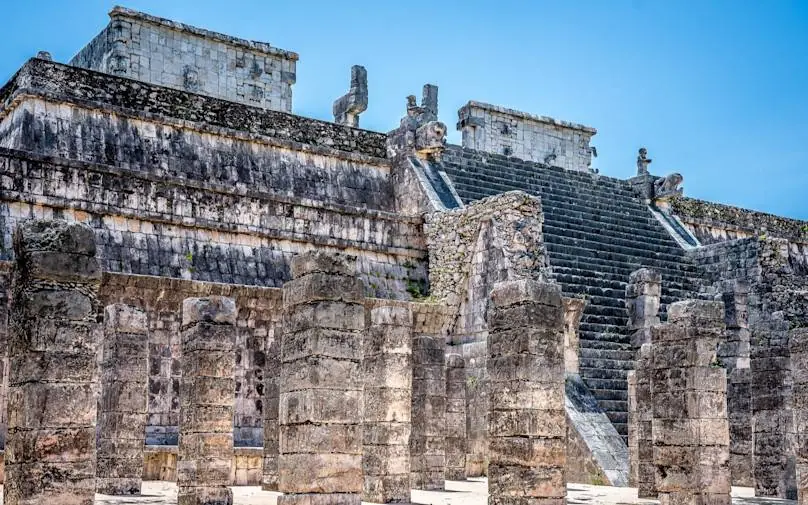
The Temple of the Warriors colonnade, far from the entrance, and the kind of structure that stays quiet longest after the wave lands.
The day's hinge is the arrival of the coach tours, and it lands at around 10:00–10:30 AM: EcoColors puts the wave "around 10", Maya Explorer at 10–10:30, and two further guides at 10:30 or "around 10". That spread is the honest form of the fact, the wave is approximate by nature, a build rather than a moment, and this page never prints it as a precise daily timetable. What it changes is the site's centre of gravity: the entrance plaza and El Castillo's apron fill first, the guided groups move in their circuits, and the site goes from early-morning quiet to full operation inside the hour.
If you arrive with the wave, plenty of honest days start that way, the site is still usable, with one piece of advice-grade tactics: the far structures empty first, so walk to them first. The Temple of the Warriors group, the Ossuary and the structures toward the Sacred Cenote end of the site fill later than the plaza everyone photographs on arrival. Do the far end while the wave is doing the near end, and let the plaza be your last stop instead of your first: by the time you come back to it, the day has already started to turn. The full monument-by-monument layout is on the visitor guide; this section owns only what the clock does to it.
Midday: The Peak. Busiest and Hottest, 11:00 AM to 2:00 PM
Between 11:00 AM and 2:00 PM the two curves this page tracks, crowds and heat, peak together, on multi-guide agreement. This is the fullest the plaza gets and the hardest the sun works, and the site's geography makes it worse than the temperature alone suggests: the great plaza is open ground with little shade, and the monuments at its centre stand in full sun. The one temperature figure this page publishes is the attributed one: April–May highs average around 35°C / 95°F (EcoColors, sourced to Valladolid's long-term averages). Morning is cooler in words only, no trustworthy source publishes temperatures by the hour, and the guides that print a cooling figure or an hour-by-hour temperature table do so without sources. This page will not repeat them.
If midday is genuinely your only option, a fixed departure, a cruise window, a single free day, the visit is still worth making, worked honestly:
- Carry water and drink it on a schedule, not on thirst. The plaza's exposure is the risk, not the walking.
- Rotate the shade. The tree-lined paths and the structures away from the plaza's centre break the sun up; alternate exposed monuments with shaded stretches instead of crossing the open ground monument to monument.
- Save the centre for the edges. El Castillo's apron at 11:30 is the worst version of the day's best monument; the far structures first, the plaza last, is the same tactic as the bus-wave section, midday is simply when it matters most.
- Do not plan the swim for the middle of this stretch. Cenote Ik Kil's own busiest hours sit inside it, as section 7 sets out.
What this page will not give you for midday is a fixed "hottest hour", no source supports one, and the honest statement is the stretch itself: 11:00 to 2:00, busiest and hottest, planned around where possible and endured intelligently where not.
The Afternoon Window: Arrive by 2:00–2:30 PM, and Read the Last-Entry Warning First
The day's second good window opens as the first one's crowds go home. After about 3:00 PM the site thins, a 2019 forum consensus, a March 2026 ticket guide's observation that the groups have gone by 3, and two further guides agree on the shape, and the light softens with the crowds. For travellers who cannot make an 8:00 AM gate, a late start, a long drive, a morning elsewhere, this is the window that makes the day work, and it is genuinely good: the same monuments, a fraction of the people, the kindest light of the afternoon.
But the late window has a condition, and this page states it instead of smoothing it over. Official listings currently disagree on the last entry. INAH's zone page and fresh sources give the settled programme line used across this site, the site runs 8:00 AM–5:00 PM with last entry at 4:00 PM, but one INAH listing (Lugares) says the site closes at 4:00 PM with last entry at 3:00 PM, and one Spanish AI answer says last access is 4:30 PM. Those versions cannot all be right, and a late plan built on the wrong one ends at a closed gate.
The honest late target: arrive by about 2:00–2:30 PM. Most visitors need 2–3 hours inside (the guides' figure; Google's Popular Times suggests 2–4), so a 2:00–2:30 arrival leaves a real, unhurried visit under either last-entry version, and this page therefore never promises "arrive at 3:30 and you'll have 90 minutes". If you are planning later than 2:30, confirm the day's last entry before you set out, the disagreement above is exactly why that check is not optional.
Worked through, the afternoon day looks like this: in by 2:30, the plaza and El Castillo first while the thinning is under way, the far structures in the softening light, and out by the 5:00 PM close with the visit complete rather than curtailed. It is a shorter margin than the morning's, the morning visitor who dawdles still has a day; the afternoon visitor's clock runs one way, but inside that margin it is the calmest full version of the site most travellers ever see.
Arriving at 8 only pays if the day holds enough hours: how long you need at Chichen Itza budgets them.
Heat and Light Through the Day
The heat curve, in words
The day warms from the opening toward the midday stretch and eases through the afternoon, that curve, stated in words, is all the evidence supports. Morning is cooler; midday is the hottest stretch; late afternoon is the most comfortable part of the day after the first hour. This page publishes exactly one temperature anywhere: the attributed April–May average high of around 35°C / 95°F in section 4. There is no per-hour temperature table here, no "degrees cooler" figure and no fixed hottest hour, because every version of those numbers found in this page's research was unsourced. A page that prints them is decorating, not informing.
The light curve, for photos
Light follows a cleaner pattern than heat. Early: the soft morning light of the first window is the photo consensus, low sun, long shadows, stone with texture in it, and the fewest strangers in the frame. Midday: the worst light of the day, hard and overhead, shadows harsh and faces squinting. Late: the light softens again as the afternoon window opens, which is why the post-3:00 PM visit photographs better than it has any right to. One label is refused here: operators who market set morning hours as "golden hour" are using the term loosely, and no golden-hour clock times are published on this page, because no source supports any.
The one day of the year when the afternoon light does something no other day's does, the equinox serpent on El Castillo's staircase, is section 9 below.
Ruins First or Cenote First? The Sequencing Decision
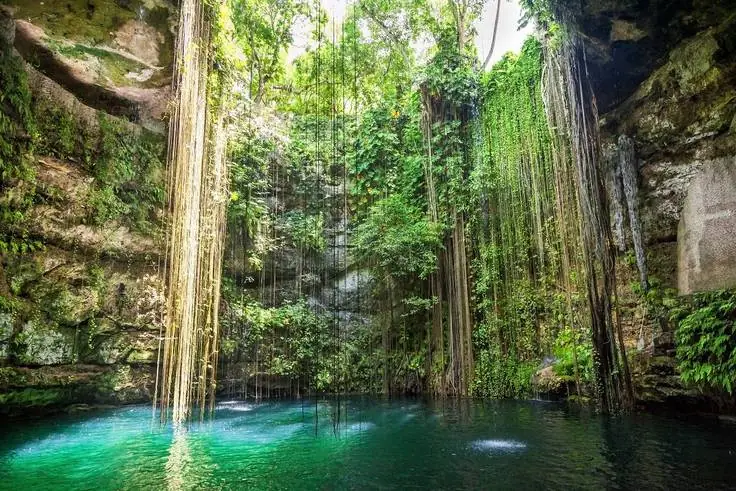
Cenote Ik Kil, about 3 km from the ruins. Its busiest stretch sits inside the ruins' busiest stretch, which is what decides the order.
The default is ruins first, and it is the only defensible one: the quiet first hour is worth most exactly where the crowds matter most, at El Castillo and on the plaza, so the opening belongs to the stones. Spend it on a swim and you have traded the day's scarcest resource for water you could have had later on better terms. The cenote keeps; the first hour does not.
The better terms, stated at the grade they deserve: Ik Kil's busiest stretch is put at around 11:30 AM–2:00 PM by ADO's own Ik Kil page and by guides, and the consistent advice is to swim after about 2:30 PM, once that stretch eases. That is advice-grade, not measured fact, no hourly admissions data for the cenote exists in any source, and this page presents the timing as the guides' shared counsel, nothing harder. Ik Kil's hours are 9:00 AM–5:00 PM. The full cenote depth: the water, the rules, the facilities, lives on the Chichen Itza and cenote tour page; this page owns only the order of the day.
There is one exception, and it is the late arrival's: if you reach the area in the afternoon, the default inverts. Swim first, then take the ruins in the thinning late light, the cenote is at its most swimmable as its own peak passes, and the ruins reward the last hours most. Sequencing is a clock decision, and the clock, not habit, should make it.
Does the Day of the Week Change the Clock?
It changes the baseline the clock runs against. Sunday is the busiest day of the week, entry is free for Mexican nationals (residents included, per EcoColors and INAH), and every guide agrees on the result. That verdict is published in words, because that is all that exists: no percentage, no multiplier, no crowd count for Sundays appears in any trustworthy source, and the only queue figure anywhere is a single forum anecdote about one Sunday, which is not data and is not published here as any. The clock logic still holds on the worse baseline, a Sunday morning still beats a Sunday midday, by the same shape as every other day.
At the other end, Tuesday to Thursday are the quietest weekdays (two guides and the AI Overview agree), which makes midweek-plus-opening the calmest combination this page can honestly offer. Saturdays and long weekends sit between: heavier than midweek, lighter than Sunday, and best handled with the same two windows. The calendar beyond the week, which months run hot, wet or crowded, belongs to the season, not the clock, and is covered on the best month to visit Chichen Itza page.
The Equinox Exception: When the Afternoon Is the Whole Point
Twice a year the clock inverts on purpose. At the equinoxes, the light on El Castillo's northern staircase forms the famous serpent effect in the mid-to-late afternoon, from around 3:00 PM (EcoColors, for 20 March 2027; INAH's September 2026 event estimate put the phenomenon at 3:00–4:30 PM). On those days the afternoon window is not the second-best choice; it is the only one that contains the event, and arriving early buys you a front position for something that happens at the end of the day.
Price it honestly before you choose it: equinox day drew 32,872 visitors in 2025 (EcoColors, attributed, with the year), the only crowd count published anywhere on this page, in that attributed form, because it is the only one any source stands behind. Special operations apply on the day, and the crowds rewrite every pattern in section 1. The depth: the phenomenon, the dates, how the day is run, belongs to the equinox guide, and the arrival product for the ordinary days around it is the early access tour. This section exists so the exception is on the clock page, at passage depth, where a reader planning an equinox trip will find it.
The Tour: The Day Without a Gate Time to Defend
Everything above is the clock for a traveller running their own day. Our shared tour takes the other shape: pickup from your own hotel or point, Chichen Itza with the 697 MXN entrance fee included (the full fee breakdown lives on the tickets and entrance fee page), a swim at Cenote Ik Kil, and a stop in Valladolid, then back to your pickup point. It costs $130 per adult and $115 per child (children up to age 12). Booking is by WhatsApp: your written confirmation comes first and restates the whole position: date, party, pickup point, total price, the advance and balance split, and the cancellation position for your date, and only then is the 30% advance paid to reserve, with the balance on the day of the tour. Cancellation is free up to 48 hours before the tour, with the advance refunded in full. Your exact pickup time is confirmed on WhatsApp the night before.
One honesty note that belongs on this page above all: this page makes no claim about what hour the tour reaches the ruins, because that timing is not a settled fact we can publish, your pickup time is confirmed the night before, and the written confirmation is the document to hold us to. We are a new operator with a short record; that is stated rather than dressed up. The tour days from each pickup city are set out on the tour from Cancun and the tour from Tulum, with the Playa del Carmen, Riviera Maya and Merida days linked from those pages. If you are running your own day, the clock above is yours either way, the calculator simply prices the alternative exactly.
Price it for your party
The button below composes a WhatsApp message with this party and pickup city already written in.
Book on WhatsAppBest Time to Arrive at Chichen Itza: Questions
What is the best time to arrive at Chichen Itza?
The quietest arrival is at the 8:00 AM opening: be at the entrance for opening and you get the first hour, before the tour-bus wave builds around 10:00–10:30. The second-best window is the late afternoon: aim to arrive by about 2:00–2:30 PM, once the crowds start thinning after 3:00 PM, and you still have a real visit of 2–3 hours. The stretch to avoid is 11:00 AM to 2:00 PM, the busiest and hottest part of the day. No honest source counts the crowds by the hour, so this pattern is graded in words from guides' experience, not measured data.
Can you enter Chichen Itza before 8 AM?
No. The site opens at 8:00 AM and nobody enters before 8:00, pages that advise you to 'arrive before 8 AM' are selling an impossibility. The correct play is to be at the entrance for the 8:00 opening itself, joining the queue shortly before if you want to be near the front of it. That still does not promise instant entry: it puts you in the first hour, which is the quietest stretch of the day.
What time do the tour buses arrive at Chichen Itza?
The coach tours build in a wave from around 10:00 to 10:30 AM, guides put it at 'around 10' and at 10:30, so treat it as approximate, not a daily timetable. Before the wave, the site belongs mostly to independent travellers; after it, 11:00 AM to 2:00 PM is the busiest stretch of the day. If you arrive with the wave, head for the structures furthest from the entrance first, they fill last.
What is the least crowded time of day at Chichen Itza?
The first hour after the 8:00 AM opening, on every guide's account, and Google's Popular Times agrees on weekday mornings. The second-quietest stretch is the late afternoon, once the crowds thin after about 3:00 PM. The busiest stretch is 11:00 AM to 2:00 PM. These are patterns in words, not hourly counts: no trustworthy source publishes visitor numbers by the hour, and any page that does is inventing them.
Is it worth arriving at Chichen Itza in the afternoon?
Yes, the afternoon is the second-best window of the day, provided you plan it honestly. Arrive by about 2:00–2:30 PM: the crowds thin after 3:00 PM, the light softens, and 2–3 hours inside is enough for most visitors. One caution is built into that target: official listings currently disagree on the last entry, the settled programme line is last entry 4:00 PM, but one INAH listing says 3:00 PM. Arriving by 2:00–2:30 works under either version; confirm the day's last entry before planning a later arrival.
How hot does Chichen Itza get at midday?
Midday is the hottest stretch of the day, and the open plaza offers little shade. The one temperature figure this page publishes is the attributed one: April–May highs average around 35°C (95°F), from EcoColors, sourced to Valladolid's long-term averages. Morning is cooler, in words only, because no trustworthy source publishes per-hour temperatures, and any table that does is unsourced. If midday is your only option, carry water, take the shaded structures in rotation and save the exposed plaza for the edges of the day.
Should I visit the ruins or Cenote Ik Kil first?
The ruins, as the default: the quiet first hour is worth most where the crowds matter most, at El Castillo and the main plaza. Cenote Ik Kil's busiest stretch is put at around 11:30 AM–2:00 PM by ADO's own Ik Kil page and by guides, and the consistent advice is to swim after about 2:30 PM, once it eases, that is advice, not measured data. The one exception is a late arrival: if you reach the area in the afternoon, swim first and take the ruins in the thinning late light instead.
What time does Cenote Ik Kil get busy?
Guides and ADO's own Ik Kil page put its busiest stretch at around 11:30 AM–2:00 PM, when the day's tour groups arrive for their swim, which is why the consistent advice is to swim after about 2:30 PM. Treat that as advice-grade: no hourly admissions data for the cenote exists in any source. Ik Kil's hours are 9:00 AM–5:00 PM.
Is Sunday a bad day to visit Chichen Itza?
Sunday is the busiest day of the week, entry is free for Mexican nationals and residents that day, and every guide agrees on the result. No percentage or crowd count for Sundays exists in any trustworthy source. The clock still helps: a Sunday at the 8:00 AM opening beats a Sunday at midday by a wide margin. Tuesday to Thursday are the quietest weekdays, so if your dates are flexible, midweek plus an early arrival is the calmest combination this page can offer.
What is the best time for photos at Chichen Itza?
The first window: soft morning light just after the 8:00 AM opening, with the fewest people in the frame. Midday is the worst light of the day, hard sun and harsh shadows on the stone. Late afternoon softens the light again, which is one more reason the post-3:00 PM window works. Operators who label set hours of the morning as 'golden hour' are using the term loosely; this page publishes no golden-hour clock times because no source supports any.
¿Cuál es la mejor hora para visitar Chichén Itzá?
La hora más tranquila es la apertura: el sitio abre a las 8:00 AM y nadie entra antes de las 8:00, así que conviene estar en la entrada para la apertura y aprovechar la primera hora, antes de que lleguen los autobuses de tours alrededor de las 10:00–10:30. La segunda mejor franja es la tarde: llegar hacia las 2:00–2:30 PM, cuando la gente empieza a irse después de las 3:00 PM, deja una visita real de 2–3 horas. La franja a evitar es de 11:00 AM a 2:00 PM, la más concurrida y calurosa del día. Los martes a jueves son los días entre semana más tranquilos, y el domingo es el día más concurrido.
How long do you need inside Chichen Itza?
Most visitors need 2–3 hours inside; Google's Popular Times suggests 2–4. That arithmetic is what the late window is planned with: arrive by about 2:00–2:30 PM and a full visit still fits before the site closes at 5:00 PM, under either version of the disputed last entry. An early arrival can take the site more slowly, but the core monuments: El Castillo, the Ball Court, the Temple of the Warriors, the Sacred Cenote, fit the same 2–3 hours either way.
Check Your Date on WhatsApp
You now know the day cold: the 8:00 opening, the 10:00–10:30 wave, the midday peak to avoid, and the afternoon window with its last-entry warning read first. If you would rather not run that clock yourself, no gate time to defend, no last entry to verify, no sequencing to plan, send us your date, your party and your pickup city, and you will get the written confirmation first: price, pickup point, advance and balance, cancellation position, before any money moves. Your exact pickup time is confirmed on WhatsApp the night before.
$130 per adult · $115 per child to age 12 · 697 MXN entrance fee included · free cancellation up to 48 hours before the tour.