Kukulkan: The Feathered Serpent God
Kukulkan is the feathered serpent god of the Maya of Yucatan, the deity whose temple is El Castillo and whose body the equinox light draws down its staircase. This page covers the god himself: his name, his domains, his symbols, and the famous question of whether he and Quetzalcoatl are the same.
We run the shared Chichen Itza tour described near the end of this page. We are a new operator with a short record. What is documented about Kukulkan, and what is later tradition, are labelled as such throughout this page.
Who Is Kukulkan?
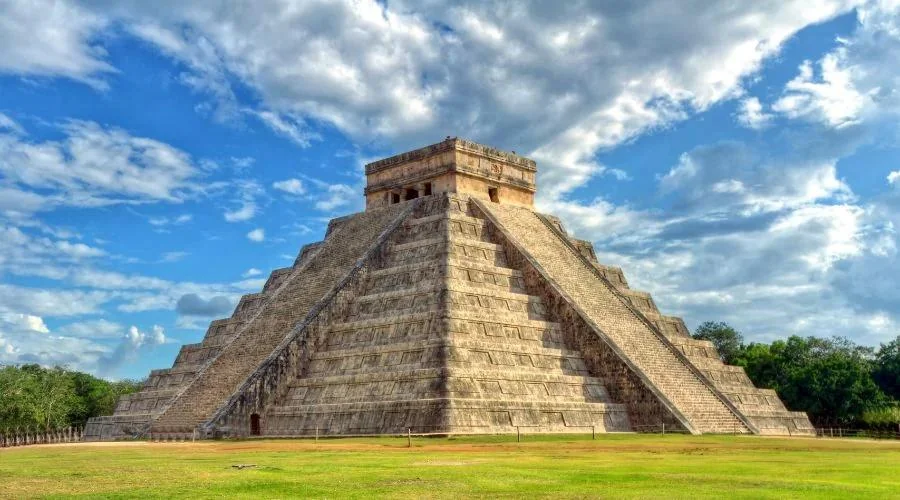
Kukulkan is the feathered serpent god of the Maya of Yucatan: a great serpent bearing the plumage of the quetzal bird, a being of sky and earth at once, associated in the sources with wind, rain, Venus, kingship and the calendar. His name in Yucatec Maya joins k'uk', feather (and the quetzal itself), with kan, serpent. At Chichen Itza he is not an abstraction: the city's greatest temple is his, the serpent balustrades of El Castillo frame its north stair, and twice a year the equinox light draws his body down the pyramid's side in shadow and sun.
This page is about the god. The pyramid that carries his name has its own guide, El Castillo; the light effect has the equinox guide; and the tradition of Kukulkan as a historical man, a culture hero who came to Chichen, is treated with the Itza themselves in who built Chichen Itza. Here the subject is the deity those monuments serve.
Kukulkan the God: What He Governed
A god's domains are read from his images and his stories, and Kukulkan's images are everywhere at Chichen: serpent heads with open jaws at the feet of stairways, feathered rattlesnakes carved along balustrades and platforms, serpent columns framing temple doorways, most famously on the Temple of the Warriors. In the Maya world the serpent is a creature that moves between worlds, shedding its skin, travelling between earth, water and sky; feathered, it carries the sky's most precious bird into the same body. Kukulkan is that union made divine, which is why he belongs simultaneously to rain and agriculture, to the planet Venus whose cycles the Maya tracked with unmatched care at El Caracol, and to the authority of kings who ruled under his sign.
Later Maya tradition, written down in the colonial period in books like the Chilam Balam, remembers Kukulkan as a lord who came to Chichen Itza and ordered its world: its calendar, its rituals, its kingship. Read carefully, that tradition is doing two things at once, preserving a god's mythology and a dynasty's claim to descent from him. The scholarly handling of that double tradition, including the figure of Kukulkan the man, sits with the Itza page; the Toltec-era question of how his cult intensified at Chichen is part of the Toltec debate. This page's position is the disciplined one: the god is documented in stone all over the city he names; the man's biography is tradition, and is printed as tradition wherever it appears here.
What Kukulkan Means: Name, Symbols and Stories
The name is a description: feathered serpent. In the art, the formula is consistent across centuries and cities: a rattlesnake's body and head, the tail rattles often present, with a crest and body plumage of quetzal feathers, and frequently a human face emerging from the open jaws, the god or the ancestor looking out from inside the serpent. At Chichen the formula becomes architecture: whole balustrades are serpent bodies, and the Temple of the Warriors' doorway is held up by two great serpents whose heads rest on the ground and whose rattled tails carry the lintel.
The stories that survive are fragments: creation associations in the wider feathered-serpent tradition, the culture-hero arrival at Chichen in the chronicles, and the serpent's descent at the equinox, which is not a written story at all but a built one, told in light on the pyramid's north side. That effect, and the argument about whether it was designed, belongs to the equinox guide and the El Castillo guide; as a passage here: on the equinoxes and across a season of afternoons around them, the stepped corner of the pyramid throws a pattern of light triangles down the balustrade to the serpent head at its foot, and visitors have read it as the god descending for as long as the effect has been watched.
One modern layer should be labelled as modern: Kukulkan's presence in games, films and tattoo art (the tattoo search is large, and it is not this site's subject) draws on the same images. The god's iconography is genuinely striking; the ancient meanings are the ones in the stone and the chronicles, and this page stays with those.
Kukulkan and Quetzalcoatl: The Same God?
Quetzalcoatl is the Nahuatl name, from central Mexico, for the same feathered serpent: quetzal, the bird and its precious feathers; coatl, serpent. The equivalence is standard and old: colonial sources themselves translate between the names, and the Maya Kukulkan and the Aztec and Toltec Quetzalcoatl share the iconography, the Venus and wind associations, and the culture-hero traditions, including a famous exile-and-return story told of the Toltec priest-king Topiltzin Ce Acatl Quetzalcoatl.
"The same god" is true at the level of the tradition and too simple at the level of the cities. The feathered serpent is far older than either name's famous temples: Teotihuacan built its great feathered-serpent pyramid in the Ciudadela centuries before Chichen's peak, with serpent heads in a style all its own. Each civilisation made the being its own: the Maya Kukulkan of Chichen is bound to this city's kingship, calendar and equinox architecture in ways the Aztec Quetzalcoatl of Tenochtitlan, a wind god who sweeps the road for the rain, is not. The honest answer to the comparison is: one pan-Mesoamerican deity, many local gods, and Chichen Itza is where the Maya version received his greatest temple.
How the central Mexican connection reached Chichen, by conquest, migration or exchange, is the single most argued question in the city's archaeology; it has its own evidence table on the Toltec influence page, and the answer is not settled there either, because it is not settled anywhere.
Kukulkan at Chichen Itza: Where You Actually See Him
On the ground, the god's itinerary is the site's itinerary. Start at El Castillo, his temple: serpent heads at the foot of the north balustrade, the feathered-serpent programme in its carvings, and, built inside it, an earlier pyramid from an earlier phase of his cult. Cross the plaza to the Great Ball Court, whose benches and temples carry serpent imagery through the game's mythology. Continue to the Temple of the Warriors, where his serpents are the doorposts, and to the Platform of the Venus and the Tzompantli, treated in the platforms guide, where the planet he is bound to is carved in symbol after symbol.
And if your date allows it, the equinox: the one time the god's image is not carved but performed by the building itself. Dates, the visible-days window and the honest limits of a day-trip itinerary for it are in the equinox guide, which also covers the Noches de Kukulkan night show that carries his name into the present tense.
Kukulkan and the Calendar: Venus, the Year and the Serpent
Kukulkan’s deepest association at Chichen is with time itself. The Maya tracked Venus with a precision the El Caracol observatory was built to serve, and the feathered serpent is woven through that Venus programme: the Platform of Venus in the great plaza carries the planet’s symbols, and the god’s imagery and Venus imagery travel together across the northern monuments. The calendar connection runs through his temple: El Castillo’s four stairways and terrace counts are the famous solar arithmetic, 91 steps four times plus the platform making the popular 365, an interpretation the El Castillo guide states with its scholarly caveats attached.
Read the two together and the god’s character at Chichen sharpens: he is not a nature sprite but the patron of an ordered cosmos, of a kingship that kept the counts of days and planets and staged the serpent’s descent, in light, on schedule, in front of the city. That is also why the culture-hero tradition makes him a lawgiver and calendar-bringer: the stories remember, in personified form, what the monuments show in stone.
Stand in Front of His Temple: The Shared Tour
On our shared day trip, visit Chichen Itza, swim at Cenote Ik Kil, and stop in Valladolid. The price is $130 per adult and $115 per child up to age 12, including the 697 MXN Chichen Itza entrance fee. We pick you up at your hotel or pickup point and confirm the exact time on WhatsApp the night before. A 30% advance reserves your place, with the balance due on the tour day. Cancellation is free up to 48 hours before the tour, with the advance refunded in full. We are a new operator and say so plainly.
City pages: Chichen Itza tour from Cancun · from Tulum · from Playa del Carmen
Price calculator
The 697 MXN Chichen Itza entrance fee is already included in these prices, so there is nothing extra to pay at the gate for entry.
Kukulkan: Questions, Answered
Who is Kukulkan?
The feathered serpent god of the Maya of Yucatan: a serpent bearing quetzal plumage, associated with wind, rain, Venus, kingship and the calendar. El Castillo at Chichen Itza is his temple, and the city’s art is full of his image.
What does Kukulkan mean?
Feathered serpent, in Yucatec Maya: k’uk’ is feather, and the quetzal bird itself, and kan is serpent. The name describes exactly what the carvings show, a rattlesnake in quetzal plumage.
Is Kukulkan the same as Quetzalcoatl?
They are the Maya and Nahuatl names for the same pan-Mesoamerican feathered serpent tradition, and colonial sources translate between them. Each city made the god its own, so the Chichen Kukulkan of kingship and the equinox is not identical in character to the Aztec Quetzalcoatl, but they are one tradition, not two unrelated gods.
What is Kukulkan the god of?
In the images and later tradition: wind and rain, the planet Venus, the calendar, and legitimate kingship. His serpent nature ties earth, water and sky together, which is why his domains cross categories modern readers expect to be separate.
Was Kukulkan a real person?
Later Maya and central Mexican traditions remember a culture hero and ruler of the same name, Topiltzin Ce Acatl in the Toltec telling. That is tradition recorded centuries afterward, not a documented biography; the god is documented in stone across Chichen Itza, and the man is treated in full on the Itza page of this site.
Where can you see Kukulkan at Chichen Itza?
At El Castillo, his temple, in the serpent heads and balustrades; on the Temple of the Warriors, whose doorway serpents carry the lintel; in the Great Ball Court’s carvings; and, around the equinoxes, as a pattern of light and shadow descending the pyramid’s north staircase.
What does the feathered serpent symbolise?
The union of earth and sky: a serpent, which travels the ground and the water, wearing the feathers of the quetzal, the most precious bird of the Maya world. In royal art it also carries ancestry and Venus symbolism, depending on the monument.
Is Kukulkan evil or dangerous in the stories?
No. Unlike the villain serpents of some traditions, Kukulkan is a civilising, ordering deity in the Maya record: a bringer of calendar, law and kingship. The fearsome imagery, open jaws and rattles, is the standard visual language of Mesoamerican sacred power.
Check Your Date on WhatsApp
Booking opens on WhatsApp: that is where your date is checked, your pickup point is set, and your exact pickup time is confirmed the night before the tour. Send one message with:
- Your tour date
- Your pickup city and hotel or pickup point
- How many adults and children (to age 12)
$130 per adult · $115 per child · 697 MXN entrance fee included · 30% advance to reserve · free cancellation up to 48 hours before.
Start with your date
One tap opens the conversation. Prices above are the full per-person prices: the entrance fee is already in them.