What Is a Cenote?
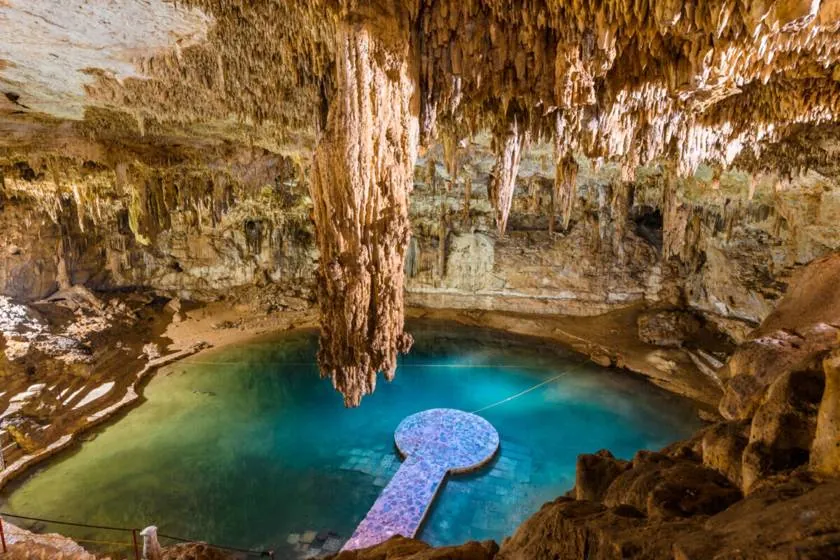
A cenote is a window into an underground river: a natural sinkhole where the limestone roof of Yucatan’s groundwater system has opened to the sky. This page gives the definition properly: the word, the geology, the four types, and why the greatest Maya city in the region is named after two of them.
We run the shared Chichen Itza tour described near the end of this page, which swims at Cenote Ik Kil. We are a young operator with a short record. Venue rules and figures for specific cenotes live on their own guides, not here.
What Is a Cenote, in One Paragraph
A cenote is a natural sinkhole in limestone that exposes the groundwater beneath it: a place where the roof of an underground river system has fallen in, or where the water table simply reaches the surface, leaving a pool of strikingly clear fresh water open to the sky or lit through a hole in a cave roof. The Yucatan Peninsula has thousands of them, because almost the whole peninsula is a flat slab of limestone with virtually no rivers on its surface: its rivers run underground, and cenotes are the windows into them. For the Maya they were wells, the only reliable water in a dry land, and sacred places, doorways to the world below. For a visitor today they are the swim that ends almost every Chichen Itza day.
This page defines the thing itself. The swimmable cenotes near the ruins each have a guide: Ik Kil, Suytun, Hubiku and Saamal and others, compared on the best cenotes hub. The one cenote that is not for swimming, the Sacred Cenote at the ruins themselves, is a ceremonial site you look into, never enter.
The Word: Where "Cenote" Comes From
The word is Yucatec Maya before it is Spanish: ts'onot (written dz'onot in older orthography), meaning a well or a pit with water. Spanish took the word because Spanish had no word for the thing, and English took it from Spanish for the same reason. It is pronounced seh-NOH-teh, and the plural is cenotes. When colonial writers described the Maya carrying offerings to the great well at Chichen Itza, the ts'onot they meant is the Sacred Cenote, and the city itself is named for wells: Chichen Itza means "at the mouth of the well of the Itza".
The word's journey is the concept's journey. To the Maya, a cenote was never scenery: it was infrastructure, the well a town was built around, and cosmology, an opening into Xibalba, the world below. Modern tourism added a third meaning, a swimming attraction, without removing the first two: the cenote you swim in on a tour is still, very often, a village's historic water source, on land the village owns and runs.
How a Cenote Forms: Rain, Limestone and Time
The formation story has three ingredients. Limestone: the Yucatan platform is a young, porous limestone, laid down as seabed and lifted flat and low. Rain: with no mountains and few surface streams, rainwater soaks straight down, slightly acidic from the soil, dissolving the rock as it goes. Time: over hundreds of thousands of years the dissolving water carves caves and caverns along fractures, and where a cavern roof thins and falls, a cenote opens. Where sea levels fell during the ice ages, systems that are flooded today once stood dry and grew stalactites; the flooded caves of the peninsula still hold their dry-age formations underwater, which is why cave divers swim through stone forests.
A famous arc of cenotes, the Ring of Cenotes around the peninsula's north-west, follows the buried rim of the Chicxulub impact crater, where the ancient impact fractured the rock. That ring has its own page, the Chicxulub crater guide, and one correction belongs in every definition: Chichen Itza and Ik Kil are not on the Ring. They are ordinary, magnificent limestone cenotes of the plains, far east of the crater rim, and any page that places them on the ring is copying an error.
The water itself: cenote water is groundwater, filtered through the limestone, which is why it is so clear, and it is cool year-round, reported around 24 to 26 °C in Ik Kil's case, cold enough to be a shock after the ruins and exactly the point of the swim. Fresh water floats on the denser salt water that intrudes from the coast deep in the aquifer, and in some cenotes the boundary between the two layers is visible as a shimmering halocline.
The Four Types of Cenote
Cenotes are classed by how open they are, and the type decides the experience before you arrive:
The types blur at the edges, Ik Kil has a cavern's walls and an open pool's sky, but the classification predicts the practical things: how much light, how steep the descent, how cold the first moment feels, and whether the famous photograph (a beam through blackness) is even possible. Each near-Chichen guide on this site states its cenote's type in the first section, and the hub compares them side by side.
Cenotes at Chichen Itza: Wells, Offerings and the Two Inside the Fence
Chichen Itza exists because of cenotes, and two lie inside the archaeological zone. The Sacred Cenote, at the end of a 300 m sacbe north of El Castillo, is about 60 m across with water lying some 20 m below the rim, at most 13.50 m deep in INAH's figures: a ceremonial well into which the Maya cast offerings of gold, jade, copal and ceramics, and human beings, across centuries. It is viewed from the rim only. The second, Cenote Xtoloc, named for the iguana, was the city's working water supply, quieter in the record and on the ground.
The swims of a modern tour day are outside the fence, in the working cenotes of the local communities: Ik Kil, our tour's cenote, a vast open cylinder about 60 m across with the water some 26 m below the rim and reported 40 to 50 m deep; Suytun, the cavern of the light beam; and the rest of the ring of visits the best cenotes page compares. Understanding the definition changes the visit: you are not swimming in a curiosity, you are swimming in the reason the city is there.
One rule follows from the definition, and it applies at every cenote in this guide layer: these are living ecosystems and, in many places, protected water. Sunscreen, insect repellent and anything else on your skin goes into a closed freshwater system; several venues ban products entirely or allow only biodegradable ones, and the specific rule at each venue, including the ones where no official rule is published, is stated on its own guide rather than guessed here.
Cenotes as Ecosystems: Life in the Water
A cenote is also a habitat, and a strange one: isolated pools of groundwater, connected below the surface, in near-darkness at their cave ends. Small fish work the lit shallows of the managed cenotes, turtles appear in the quieter open pools, bats roost in the cavern roofs, swallows and the turquoise-browed motmot, the toh bird of Maya tradition, nest around the openings, and in the dark flooded caves live species found nowhere else on earth, blind and pale from generations without light. The clarity that makes the water beautiful is part of the fragility: very clear water is very low in nutrients, and systems like this absorb change slowly and show damage late.
Which is the practical reason every guide in this layer repeats the same two rules. What goes on your skin goes into a closed aquifer that villages drink from, so follow each venue’s product rule exactly, including a total ban where one is posted; and treat the cave ends of any cenote as what they are, a separate, diver-only world. The managed pool at the bottom of the stairs is the visitor’s cenote; the ecosystem extends far beyond it, in the dark, in both directions.
Now Swim in One: The Shared Tour
Swim at Cenote Ik Kil on our shared day trip to Chichen Itza and Valladolid. The tour costs $130 per adult and $115 per child up to age 12, including the 697 MXN Chichen Itza entrance fee. We pick you up from your own hotel or pickup point and confirm the exact time on WhatsApp the night before. A 30% advance secures your reservation, with the balance due on tour day. Cancellation is free up to 48 hours before the tour, and the advance is refunded in full. We are a new operator, and we say so plainly.
City pages: Chichen Itza tour from Cancun · from Tulum · from Playa del Carmen
Price calculator
These prices include the 697 MXN Chichen Itza entrance fee, so there is nothing extra to pay for entry at the gate.
What Is a Cenote: Questions, Answered
What is a cenote in simple words?
A natural hole in limestone where you can reach the groundwater: part cave, part well, part swimming pool made by geology. Rain dissolves the rock over thousands of years, the roof of an underground cavern falls in, and a pool of clear fresh water opens to the sky.
How do you pronounce cenote, and what does the word mean?
Seh-NOH-teh. The word comes from the Yucatec Maya ts’onot, a well or water pit, borrowed into Spanish and then English because no European word existed for the thing.
How deep is a cenote?
It varies by type and by venue, from shallow pools to Ik Kil’s reported 40 to 50 m. The Sacred Cenote at Chichen Itza is at most 13.50 m deep by INAH’s figures. Every guide on this site prints its cenote’s depth with its source, and prints nothing where no reliable figure exists.
Is cenote water fresh or salt?
Fresh: it is rainwater filtered through limestone, which is why it is so clear and cool. Deep in the coastal aquifer, fresh water floats over intruding salt water, and the shimmering boundary between them is called a halocline.
Why are there so many cenotes in Yucatan?
Because the peninsula is a flat slab of porous limestone with almost no surface rivers. Its water runs underground, and the roofs of its caverns collapse into cenotes; thousands are known, and the count keeps rising.
Can you swim in the Sacred Cenote at Chichen Itza?
No. The Sacred Cenote is a ceremonial archaeological site, viewed from its rim; swimming in it is prohibited. The swimmable cenotes of a Chichen Itza day, Ik Kil, Suytun and others, are outside the archaeological zone and are run as visitor venues.
Is Ik Kil on the Ring of Cenotes?
No. The Ring of Cenotes follows the buried rim of the Chicxulub crater in the peninsula’s north-west. Ik Kil and Chichen Itza lie well east of it; pages that place them on the Ring are repeating an error.
Are cenotes safe to swim in?
At managed venues, yes, with the venue’s rules followed: life jackets where required, no diving except where a platform allows it, and care on wet stone stairs. Depths are real and underwater caves are for certified divers only; the open pool of a managed cenote is a different environment from its cave system.
Check Your Date on WhatsApp
Booking opens on WhatsApp: that is where your date is checked, your pickup point is set, and your exact pickup time is confirmed the night before the tour. Send one message with:
- Your tour date
- Your pickup city and hotel or pickup point
- How many adults and children (to age 12)
$130 per adult · $115 per child · 697 MXN entrance fee included · 30% advance to reserve · free cancellation up to 48 hours before.
Start with your date
One tap opens the conversation. Prices above are the full per-person prices: the entrance fee is already in them.