History of Chichen Itza: The Timeline, With the Debates Left In
Chichen Itza was a Maya town by the wells, then a capital of the northern lowlands, then a pilgrimage ruin, then the most studied Maya city on earth. This is its history in order, with the founding dates, the famous conquest date and the discovery story each labelled for what the evidence actually is.
We run the shared Chichen Itza tour described near the end of this page. We are a new operator with a short track record. The history here follows the published sources named at the foot of the page, and dates that scholars contest are printed as contested.
A Short History of Chichen Itza
Chichen Itza's history runs in three acts. In the first, Maya settlers build a town beside two great wells in a dry limestone land, and raise palaces and temples in the Puuc style of the northern hills. In the second, the town becomes a capital: a monumental core of pyramids, colonnades and the largest ball court in Mesoamerica rises in a style that mixes Maya craft with imagery shared across the continent. In the third, the capital fades, the wells stay holy, and the city passes into pilgrimage, abandonment, rediscovery and finally protection, becoming the most visited archaeological zone in Mexico.
Two honest warnings before the dates. First, this city's chronology is genuinely argued about: the traditional account, written down in Maya chronicles after the Spanish conquest, puts the founding in the 5th century; archaeology works with a settlement sequence that firms up from the 6th century onward. This page prints the layers separately rather than blending them into one smooth story. Second, the people are a page of their own: who the Itza were, where they came from and where they went is told in full in who built Chichen Itza, and the famous argument about Toltec influence is adjudicated in the Toltec debate. What follows is the timeline those two arguments hang on.
When Was Chichen Itza Built? The Timeline in Brief
So, how old is Chichen Itza? Counting from the archaeological settlement, about 1,400 years; counting the great monuments visitors come to see, between roughly 900 and 1,200 years. Any single founding year printed without a label, including the popular "founded in 435" and "founded in 550", is choosing one layer of the evidence and hiding the others.
First Settlement: The Town by the Wells
Why here? The northern Yucatan has almost no surface water: rain disappears into limestone. The two cenotes inside what became the city, the Sacred Cenote and Cenote Xtoloc, were permanent water in a dry country, and the settlement grew where the water was. UNESCO's dossier records the later local accounts of the founding (one manuscript gives 415 to 435, others 455) and dates the first town's important monuments, the Nunnery group, the Church, Akab Dzib, the Red House and the Temple of the Panels among them, between the 6th and 10th centuries in the regional Puuc style.
Those southern districts are the older city: lower, denser, carved with the stone-mosaic facades and Chaac masks of the Puuc world. They are also the part most tours rush. The buildings themselves, Las Monjas and La Iglesia, Akab Dzib, Casa Colorada and their neighbours, are walked through in the lesser-known structures guide; the observatory that belongs to this same southern world has its own page, El Caracol.
The builders were Maya, and the city's name ties it to one Maya people in particular, the Itza. In one passage, because the depth is theirs: the Itza's origins, their rule here, and their extraordinary afterlife as the last independent Maya kingdom, unconquered until 1697, are the subject of the Itza page, which owns the "who built Chichen Itza" question on this site.
The Monumental Peak: A Capital of the Northern Lowlands
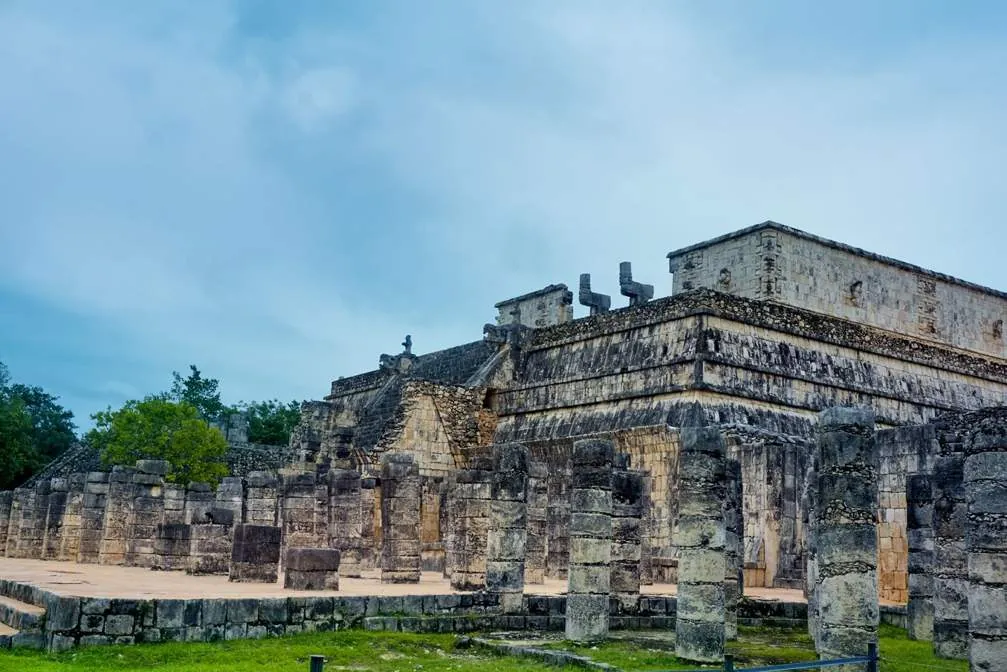
From the 9th century, and fully in the 10th to 12th, Chichen Itza was remade as a capital. El Castillo rose in stages over an earlier pyramid (the one you see is the last of at least two), the Great Ball Court was built at a scale no other Maya city attempted, and the Temple of the Warriors opened onto a forest of a thousand columns. Sacbeob, raised stone roads, tied the centre to its cenotes and districts, and the city stood at the head of a territory reaching to the north coast, whose port traded salt and goods across the Maya world.
The new architecture speaks two visual languages at once: Maya Puuc craft and a set of images, feathered serpents, warrior columns, chacmool figures, skull platforms, that Chichen shares with Tula in central Mexico. The older textbooks called this a Toltec conquest and even dated it, to 987. That date is a modern model's date, not an event any source records, and the current scholarly centre of gravity is interaction rather than invasion. Both the evidence table and the verdict live on the Toltec influence page; the timeline here simply marks the transition in the centuries where the buildings put it.
The calendar science of the peak is its own subject: the equinox light effect on El Castillo, the Venus alignments of El Caracol, and the counting systems behind them are covered by the Maya calendar page and the equinox guide. And the ritual life of the capital, including what the Sacred Cenote's offerings and the 2024 burial study actually prove, is weighed on the sacrifice evidence page.
Decline: The Long Pilgrimage Afterlife
Chichen Itza was not destroyed in a day, and it was never simply abandoned. Monumental construction stops in the 13th century and political primacy passes to Mayapan, the next great northern capital; drought, shifting trade and internal conflict are the causes the literature debates, in proportions nobody can measure. What the record does show is continuity of a different kind: the Sacred Cenote remained a pilgrimage destination into the Spanish colonial period, centuries after the last pyramid was built, with offerings still being made at a city whose government had long gone.
That long afterlife matters for how you read the ruins. The Chichen Itza a visitor walks is not a city frozen at its peak: it is a peak-era core, an older southern town, and a sacred landscape that outlived both, all in one fence. The Maya world around it did not end either: the Itza kingdom at Nojpeten, in modern Guatemala, remained independent until 13 March 1697, the last Maya kingdom to fall, a date the Itza page treats in full.
The Spanish Centuries
Spanish forces reached Yucatan in the 1520s and 1530s and found Chichen Itza already a ruin with a living cult. Colonial writers described the site and its well; the Franciscan Diego de Landa, whose account of Yucatan is one of the great, and most compromised, sources for Maya civilisation, wrote of the cenote pilgrimages as a practice of the recent past. The city itself passed into hacienda land, grazed and largely unvisited, while its stones were recorded mainly when travellers with antiquarian interests passed through.
Those three centuries are the quiet part of the timeline, and honesty requires saying what fills them: not events at the site, but the survival of the site. Roofs fell, scrub grew over the southern districts, and the northern monuments stood in the open, weathered but standing, which is precisely why so much survives to be argued about today.
Rediscovery: Stephens, Catherwood and the Explorers
"Discovered" needs its label: the site was never lost to the Maya of Yucatan, who lived beside it and worshipped at its well. What happened in the 1840s was its introduction to the wider world's print culture. The American traveller John Lloyd Stephens and the English artist Frederick Catherwood visited in 1841 to 1842 and published Incidents of Travel in Yucatan in 1843, with Catherwood's drawings of El Castillo, the ball court and the southern temples. The book made Chichen Itza famous in the United States and Europe and started the modern era of its study.
The decades after brought the first archaeologists and the first controversies: explorers cleared temples, a French expedition photographed the facades, and Augustus Le Plongeon damaged the Las Monjas complex in a misguided hunt for hidden chambers, an early lesson in what unregulated enthusiasm costs a site. The modern, documented era begins with the work described in the next section.
Excavation and Restoration: Thompson, the Carnegie Years and INAH
Edward Herbert Thompson, an American who bought the hacienda containing the ruins, dredged the Sacred Cenote between 1904 and 1910 and shipped its offerings, gold, jade, copal, textiles and human remains among them, to Harvard's Peabody Museum, where the museum records more than 3,000 offerings still in its care. The dredging proved the cenote cult beyond argument and opened a restitution argument that has never entirely closed.
From the 1920s, systematic excavation and restoration, Mexican-led and, in the Carnegie Institution years, jointly documented, rebuilt the northern core visitors know: the Warriors complex, the ball court's benches, El Castillo's stairways, including the tunnel into the earlier pyramid inside it with its chacmool and red jaguar throne. INAH, founded in 1939, has stewarded the zone since, through the land settlements that made the core public, the 1988 UNESCO inscription, the closure of the monuments to climbing, and the 2024 opening of the Gran Museo and the new CATVI entrance. The honours layer of that story, UNESCO versus the 2007 vote, is separated carefully on the New7Wonders page.
The history is not finished. The Chichén Viejo sector opened to reservation-only visits only in the 2020s, two millennia of burials near the Sacred Cenote yielded a landmark genetic study in 2024, and INAH's own counts recorded the site's busiest year on record in 2025. Chichen Itza's timeline now includes its archaeologists.
Walk the Timeline: The Shared Tour
Explore Chichen Itza's history on our shared day trip, which also includes a swim at Cenote Ik Kil and a stop in Valladolid. The price is $130 per adult and $115 per child up to age 12, including the 697 MXN Chichen Itza entrance fee. We pick you up from your own hotel or pickup point and confirm the exact time on WhatsApp the night before. A 30% advance reserves your place, with the balance due on the tour day. Cancellation is free up to 48 hours before the tour, with the advance refunded in full. We are a new operator, and we say so plainly.
City pages: Chichen Itza tour from Cancun · from Tulum · from Playa del Carmen
Price calculator
The 697 MXN Chichen Itza entrance fee is included in these prices, so there is nothing extra to pay at the gate for entry.
Chichen Itza History: Questions, Answered
When was Chichen Itza built?
In stages over centuries. Settlement by the wells is established by the 6th century CE, the Puuc-style southern districts rose between the 6th and 10th centuries, and the famous northern monuments, El Castillo in its present form, the Great Ball Court and the Temple of the Warriors, are broadly 9th to 12th century work.
Who built Chichen Itza?
The Maya, and in particular the Itza, the people the city is named for. That answer has a whole page of its own on this site, covering who the Itza were, where they came from and their last kingdom at Nojpeten, which held out until 1697.
How old is Chichen Itza?
About 1,400 years from the archaeological settlement, and roughly 900 to 1,200 years for the great monuments most visitors come to see. Later Maya chronicles give founding dates of 415 to 455 CE; those are tradition recorded centuries afterward, and this page prints them as such.
When was Chichen Itza discovered?
It was never lost to the Maya of Yucatan. For the wider world, John Lloyd Stephens and Frederick Catherwood published their account and drawings in 1843, after visiting in 1841 to 1842, and that book began the modern era of study at the site.
Why did Chichen Itza decline?
Monumental building stops in the 13th century and political primacy passes to Mayapan. Drought, shifting trade and internal conflict are the causes debated in the literature; what is documented is the long afterlife, with pilgrimage to the Sacred Cenote continuing into the Spanish colonial period.
Did the Toltecs conquer Chichen Itza in 987?
The year 987 is a date from a modern scholarly model of the Toltec-era transition, not an event any source records. The central Mexican influence in the later architecture is real; whether it arrived by conquest, migration or exchange is debated, and the current centre of gravity is interaction rather than invasion.
What is the oldest firmly dated object at Chichen Itza?
The site’s only full Initial Series date: a carved lintel reading 10.2.9.1.9 in the Long Count, which converts to 878 CE under the standard GMT correlation. It anchors a chronology that is otherwise built from styles and stratigraphy.
When did Chichen Itza become a World Heritage Site?
In 1988, when UNESCO inscribed the Pre-Hispanic City of Chichen-Itza on the World Heritage List. The New7Wonders title is separate: it came from a private foundation’s vote in 2007.
Check Your Date on WhatsApp
Booking opens on WhatsApp: that is where your date is checked, your pickup point is set, and your exact pickup time is confirmed the night before the tour. Send one message with:
- Your tour date
- Your pickup city and hotel or pickup point
- How many adults and children (to age 12)
$130 per adult · $115 per child · 697 MXN entrance fee included · 30% advance to reserve · free cancellation up to 48 hours before.
Start with your date
One tap opens the conversation. Prices above are the full per-person prices: the entrance fee is already in them.