El Castillo, the Temple of Kukulkán: The Complete Guide
El Castillo is the building every visitor to Chichen Itza photographs first, and the building about which the most confident claims are repeated. This guide goes through it claim by claim: what is documented, what is interpretation, and what is unproven, with the source named each time.
We run the shared Chichen Itza tour described near the end of this page. We are a new operator with a short record of reviews, that is stated plainly here rather than dressed up. Everything about the building itself comes from the published sources named on this page, not from us.
What El Castillo Is
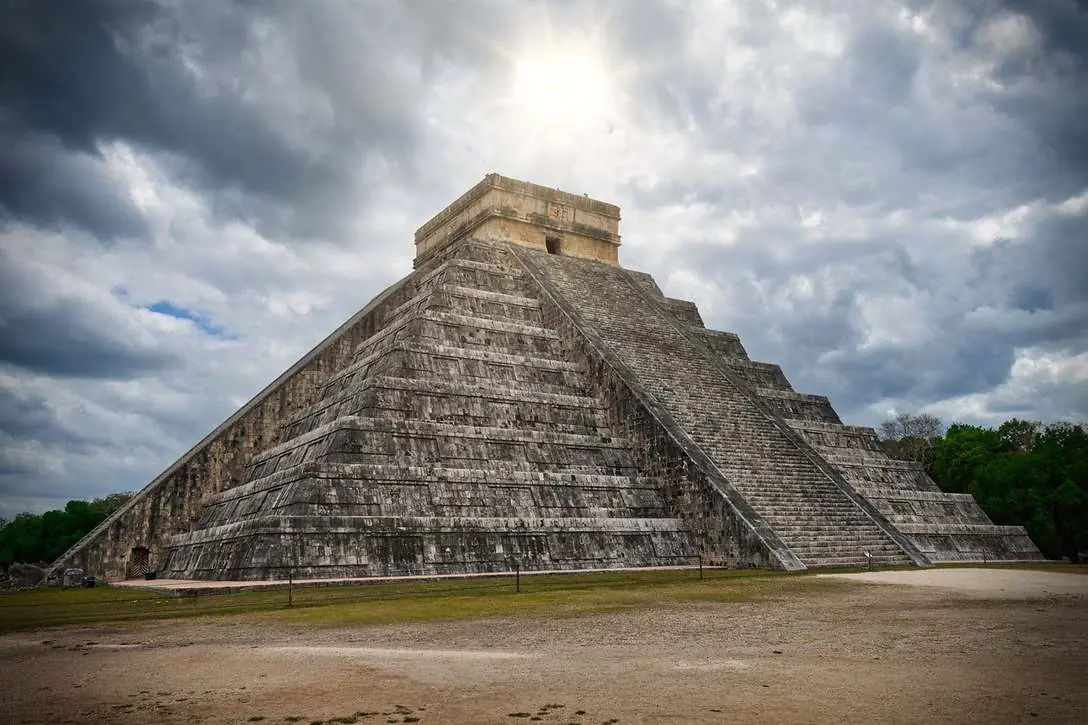
El Castillo, "the castle," the name Spanish-era visitors gave it, is the Temple of Kukulkán, the great stepped pyramid standing at the centre of the Great Plaza at Chichen Itza in Yucatán, Mexico. It is the building the whole site is organised around: the Great Ball Court lies to its west, the Platform of the Eagles and Jaguars and the Tzompantli nearby, and the sacbé (raised Maya road) runs north from its main staircase toward the Sacred Cenote.
Kukulkán is the Maya Feathered Serpent, the counterpart of Quetzalcóatl in central Mexican tradition. Naming the pyramid the Temple of Kukulkán is a cultural identification, it frames what the building meant, not a dated historical event, and this guide treats it that way throughout. For the site as a whole, start with the Chichen Itza Visitor Guide; this page stays with the one building.
The court that closes the plaza's north end has its own scale problem, it is the largest in Mesoamerica, and the Great Ball Court gets a guide of its own.
Across the same plaza stands the complex whose serpent columns echo this pyramid's balustrades, the Temple of the Warriors and the Thousand Columns.
Measurements, With the Conflicts Printed
DocumentedHeight: approximately 30 m in total: a 24 m stepped-pyramid body plus the 6 m temple on top. That breakdown is INAH's (Boletín 180, April 2026, summarising Arqueología Mexicana No. 197), and it is corroborated by Casares Contreras (2017), Wikipedia's survey of the sources, and Britannica. Of every number on this page, this is the settled one.
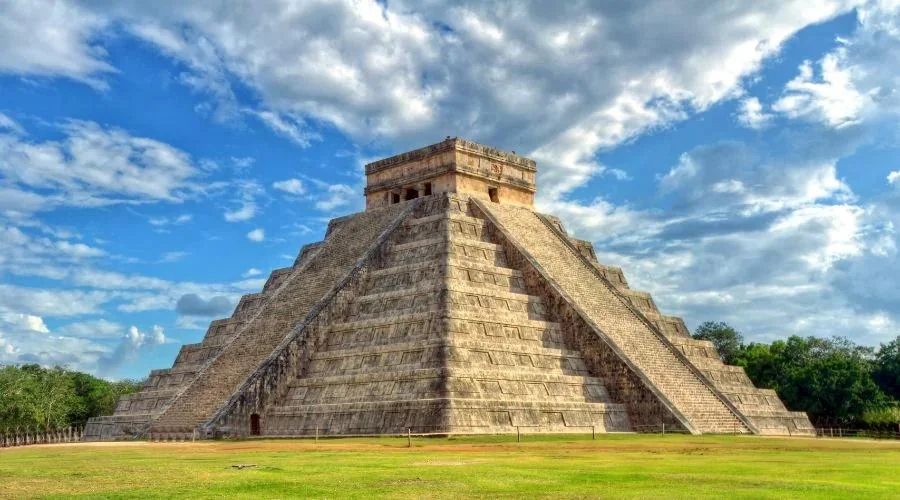
DocumentedThe body is built in nine stepped terraces (INAH: "nueve cuerpos escalonados"), with four stairways of 91 steps each in their restored, documented configuration (INAH; Casares Contreras, 2017). At the foot of the balustrades stand carved stone serpent heads; the northern pair is the one that receives the equinox light described below. A temple crowns the summit platform, the 6 m upper part of the 30 m total, and is viewed from outside only.
The standing caveat, which qualifies every count on this page: the visible pyramid is partly a 20th-century reconstruction, and scholars note the building has not been fully restored or measured. Every step count and dimension here describes the restored configuration, the building as documented after restoration, not a claim that each element survives exactly as built.
When Was It Built?
"Built in stages" is not a fudge: it is visible in the archaeology. As Section 8 explains, the pyramid you see encloses an earlier, smaller pyramid inside it, so the monument grew: an earlier structure was deliberately encased within the larger, later one. The Feathered Serpent identification belongs to the same broad period of the city's history, when Chichen Itza was a major Maya centre with strong connections across Mesoamerica.
Is It Really a Calendar?
This is the most repeated claim about El Castillo, so it gets the most careful grading on the page.
DocumentedThe count: four stairways of 91 steps each, plus the top platform, give 91 × 4 + 1 = 365. The arithmetic is exact and the step count is documented for the restored configuration. InterpretationThe meaning: that the builders designed that count to encode the year is an interpretation. Counting the top platform as the 365th "step" is itself a symbolic step. INAH presents the calendar association; Casares Contreras discusses it as an interpretation with a documented history. Honest wording: the numbers line up, and the intent behind them is argued, not proven.
DocumentedThe calendars themselves: the Maya Haab' year is 365 days: 18 months of 20 days, plus 5 extra days (18 × 20 + 5). The Calendar Round, the cycle in which the Haab' and the 260-day Tzolk'in realign, runs 52 Haab' years. That is where the number 52 genuinely belongs in this story: in the calendar arithmetic. Unproven as statedYou will find 52 attached to the pyramid's panels in popular accounts; as a total count for the whole building, that claim is wrong and misleading, and this page does not repeat it as a measurement.
InterpretationNine terraces × 2 = 18: the 18 twenty-day months of the Haab', with 9 also read as the levels of the Maya underworld. This is a widely repeated interpretation and is attributed here as one; it is not proven design. And the largest version of the claim, that the building perfectly encodes every Maya cycle, is not something the evidence supports, and it is not claimed here.
How the Equinox Serpent Works
First, a correction to the usual description. The effect is not "shadows on the stairs." In the late afternoon, sunlight falling past the stepped north-west corner of the pyramid throws illuminated triangles, separated by shadow, across the western balustrade of the north staircase. Joined together, the lit triangles form the body of a serpent descending the balustrade to the carved stone head at its foot.
Second, the calendar of the effect is far longer than the two famous dates. INAH's annual sequence (Boletín 180, 2026) runs like this:
Either side of the winter solstice there is a shadow period of 52 days in which the effect does not form. So the serpent light is a season, not a single afternoon, which also means a visit near, not exactly on, the equinox can still see a partial effect.
This page owns the geometry. The event itself, the equinox dates, the crowds, INAH's special operativo, and the Noches de Kukulkán night show, lives on the Equinox Guide, and nothing here should be read as a promise about what any single tour's timing on site will catch.
The serpent is a date made visible, the Maya calendar behind the serpent explains the counts that put it on the staircase.
Was It Designed on Purpose?
The geometry in the last section is not in dispute. Whether the Maya intended the serpent is, and this page names both positions without declaring a winner.
Position one: emergent by-product. Šprajc and Sánchez Nava (2018), in the most systematic study of Maya building alignments, argue that those alignments target calendar and agricultural dates rather than the modern equinox. On that reading, the serpent of light is an emergent effect of the pyramid's corner geometry, real, striking, and not necessarily the purpose the alignment was built for.
Position two: an intentional programme. Casares Contreras, and the INAH authors behind the 2026 summary, treat El Castillo as a broader intentional calendrical programme, one that takes in Venus and the agricultural cycles as well as the solar effects. On that reading, the equinox light is one designed element among several.
Unproven either wayBoth positions are held by serious specialists working from the same building. What no honest page can do is print either one as settled. If a guide tells you the serpent was definitely designed, or definitely an accident, they have gone past what the published debate supports.
Why It Echoes Like a Bird
Stand at the base of the north staircase and clap once, sharply. The echo that comes back is not a normal echo: it is a chirp whose pitch falls: a descending "weeoo" rather than a repeated clap.
Documented physicsThe chirp is measured, and its mechanism is understood. Sound reflects off the stair treads one after another; because the treads form a regular, periodic staircase, the returning reflections arrive in a pattern that the ear hears as a pitch that slides downward. David Lubman characterised the effect in 1998–99. Declercq and colleagues (2004, Journal of the Acoustical Society of America) simulated the periodic staircase and showed the chirp follows from the geometry, it occurs on other periodic staircases too, not only this one. Bilsen (2006) proposed a repetition-pitch model and disputed that diffraction alone explains every feature, so even the physics has a live footnote; the chirp itself is not in question. Position matters, and so does a sharp sound: a soft or smeared clap will not produce it cleanly.
InterpretationLubman compared the chirp to the call of the resplendent quetzal, the bird whose feathers were among the most prized materials in the Maya world. The resemblance is his proposed comparison. That the Maya designed the staircase to imitate the bird is a further step, an interpretation that physics, by itself, cannot prove. Lubman's most dramatic framing of the echo was presented by Lubman himself as hypothetical, and it is not repeated here as a finding. Enjoy the chirp; it is genuinely strange and genuinely explained. Just keep the bird in the "interpretation" column, where the evidence leaves it.
The Pyramid Inside the Pyramid
El Castillo is not one building but two: an earlier, smaller pyramid stands enclosed inside the visible one, its structure preserved within the later pyramid's mass. Archaeologists reached it by tunnel in the 1930s, in excavations under Ignacio Marquina and Eduardo Noguera.
Inside the earlier pyramid's chambers they found two famous objects. The first is a chacmool, the reclining figure with a bowl on its stomach, a signature sculpture of Chichen Itza. The second is the red jaguar throne: a jaguar-form seat painted red, its spots and eyes inlaid with jade disks, more than 70 of them; 74 is also reported, and this page prints the range with its uncertainty rather than one bare number. The red pigment has been reported as cinnabar in a 2018 reassessment, reported, and attributed here as such.
DocumentedThe inner chambers are closed to visitors, and have been the preserve of researchers for a long time; what you can see of them is through published photographs and museum reproductions. One more discipline point: no royal tomb has been confirmed inside El Castillo. A hidden pyramid with a jaguar throne is remarkable enough without inventing a burial the archaeology has not produced.
The Cenote Beneath
DocumentedIn August 2015, researchers from the National Autonomous University of Mexico (UNAM), the team led by René Chávez Segura and Andrés Tejero-Andrade of the Institute of Geophysics, announced the result of a 3D electrical resistivity tomography (ERT) survey: a low-resistivity body beneath El Castillo, interpreted as a partially water-filled karst cavity, a cenote, sealed under a limestone layer of roughly 4 m. The preliminary size was put at about 20–25 m (north–south) by about 30 m. The peer-reviewed follow-up appeared in Geofísica Internacional (Chávez et al.).
Uncertain: in UNAM's own wordsThe survey probed to about 20 m, and the cavity's exact depth is uncertain; UNAM said so itself. The team also explicitly cautioned against the dramatic reading of the pyramid sitting on open water, the cavity is a karst void in limestone, detected electrically, and it has never been entered or seen. Later reporting of a "secret passageway" (2017) traces back to a 2016 INAH meeting and geophysical anomalies: it is unconfirmed, and no walkable tunnel has been found. A December 2025 muon scan was reported in the press as finding no hidden chambers; that is preliminary press reporting, not a peer-reviewed result, and it is presented here as exactly that.
Do not confuse this hidden cavity with the Sacred Cenote, the great open cenote at the end of the sacbé north of the pyramid, a different place entirely, covered in the Sacred Cenote guide.
Exploration and Restoration
The pyramid the 19th century found was a ruin in the forest. John Lloyd Stephens and Frederick Catherwood documented the overgrown pyramid in 1839–42, publishing it in Incidents of Travel in Yucatán (1843), Catherwood's drawings are the reason the wider world knew what stood here.
Systematic work came with the Carnegie Institution, which worked at Chichén Itzá from 1924 to 1934 (INAH), alongside Mexican archaeologists; the restoration of the north and west faces, the crisp pyramid of today's photographs, belongs to that era and what followed it. Sources differThe span given for that restoration varies by source, printed variously as ending in 1935 or running to 1951; the conflict is left standing here rather than resolved by picking the tidier date. INAH consolidation and maintenance continue to the present.
Which returns to the caveat from the measurements section, restated in one line: what you photograph is a partly reconstructed building, and every count and dimension on this page describes that restored, documented configuration.
Seeing It Today
Today El Castillo is viewed from the Great Plaza, from ground level, inside a roped perimeter. There is no climbing and no entry, that is one line here, with the full set of what is and is not allowed on the Chichen Itza site rules page.
Where to stand
- North-west plaza: the classic full view: the whole north face, the main balustrade and the serpent head at its foot. This is the equinox face.
- North-east: the best angle for the terrace profile: the nine stepped bodies read clearly in raking light.
- The handclap: done facing the north staircase, at its base: one sharp clap, not a shout. The chirped echo described in Section 7 is real, measured physics; the quetzal reading stays an interpretation, even while your ears are enjoying it.
Visiting around the equinoxes or the zenith passages changes the crowds more than the building, dates, operativo details and the night show are on the Equinox Guide.
This pyramid is the site's most photographed building; photographing El Castillo: the spots that work covers the viewpoints, the light and the fee conflict honestly.
See El Castillo on the Shared Tour
See El Castillo on our shared day trip to Chichen Itza, with a swim at Cenote Ik Kil and a stop in Valladolid. The price is $130 per adult and $115 per child up to age 12, including the 697 MXN Chichen Itza entrance fee. We pick you up from your own hotel or pickup point and confirm the exact time on WhatsApp the night before. Reserve with a 30% advance and pay the balance on the tour day. Cancellation is free up to 48 hours before the tour, with the advance refunded in full. We are a new operator, and we say so plainly.
City pages: Chichen Itza tour from Cancun · from Tulum · from Playa del Carmen
Price calculator
The 697 MXN Chichen Itza entrance fee is already included in these prices, so there is nothing extra to pay at the gate for entry.
El Castillo: Frequently Asked Questions
How tall is El Castillo at Chichen Itza?
About 30 m in total: a 24 m stepped-pyramid body plus the 6 m temple on top (INAH, Boletín 180, April 2026).
How many steps does the Temple of Kukulkan have?
In its restored, documented configuration, El Castillo has four stairways of 91 steps each: 364 steps, plus the top platform, which the popular calendar count treats as the 365th.
Why does El Castillo have 365 steps?
The arithmetic is exact: 91 × 4 + 1 = 365, matching the 365 days of the Haab' year, but that the count was designed as a calendar is an interpretation, not a proven fact. INAH presents the association; scholars discuss it as an interpretation.
What is inside the Pyramid of Kukulkan?
An earlier, smaller pyramid is enclosed inside the visible one. Excavated in the 1930s, its inner chambers hold a chacmool and a red jaguar throne set with more than 70 jade disks (74 is also reported). The chambers are closed to visitors.
Can you go inside El Castillo?
No. The inner chambers of El Castillo are closed to visitors, and the pyramid can only be viewed from the roped perimeter on the Great Plaza.
Can you climb El Castillo?
No. Climbing El Castillo is not allowed. The pyramid is viewed from ground level inside a roped perimeter.
Why does El Castillo echo like a bird?
A sharp handclap at the base of the north staircase returns a chirped echo whose pitch falls: measured physics, explained by periodic reflections from the stair treads (Lubman, 1998; Declercq et al., 2004). That it imitates the quetzal, or was designed to, is an interpretation physics cannot prove.
Is there really a cenote under El Castillo?
Instruments say a cavity is there: in August 2015 UNAM announced that electrical resistivity tomography had detected a low-resistivity body beneath the pyramid, interpreted as a partially water-filled karst cavity: a cenote. Its exact depth is uncertain; UNAM said so itself. It has never been seen directly.
How does the equinox work at El Castillo?
Late-afternoon sun past the stepped north-west corner throws illuminated triangles separated by shadow across the western balustrade of the north staircase, forming the serpent's body down to the stone head at its foot. INAH's 2026 sequence runs from February to October: the effect is not limited to one day.
When was El Castillo built?
In stages, broadly in the 9th to 12th centuries CE (INAH, 2026). The often-quoted c. 800–900 CE is a shorthand for the main construction, not a single build date.
¿Cuánto mide El Castillo de Chichén Itzá?
Unos 30 metros en total: un cuerpo piramidal escalonado de 24 metros más el templo superior de 6 metros (INAH, Boletín 180, abril de 2026). La base mide unos 55 metros por lado; las cifras publicadas varían: 55.5 m (INAH, 2026), 55.3 m ampliamente repetido y unos 54 m en un estudio geofísico.
Did the Maya design the equinox serpent on purpose?
That is debated, and neither side is settled. Šprajc and Sánchez Nava (2018) argue Maya alignments target calendar and agricultural dates rather than the modern equinox, making the serpent an emergent by-product of the corner geometry. Casares Contreras and the INAH 2026 authors treat El Castillo as a broader intentional calendrical programme.
Check Your Date on WhatsApp
Booking opens on WhatsApp: that is where your date is checked, your pickup point is set, and your exact pickup time is confirmed the night before the tour. Send one message with:
- Your tour date
- Your pickup city and hotel or pickup point
- How many adults and children (to age 12)
$130 per adult · $115 per child · 697 MXN entrance fee included · 30% advance to reserve · free cancellation up to 48 hours before.
Start with your date
One tap opens the conversation. Prices above are the full per-person prices: the entrance fee is already in them.