The Itza: The People Who Built Chichen Itza: The Complete Guide
You have just walked their city. El Castillo, the ball court, the thousand columns, all of it was built by a real, named people: the Itza. Their island kingdom outlived the fall of Tenochtitlan by 176 years, and their language is still spoken, barely. Here is their story, with every claim labelled by what kind of source tells it: archaeology, the Maya's recorded tradition, colonial testimony, or modern scholarship.
A real, named Maya people of the Petén lakes region, attested in inscriptions, Maya books, and Spanish letters, not a legend.
The Maya books' katun date converts to candidate years more than two centuries apart. Any one year sold as “the” founding date is one conversion, not a fact.
The peak population is published as a range, 20,000 to 100,000+, because each estimate counts a different city. See the table in §4.
About this site: we are a new tour operator and we do not yet have reviews. We would rather earn them. This guide is free whether or not you ever book with us. Tour details are in §15.
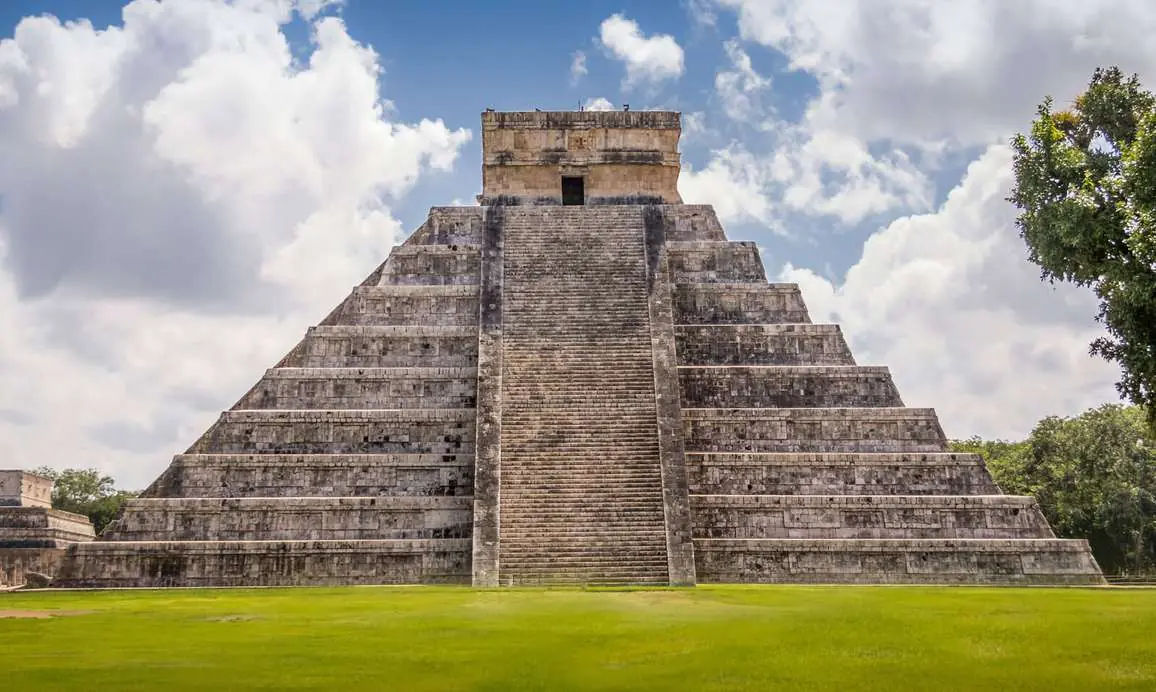
El Castillo at Chichén Itzá, the monumental city the Itza raised. Photo: chichenitza.com.
1. Who the Itza Are
The Itza are a historically attested Maya people of the Petén lakes region, in what is today northern Guatemala. Their name attaches to two places at once: Chichén Itzá in Yucatán, and the island kingdom of Nojpetén, also called Tayasal, on Lake Petén Itzá. That double attachment is the spine of this page: the people who built the famous city and the people who held the last independent Maya kingdom are the same people, linked by name, language and the Maya's own recorded tradition.
Their language, Itza', belongs to the Yucatecan branch of the Mayan language family. Its closest relatives are Yucatec Maya, Mopán and Lacandon (Kaufman; Campbell). That placement matters: linguistically, the Itza are not outsiders to the Maya world, they are one of its peoples, speaking a language of the same branch spoken across Yucatán today.
The city's name, and theirs
“Chichén Itzá” means “at the mouth of the well of the Itza”: chi, mouth; ch'en, well or cenote. The “well” is the cenote, the natural sinkhole that made a great city possible on dry limestone with no river. The name tells you the city defined itself by its water, and by the people who held it.
What the Itza left in the Sacred Cenote is the physical half of this story; the evidence for ritual and sacrifice weighs what was actually recovered.
What does “Itza” itself mean? The name (itz + ha) is traditionally glossed as “water sorcerers” or “enchanters of the water.” Publish that exactly at that grade: it is a traditional gloss, a folk etymology repeated for generations, and no linguist in the sources settles it. You will see “brujos del agua” in Spanish sources; it is the same traditional gloss, not a settled translation. For the full site orientation, see the Visitor Guide.
2. Did They “Found” Chichen Itza?
Not in the way the question implies, and the honest answer is more interesting. Settlement at Chichén predates and postdates any single “arrival.” An earlier city, known today as Chichén Viejo, shows Puuc-era occupation broadly dated c. 600–800 (INAH; Cobos). People were living and building at the cenotes before the monumental city existed. The site's dated inscriptions run 832–998, carved dates from the city's literate elite, in its own calendar.
The monumental city, the Chichén of El Castillo and the Great Ball Court, is the later phase. So the sentence “the Itza arrived and founded Chichén Itzá in year X” is false in form, whatever year is chosen: there was no empty site and no single founding moment for archaeology to date. What the Maya books record as an “arrival” is treated in §7, at tradition grade, with the katun problem that makes a single year impossible.
3. The Monumental City
The florescence of the monumental core is placed broadly at ~800–1050/1100, and this page prints the conflict rather than hiding it: INAH's own pages disagree with each other, giving 525–1200 on one, 900–1200 on another, and 700–1250 with an apogee of 800–1050 on a third. Ceramic-based readings run later, to ~1200. When the institution that manages the site publishes three windows, a guide that prints one tidy range is inventing a certainty the sources do not have.
In that window the Itza raised the buildings you walk between today: El Castillo with its equinox light effect, the Great Ball Court, the largest in Mesoamerica, the Temple of the Warriors and its colonnades, the observatory called El Caracol, and the platforms of the northern precinct. Each has its own guide on this site, with its own measurements and its own graded claims: start with El Castillo and the Temple of the Warriors.
Stand in the northern precinct and the scale of the undertaking is the argument: this was a capital, not a ceremonial stop, a city that organised labour, trade and ritual at regional scale for roughly three centuries.
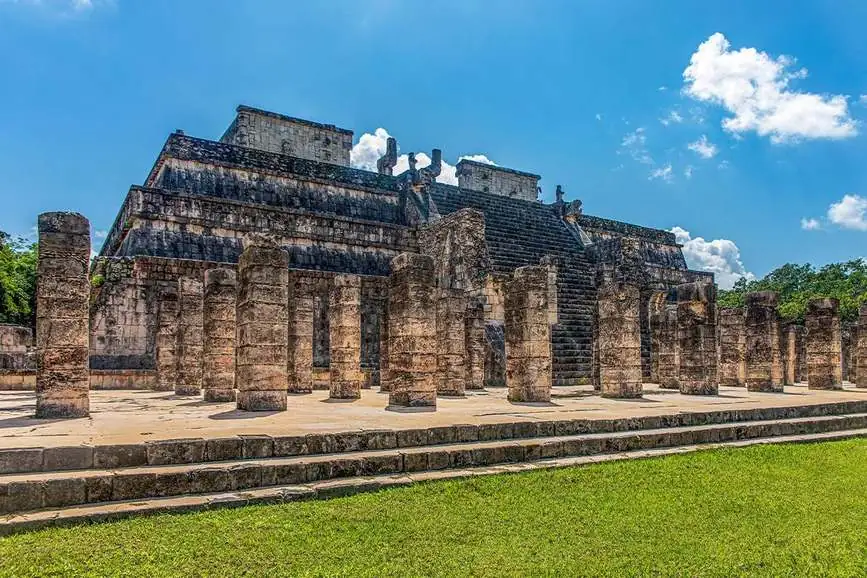
The Warriors colonnades, part of the monumental building programme. Photo: Hispani.
4. How Many People Lived Here?
A range, never a figure. Published estimates span 20,000–100,000+, and the spread is mostly a definition: what are you counting: the dense urban core, the city as its own scholars reconstruct it, or the whole regional hinterland that fed it?
| What is being counted | Estimate | Source |
|---|---|---|
| The urban core | 20,000–30,000 | Published core estimates |
| The city | 25,000–50,000 | Sharer & Traxler |
| City + regional hinterland | 50,000–100,000+ | Published hinterland estimates |
Webster's caution applies to the top of the range: high counts assume every structure stood, and was lived in, at the same time, an assumption no excavation can fully test. Single figures in popular sources are the unreliable tail of this table, each one a definition stripped of its label. This page never calls any one of them “the” population.
5. Who Ruled It?
The most famous answer comes from Bishop Diego de Landa, whose Relación (c. 1566) describes multepal: “joint rule” by a council of elite lineages. Grade it correctly: that is ethnohistoric testimony, a Spanish friar's account written from Maya informants more than a century after the city's fall, by a man who was himself an inquisitorial bishop. It is evidence. It is not a photograph.
Modern scholars dispute what multepal meant in practice. One reading takes Landa at his word: a genuine council government of lineage lords, unusual in a world of kings. Another reads a paramount king ruling with a council, the council real, but not sovereign. This page publishes the dispute and gives no verdict: the inscriptions name lords, the testimony names a council, and the sources do not force one answer.
6. Where Did the Itza Come From?
The classic answer is a named hypothesis, and it is published here as exactly that. J. Eric S. Thompson (1970) proposed that the Itza were Putun (Chontal) Maya, seafaring merchant-warriors from the Gulf coast who reached Yucatán by canoe trade routes and took or refounded Chichén. Thompson's learning was immense and his hypothesis organised the evidence of his day.
Its status today: outdated and oversimplified in part. Current work (Kowalski, Boot, Cobos) stresses local Puuc continuity, the people, pottery and building traditions already in Yucatán, and regional shifts in trade and power, over any single external origin. A coastal connection is not denied; a foreign takeover is not established. What this page will never print as fact is the short version: that the builders were outsiders to the Maya world. The language evidence in §1 points the other way.
7. What the Maya Themselves Recorded
The Books of Chilam Balam are colonial-era Yucatec Maya manuscripts, named for their towns: Chumayel, Tizimín, Maní and others, written in Roman script under Spanish rule, mixing prophecy, chronicle and ritual (Edmonson; Roys). In them, the Maya recorded their own account: the Itza's arrival at Chichén, and their later expulsion and departure. That is the Maya's own recorded tradition, precious, and graded as tradition, not as chronicle fact. These books were set down centuries after the events, in a conquered world, for Maya readers.
Landa's Relación is the second colonial witness, testimony at the same distance, from the other side of the conquest. Where the books and Landa agree, the page says so; neither upgrades the other into certainty.
The katun problem: why there is no arrival year
The books tie the arrival to a Katun 4 Ahau. A katun is a period of about 20 years, and the named katuns repeat in a cycle of roughly 256 years. So “Katun 4 Ahau” is not one date: it is a slot that recurs. Convert it and you get candidate years more than two centuries apart: Roys's sequence alone gives 452 / 689 / 985–987 / 1201, and other correlations give 948 or 1194–1204.
This is why the web's tidy founding years collapse on inspection: each one is a single conversion of a repeating cycle, repeated until it looks like a fact. The books give a katun. Honest scholarship gives the spread. This page gives the spread.
8. The Fall of the City
Modern scholarship describes a gradual decline, broadly 1050–1200: construction stops, the trade that fed the capital collapses, and the monumental city winds down. Not one event, not one battle, a capital losing its reasons to exist over generations.
Against that stands the famous story, at its correct grade. Hunac Ceel is tradition: in the Chilam Balam narrative, Hunac Ceel of Mayapán takes Chichén by treachery in Katun 8 Ahau and drives out the Itza. Print its chronology problem alongside it: the story's usual conversion (~1185–1204) lands after the decline was already under way, and before Mayapán's own peak (c. 1220–1440). A cause that postdates its effect cannot be published as chronicle, however good the story is. Mayapán, the successor capital, fell in its turn around 1441–1461 in the Xiu–Cocom feud, a later chapter, told here at passage depth only.
9. Where the Itza Went
South: back to the Petén lakes. On this point, unusually, tradition and archaeology agree in outline (Jones 1998; Rice & Rice): the Maya books' account of a departure southward matches the rise of an Itza centre on Lake Petén Itzá. The people who left the declining capital did not scatter into legend. They went home to the lakes their name had always belonged to, and there, they lasted.
10. The Last Kingdom: Nojpetén
On an island in Lake Petén Itzá, today the island town of Flores, Guatemala, the Itza held an independent kingdom centred on Nojpetén, also called Tayasal. While Yucatán and Mexico passed under Spanish rule, Nojpetén did not. For three centuries in outline, an Itza king ruled from the island, received or refused Spanish emissaries, and kept a Maya state alive into a world that believed the Maya kingdoms were finished.
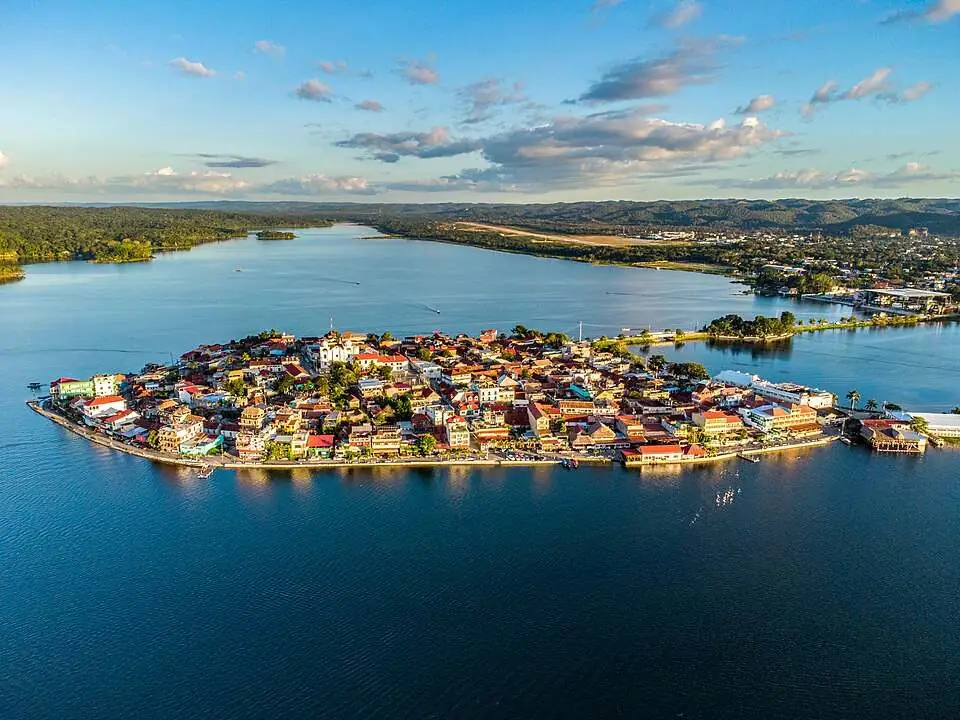
Flores island, Lake Petén Itzá, the island the sources call Nojpetén / Tayasal. Photo: Wikimedia Commons.
The island setting was the strategy: water on every side, canoe-borne trade and defence, and distance from the Spanish capitals. Spanish sources themselves attest the kingdom's persistence: the next section is built from their letters, graded as what they are: the testimony of the men who eventually came to end it.
Remember the arithmetic as you read on: Tenochtitlan fell in 1521. Nojpetén was still independent when the 1600s began, and for almost a century more.
11. Cortés and the Friars
1525: the Fifth Letter
Hernán Cortés, marching overland to Honduras, passed Lake Petén Itzá in 1525. His Fifth Letter (1526), a Spanish primary source, graded as testimony, names the island town (Taiza / Tayasal) on a great lake, and records that he met its chief, “Canec” (Kan Ek'), on 13 March 1525. Cortés was received, provisioned, and moved on. The kingdom outlasted the meeting by 172 years.
The famous sequel, that a horse Cortés left behind came to be venerated, the Tzimin Chac story, comes from Cogolludo's history of 1688, not from Cortés's letter. It is published here at that distance: a story told a century and a half later, not an entry in the conqueror's own account.
1618–19: Fuensalida and Orbita
In 1618–19 the Franciscans Fuensalida and Orbita reached Nojpetén and met Kan Ek', attempting a peaceful conversion (Cogolludo; Jones). The king heard them, asked questions of genuine theological interest in the accounts, and declined to convert on their timetable, pointing, in the friars' own telling, to the Maya's prophetic reckoning of when such a change was due. The missions withdrew. The kingdom held.
12. 13 March 1697
On 13 March 1697, Martín de Ursúa took Nojpetén. The arithmetic is this page's own, and it is the point: 1697 − 1521 = 176. The last independent Maya kingdom fell 176 years after Tenochtitlan (13 August 1521). Generations of visitors learn that “the Maya fell in 1521.” One Maya kingdom was still standing when Bach was a child.
Kan Ek's fate: handled exactly. Ajaw Kan Ek' was taken in shackles, with his son and two cousins, toward Guatemala (Jones 1998). The two men named Kan Ek' must not be merged: his cousin, the high priest Ajk'in Kan Ek', was executed before they arrived (Pugh 2016, citing Jones 1998). What finally became of the king himself in Guatemala is not established in the sources, this page says so, plainly, rather than borrowing an ending the record does not contain. Villagutierre's 1701 history is the near-contemporary Spanish account of the campaign.
13. The Itza Today
Did the Itza disappear? No. Itza communities live around Lake Petén Itzá today, and their language, though critically endangered, a grade every source agrees on, is still spoken and actively taught. What no source agrees on is the number, so this page publishes the counts as what they are: an attributed, dated set, each counting a slightly different thing.
| Source | Year | Count | What was counted |
|---|---|---|---|
| UNESCO Atlas of the World's Languages in Danger | 2011 | ~150 fluent speakers | Fluent speakers, with ~60 more non-fluent |
| Endangered Languages Project (via Wikipedia) | 2023 | Fewer than 40 fluent; 36 counted | Fluent speakers |
| SIL | 1986 | 12 | Fluent first-language speakers |
| Guatemala census | 2002 | 966 | People who first learned Itza' |
| Guatemala census | 2018 | 406 first-language speakers | In a 2,926-person Itza' community |
Different questions, different numbers: a census asking what you first learned and a field linguist counting fluent speakers are not measuring the same thing, and printing any one figure without its source and year would mislead in both directions. Revitalisation is centred on San José, Petén, the Bio-Itzá Association, the Academia de Lenguas Mayas de Guatemala (ALMG), and bilingual schooling carry the work of keeping Itza' a living language.
The takeaway, carefully stated: the city was built by a people whose descendants and language survive. The Itza were never a vanished race, and this page makes no stronger claim than the sources carry about lines of descent.
14. Kukulkán the Man
The Chilam Balam books and Landa record a lord Kukulkán who came from the west. That sentence is the whole of the evidence, and this page publishes it at tradition grade, never as biography: no birth, no reign dates, no list of deeds exists in any source this page will use. Scholars hold three open readings: a historical lord later deified; a lineage title that Maya elites adopted; or a purely religious figure. His proposed identification with Topiltzin of Tula is unsettled. The serpent, the equinox light and the pyramid belong to the El Castillo guide.
The Toltec question, in one graded passage: early scholars (Morley) read Chichén's parallels with Tula as a “Toltec invasion.” The modern consensus (Ringle, Kowalski, Andrews V, INAH) rejects a simple invasion in favour of Mesoamerican internationalism, shared Feathered Serpent elite networks and intense trade connecting the two cities. The full verdict, with both cases argued, belongs to our dedicated guide: Toltec influence at Chichen Itza. See also Chichen Itza vs Uxmal for the Puuc comparison.
15. See Their City on the Shared Tour
Our shared tour runs Chichen Itza + a swim at Cenote Ik Kil + Valladolid in one day, at $130 per adult and $115 per child (to age 12), the 697 MXN Chichen Itza entrance fee is included in that price. We pick you up from your own hotel or pickup point; your exact pickup time is confirmed on WhatsApp the night before. To reserve, a 30% advance holds your seats, no-shows are common and a blocked seat stops a ready customer from going, and the balance is paid on the day of the tour. Free cancellation up to 48 hours before the tour: cancel 48+ hours ahead and the advance is refunded in full; inside 48 hours the advance is kept.
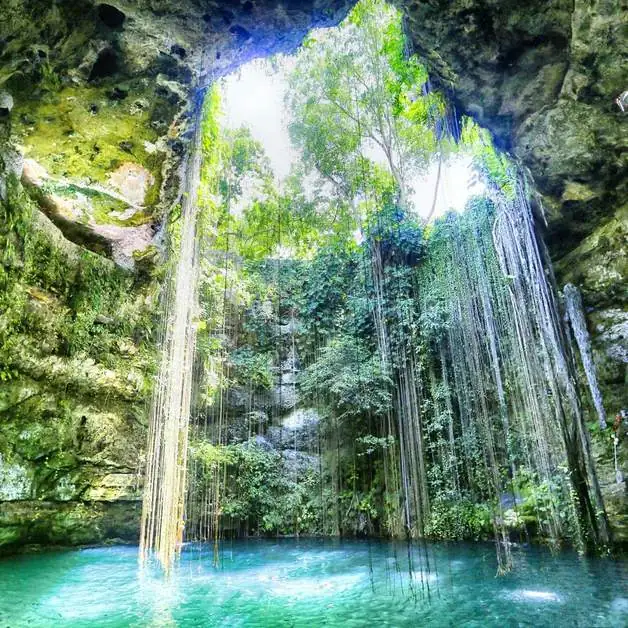
Cenote Ik Kil, the swim stop on the tour. Photo: Moon Travel Guides / iStock.
Walk the northern precinct with this page in mind and the stones change: the ball court is not a ruin of strangers, the columns are not anonymous. They are the works of a people whose king was still ruling an island capital in 1697, and whose language children in San José are learning today.
Pickup cities, in order: Cancun · Tulum · Playa del Carmen · Riviera Maya · Merida. Each city page carries its own pickup zones and drive times.
Work out your total
City pages: Cancun · Tulum · Playa del Carmen · Riviera Maya · Merida