The Maya Calendar at Chichen Itza: The Complete Guide
There was never one Maya calendar. There were four counts running at once, a 260-day sacred round, a 365-day year, the great cycle the two of them mesh into, and a day-tally deep enough to fix any moment across thousands of years. Chichen Itza's stones carry those counts in carved dates, and this page reads them the way epigraphers do: every number labelled established, reconstructed or hypothesis, every conversion carrying its uncertainty, and the famous claims, El Castillo's steps, the end of the count in 2012, audited rather than repeated.
We run the shared Chichen Itza tour described near the end of this page. We are a new operator with a short record, that is stated plainly here rather than dressed up. Everything about the calendar itself comes from the published sources named on this page, not from us.
Is El Castillo a Calendar?
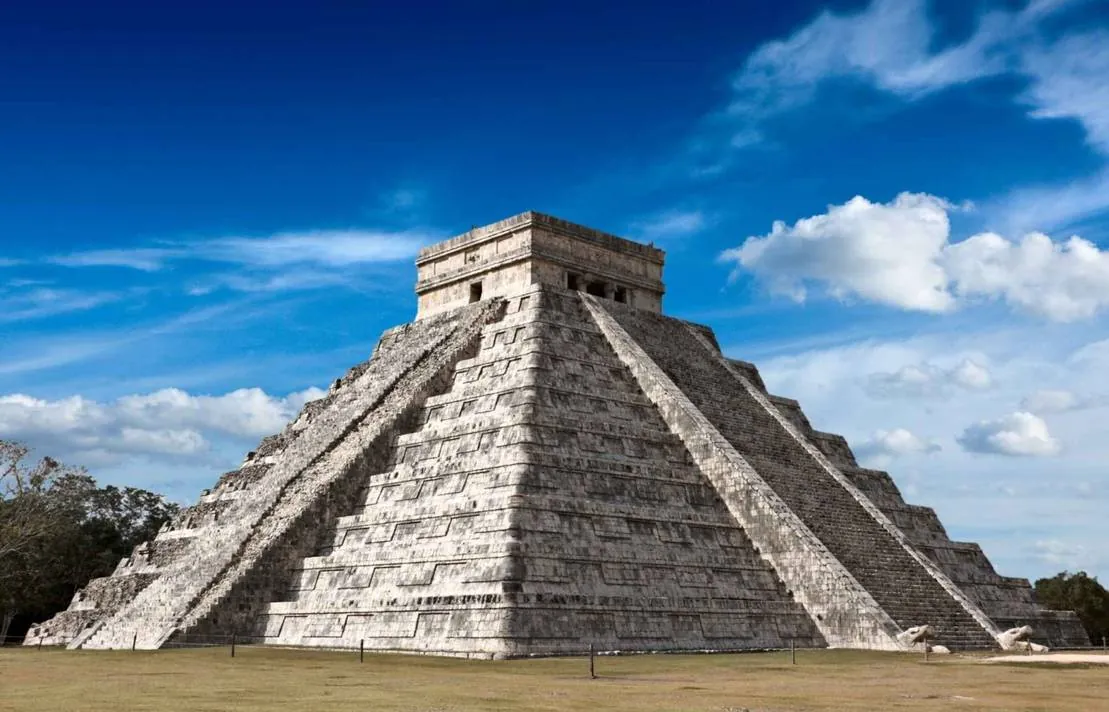
Start with the claim every visitor hears, graded piece by piece, because this is the page where the site's most famous numbers meet their evidence. El Castillo has four stairways. Established arithmeticEach stairway, as restored, has 91 steps; four stairways make 364, and the top platform adds one: 91 × 4 + 1 = 365. That arithmetic is real, and it is documented.
InterpretationWhat does not follow automatically is the intent. The 365 count is the pyramid's restored configuration, the building you count today is the building as archaeologists rebuilt it, and that its builders designed the stairways as a calendar statement is an interpretation: a strong and popular one, but an interpretation, published here at exactly that strength. The same grading covers the companion readings: the 9 terraces split by a stairway into 18, matched to the Haab's 18 months, are attributed interpretations, not documented design. And one version in circulation is simply wrong as stated: there are not "52 panels on the whole pyramid" in the sense the claim needs, the panel counts belong to specific faces and readings, and the full audit, panel by panel, is in the El Castillo guide.
So: is El Castillo a calendar? The honest answer this page gives is the graded one: the numbers are there, in restored stone; the calendar intent is an interpretation of them, and any page that prints the intent as settled fact has gone one step further than the evidence. The equinox light effect on the north stairway is a separate question again, covered on the Chichen Itza Equinox Guide.
Four Counts, Not One
Everything else on this page is an unpacking of one picture. A Maya scribe tracking time at Chichen Itza was not reading a wall calendar with one number on it; he was reading four counts turning at once, like gears of different sizes, and a full date named a position in all of them simultaneously.
The Tzolk'in, the sacred round, turned fastest: a named, numbered day that came round every 260 days (§3). The Haab' turned with the year: 365 days, pegged loosely to the seasons (§4). Run together, the two mesh: because both cycles advance one step per day, a given combination, say, a Tzolk'in day falling on a particular Haab' date, recurs only after 18,980 days, the Calendar Round (§5). And underneath all of it, the Long Count simply counted days from a fixed era base and never repeated at all, the count that lets a carved date be pinned to one moment in millennia (§6). Two further refinements ride along in full inscriptions, a Supplementary Series with the nine Lords of the Night, and a lunar series tracking the Moon, named here for completeness; their mechanics belong to specialist literature, and this page keeps them at that depth.
The Tzolk'in: The 260-Day Sacred Count
EstablishedThe Tzolk'in runs on two wheels turning together: 20 day-names in a fixed order, and the numbers 1 to 13. Each day advances both wheels by one, so a day is a pair, a number and a name, such as 1 Imix', the first name carrying the first number. Because 20 and 13 share no factor, the pair does not repeat until every combination has occurred: 20 × 13 = 260 days, after which 1 Imix' comes round again. This count was the ritual and divinatory heartbeat of Maya time, the count that named days as auspicious or dangerous, and the one still kept by daykeepers today (§13).
Hypothesis: none crownedWhy 260? Here the page must refuse the tidy answer, because scholarship does. The proposed explanations are real and named: the human gestation period (roughly 260–266 days); the scheduling of the maize cycle; the intervals between the Sun's zenith passages at the latitude where the count may have arisen; and numerical relationships to Venus. Each has serious defenders; none is proven, and this page crowns none of them. What is established is the count's age: it predates Chichen Itza by centuries, the city inherited the Tzolk'in; it did not invent it, and no origin story ties its invention to this place.
The Haab': The 365-Day Year
EstablishedThe Haab' is the count that faces the Sun: 365 days, built as 18 months of 20 days, 360, plus a closing period of 5 days, the Wayeb'. A Haab' date is a day-number inside a named month: the machinery is a straightforward solar-year count, and its arithmetic (18 × 20 + 5 = 365) is the one part of the calendar a modern reader will find immediately familiar.
Its one great peculiarity matters for everything that follows: the Haab' has no leap days. None, the "Maya leap year" found on some websites is a myth, and it is banned from this page. A 365-day count against a tropical year of about 365.24 days means the Haab' is a wandering year: it drifts against the seasons by roughly one day every four years, cycling through the full year over about 1,508 Haab'. Maya astronomers knew the true year length closely, the drift was tolerated, tracked by other means, not corrected by inserting days. One further discipline: the Wayeb' days carry a reputation in popular writing as dangerous or ill-omened, drawn largely from colonial Yucatec sources; that "the Wayeb' was evil for all Maya" is an overgeneralisation across regions and centuries, and it is not published here as a general truth.
The Calendar Round: Why Dates Repeat
EstablishedRun the Tzolk'in and the Haab' side by side, advancing both by one each day, and ask when the same pair, the same Tzolk'in day on the same Haab' date, comes round again. The answer is the least common multiple of the two counts: 18,980 days. In the counts' own terms that is 52 Haab' years (52 × 365) and exactly 73 Tzolk'in rounds (73 × 260). That 18,980-day cycle is the Calendar Round, and a date given as a Tzolk'in–Haab' pair is properly called a Calendar Round date.
Two consequences follow, and both shape the rest of this page. First, the limit: a Calendar Round date repeats every 18,980 days, so by itself it cannot identify a year, it says where in a 52-Haab' cycle a day fell, not which cycle. That is precisely why the Long Count was needed for history (§6), and why so many of Chichen Itza's later dates, written in the short form, cannot be pinned to a single year (§9, §10). Second, a piece of arithmetic hygiene this page insists on: 52 Haab' years are not 52 Gregorian years, 18,980 days is about 51.96 tropical years, because the Haab' itself has no leap days. The "52-year cycle" of popular writing is 52 Haab'; converting it silently into Gregorian years is an error, and it is not made here.
The Long Count: Counting Deep Time
EstablishedThe Long Count solves the Calendar Round's problem by the simplest possible means: it counts days, one by one, from a fixed era base, written as five numbers separated by dots: bak'tun, k'atun, tun, winal, k'in. It is a modified base-20 tally: mostly each unit is 20 of the one below, with one famous exception built for the solar year.
| Unit | Equals | In days | Roughly |
|---|---|---|---|
| k'in | 1 day | 1 | – |
| winal | 20 k'in | 20 | – |
| tun | 18 winal, the one step that is not ×20 | 360 | ≈ 1 year |
| k'atun | 20 tun | 7,200 | ≈ 19.7 years |
| bak'tun | 20 k'atun | 144,000 | ≈ 394 years |
The era base, day zero, is written 13.0.0.0.0 and carries the Calendar Round position 4 Ajaw 8 Kumk'u. The tun's 360 days (18 × 20, not 20 × 20 = 400) is the deliberate irregularity: it keeps the tun close to the solar year while the rest of the system stays vigesimal. And one fact to hold for §12: the count does not stop at the bak'tun, higher units exist above it, so a Long Count position can run far beyond 13 bak'tuns in either direction. (The names of those higher units circulate in popular lists; they were not verified to this page's standard, so they are not printed, the fact of the higher units is what the argument needs.) Thirteen bak'tuns, for scale, are 13 × 144,000 = 1,872,000 days, about 5,125 years.
Reading One Date All the Way Through
Here is the machinery of §6 doing real work, on the most important date at Chichen Itza: the Initial Series lintel, carved on a lintel of the Initial Series temple. An Initial Series is a full Long Count date written out with its introductory glyph, and this lintel carries the site's only full Initial Series (Long Count) date Established within the epigraphic corpus(Grube & Krochock 2007; Voss & Kremer). Read it position by position:
Multiply out and add: 10 × 144,000 = 1,440,000; 2 × 7,200 = 14,400; 9 × 360 = 3,240; 1 × 20 = 20; 9 × 1 = 9, a total of 1,457,669 days counted from the era base. Beside the Long Count position, the inscription gives the day's Calendar Round position: 9 Muluk in the Tzolk'in, the day-name Muluk carrying the coefficient 9, and 7 Sak in the Haab', the 7th day of the month Sak. The two systems check each other: a scribe, or a modern epigrapher, can verify the Long Count arithmetic against the Calendar Round pair, because only one day in 18,980 carries both. Converted under the standard correlation (§8), 10.2.9.1.9 falls in 878 CE, the year is the secure part of that conversion; the exact day carries the ±2-day uncertainty the next section explains.
Hold this lintel in mind through §9: it is the exception at Chichen Itza, not the rule. Most of the site's carved dates are shorter, Calendar Round dates, or katun dates, and reading them takes the graded care the inscription table applies.
The Correlation Problem: Why Two Honest Books Disagree
A Long Count date is a day-number, 1,457,669 days from the era base. To turn that number into a Gregorian date you must know which Gregorian day the era base was, and that bridge is called a correlation: a single constant added to the Long Count day-number to land on the modern calendar's own day count. Get the constant right and every inscription converts; get it wrong and every date shifts together.
So when two honest books print dates two days apart for the same inscription, neither has made an arithmetic error: they are using different constants. The discipline this page follows, stated once and applied everywhere: every CE date on this page is given under the standard correlation, 584283, and carries a ±2-day uncertainty at the level of the individual day. Years, at Chichen Itza's distance, are unaffected, 878 CE is 878 CE under either constant. It is the day-level conversions, and any "today's date in the Maya calendar" (§16, FAQ), that inherit the 2-day wobble.
The Dates Actually Found at Chichen Itza
This table is the page's spine: the dated inscriptions of Chichen Itza itself, each with its grade in words. Read the framing sentence exactly as written: the site's dated inscriptions cluster around c. 832–998 CE, a cluster, stated as a cluster, not a claim that every inscription falls inside it. All years are CE, under the standard correlation.
| Inscription | Date | Grade |
|---|---|---|
| Hieroglyphic Jambs, the site's earliest proposed date | 832 CE (an alternative placement in 884 CE has also been proposed) | ReconstructionProposed reading, Grube & Krochock |
| Casa Colorada hieroglyphic band | 869–872 CE (range only, the specific Calendar Round days proposed in secondary summaries conflict, so none is printed) | Reconstruction |
| Halakal inscription | 869 CE | ReconstructionEpigraphic corpus, Pérez de Heredia et al. 2018 |
| Initial Series lintel, 10.2.9.1.9, 9 Muluk 7 Sak; the site's only full Initial Series date (§7) | 878 CE | EstablishedWithin the epigraphic corpus, Grube & Krochock 2007; Voss & Kremer |
| Monjas lintels | 880 CE | ReconstructionEpigraphic corpus, Pérez de Heredia et al. 2018 |
| Four Lintels group (Temple of the Four Lintels) | 881 CE | ReconstructionEpigraphic corpus, Pérez de Heredia et al. 2018 |
| Osario, Pillar 4, two dates on one pillar | 998 CE, twice | Established / reconstructedGraña-Behrens et al. 1999 |
Three disciplines ride with the table. First, the gap in it: the Temple of the Warriors has no securely dated inscription, that is stated exactly, and no Warriors date appears anywhere on this page; assigning the building one of the dates above by association is the commonest quiet error in summaries of the site. Second, the pattern behind the table Reconstruction: in its later phase, Chichen Itza mostly wrote Short Count, katun, dates rather than full Long Counts, which is why the full Initial Series of 878 CE stands alone and why the later dates lean on the katun wheel of §10. Third, the standing caution, printed with every such table on this site: an inscription's date is not automatically its building's construction date, a lintel can be carved for an event, a dedication, or an anniversary, and a date can be older or younger than the walls around it.
The dates on this page are carved on buildings you can still stand in front of; the visitor guide to Chichen Itza puts each one in the order the site presents them.
The Katun Wheel: The Wheel That Eats Single Years
Established mechanicsA k'atun is 7,200 days, about 19.7 years. In the Short Count used at later Chichen Itza, a date was given by the katun a day fell in, and every katun is named for its ending day. That ending day is always an Ajaw day in the Tzolk'in, and its coefficient follows a strict pattern: because 7,200 leaves a remainder of 11 when divided by 13 (7,200 mod 13 = 11, which is −2 in a 13-cycle), each successive katun ends on an Ajaw whose number has stepped down by 2:
Thirteen katuns complete the wheel: 13 × 7,200 = 93,600 days, about 256 years, and then a Katun 4 Ajaw, or any other named katun, comes round again. That recurrence is not a curiosity; it is a mechanism with a consequence this site states on more than one page: a katun date cannot be pinned to a single year, because the same name returns every ~256 years. It is the mechanical reason the Itza arrival dates in the Maya chronicles convert to years 200 and more years apart, the chronicles name a katun, and the wheel offers several centuries it could belong to. The history itself, the chronicles, the traditions, the disputed conversions, is told on The Itza: The People Who Built Chichen Itza; this page owns only the mechanism. And one confusion to refuse outright: the 13-katun wheel (~256 years) is not the 13-bak'tun span of §12 (~5,125 years). Same number 13, different units, different wheels.
Venus and the Dresden Codex
Venus was the calendar's precision instrument, and the place where Maya arithmetic is most impressive, provided it is stated exactly. EstablishedVenus's true average synodic period, its cycle of appearances as morning and evening star, is 583.92 days. The Maya conventional count was 584 days: a schematic value, chosen because it meshes beautifully with the Haab'. The word "schematic" is printed out loud on this page because it is the truth of the matter: 5 × 584 = 8 × 365 = 2,920 days, while five true Venus cycles run about 2,919.6 days. The scheme drifts slowly against the real planet, and the table's keepers managed that drift; what they built was a working model, not a perfect one, and it is more impressive stated honestly.
The instrument is the Venus table of the Dresden Codex, which divides each 584-day cycle into four phases: Venus as morning star, its disappearance at superior conjunction, its return as evening star, and its brief disappearance at inferior conjunction:
Left to right: 236 days as morning star, 90 days absent at superior conjunction, 250 days as evening star, and 8 days absent at inferior conjunction, 236 + 90 + 250 + 8 = 584 days; the final 8-day phase is the thin band at the right end. The full table runs 37,960 days = 65 Venus periods = 104 Haab' (Bricker & Bricker 2011), a century of Venus, reconciled with the solar year on a single set of manuscript pages: pages 24 and 46–50 of the Codex (SLUB Dresden).
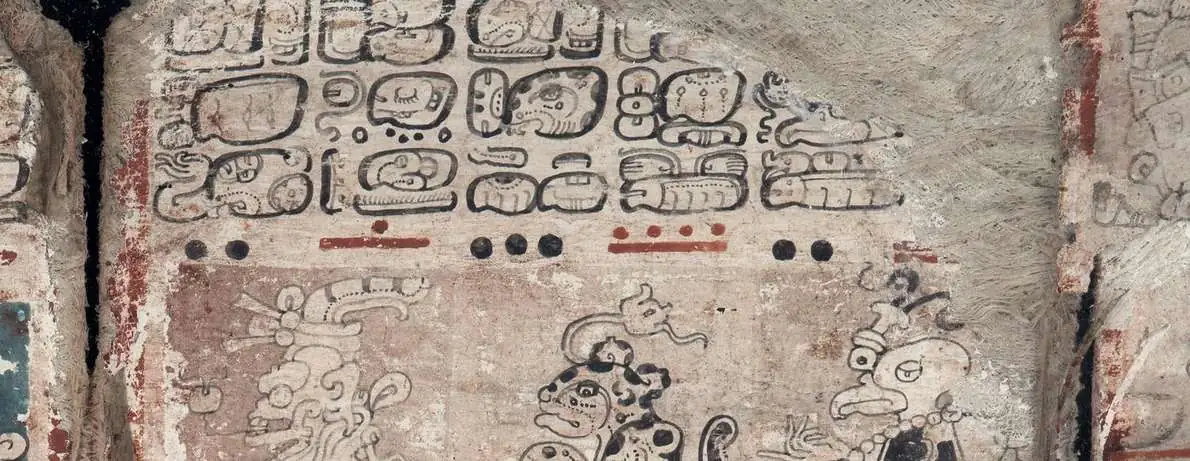
Two disciplines close the section. First, provenance: the Dresden Codex is not from Chichen Itza. It is a Postclassic manuscript, probably from northern Yucatán; no narrow production date is published on this page, because the proposed ranges in circulation conflict and neither met this page's standard. Second, practice: that Venus's morning-star appearances carried timed ritual weight is a scholarly interpretation(Milbrath), supported, argued, and published here as an interpretation. The flat version in circulation, that priests simply "sacrificed when Venus rose", is not a fact and does not appear here as one. For Venus measured in stone rather than on paper, the window diagonals of El Caracol, which frame Venus setting at its extremes, see the El Caracol guide.
What Happened on 21 December 2012?
A period ended. That is the whole event, and it is enough. Under the standard correlation, 21 December 2012 carried the Long Count position 13.0.0.0.0, 4 Ajaw 3 K'ank'in: the completion of the 13th bak'tun, 1,872,000 days from the era base. A bak'tun ending is a period ending, of the same kind the Maya marked at every k'atun and bak'tun completion for centuries, and the count itself continues past it: the Long Count has higher units above the bak'tun (§6), positions run on beyond 13.0.0.0.0, and the tally did not stop, complete, or run out in 2012. It is still running.
The positive evidence runs the same way. Maya inscriptions themselves project dates far beyond 2012, most famously, a calculation in Palenque's Temple of the Inscriptions reaches the year 4772 CE, millennia after the 13th bak'tun closed (the year is agreed; this page publishes no exact day for it). And the one ancient text that does mention the 2012 date says nothing about an ending of anything: Tortuguero Monument 6, from Tabasco, not from Chichen Itza, refers to the 13th bak'tun's completion with a passage invoking the deity Bolon Yokte' K'uh. That passage is damaged and fragmentary, and its reading is disputed among epigraphers; it is published here as exactly the fragment scholars actually have, with interpretations named as interpretations, never as a doomsday text, because as a text it cannot carry that weight.
Scholarly consensusNo Maya source predicts an apocalypse, not for 2012, not for any date. That is the stated consensus of the epigraphers who read these inscriptions (scholars such as David Stuart and Stephen Houston), and of the Smithsonian, the Met and INAH. The modern 2012 phenomenon, the books, the films, the countdown, is a late-20th-century popular creation, layered onto a real Maya period ending by writers outside the inscriptions. It deserves a sentence of respect for the genuine public curiosity it carried into Maya studies; it does not get a paragraph of mockery here, and it never gets presented as a Maya teaching.
The Calendar Today: Kept by Named People, in a Named Place
The 260-day count is not only an artefact. Documented living practiceIn the highlands of Guatemala, K'iche' Maya daykeepers, Ajq'ijab', keep the 260-day count today: the Chol Q'ij, consulted for divination, naming, planting and the timing of ceremonies, with Wajxaqib' B'atz' (8 B'atz') kept as a renewal observance in the count's cycle (Smithsonian, Living Maya Time; Tedlock 1992). These are named people keeping a named practice in a named place, which is exactly the form a continuity claim has to take to be published on this page.
And the two claims that do not get made, stated plainly so their absence is a decision and not an oversight. This page does not claim that every Maya community keeps an identical, unbroken calendar practice, practices vary by community and history, and the smooth phrase "an unbroken chain" papers over real ruptures, including a conquest. And it makes no continuity claim for Chichen Itza itself: the counts were carved here a thousand years ago, and the living keeping of them documented today is Guatemalan highland practice. Both things are true at once, and the page holds both.
What You Can Actually See at Chichen Itza
Honesty about the visit itself, because calendar pages usually skip it. The dated inscriptions of §9 are lintels and jambs, carved stone beams and doorframes, in buildings you view from outside, several of them high, weathered, or in structures whose interiors are not entered on an ordinary visit. Nobody reads a Long Count date off a wall during a tour, and a guide who points at a random glyph band and "reads the date" is performing, not reading. Epigraphers work from photographs, drawings and squeezes, over months; the dates in the table were established that way.
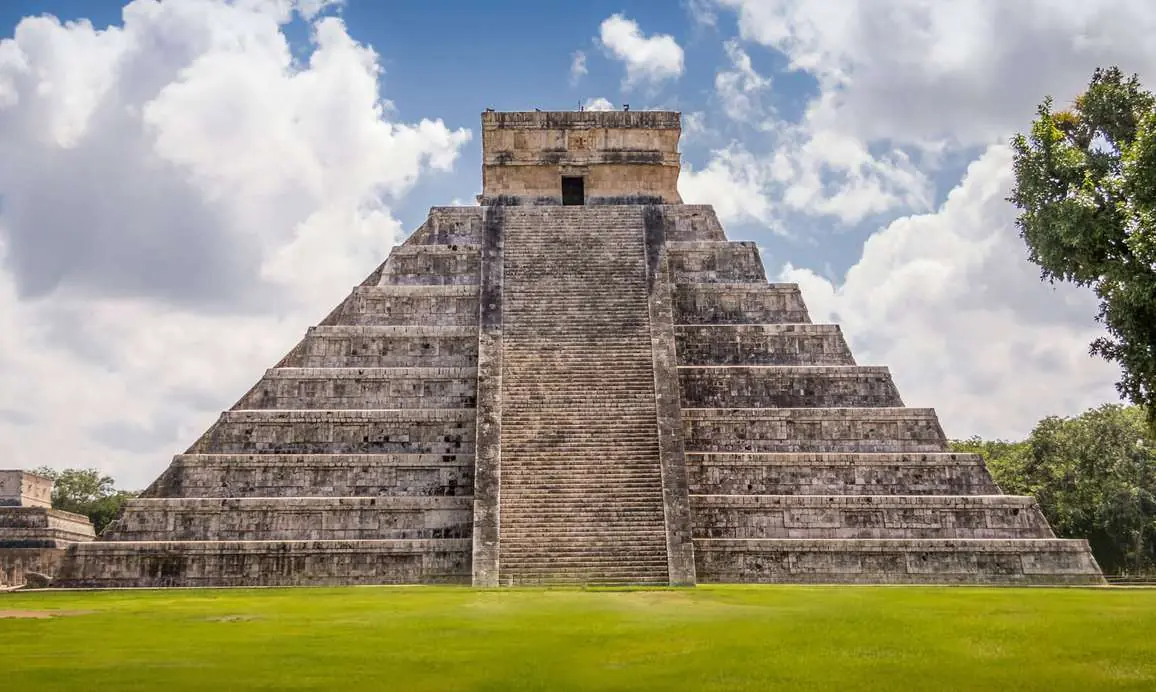
What you can see is the calendar in the architecture, at its graded strength: El Castillo's nine terraces and four stairways (§1, arithmetic established, intent interpreted), El Caracol's window slits (§11), and the sheer fact of the dated lintels in the Monjas and Initial Series buildings, whose dates anchor the site's chronology. Read that way, numbers first, meanings labelled, the site is more interesting, not less: you are standing in a city that wrote its own dates into its doorways and then, in its later years, switched to a shorter count whose wheel still frustrates historians today (§10).
See It on the Shared Tour
Our shared tour is a day trip to Chichen Itza, a swim at Cenote Ik Kil, and a stop in Valladolid, $130 per adult, $115 per child up to age 12, with the 697 MXN Chichen Itza entrance fee included in that price. We pick you up from your own hotel or pickup point, and your exact pickup time is confirmed on WhatsApp the night before. To reserve, a 30% advance is paid, with the balance on the day of the tour; cancellation is free up to 48 hours before the tour, with the advance refunded in full. We are a new operator, and we say so plainly.
City pages: Chichen Itza tour from Cancun · from Tulum · from Playa del Carmen
Price calculator
The 697 MXN Chichen Itza entrance fee is already included in these prices, so there is nothing extra to pay for entry at the gate.
The Maya Calendar: Frequently Asked Questions
How does the Maya calendar work?
It was not one calendar but several counts running at once. The 260-day Tzolk'in paired 20 day-names with the numbers 1 to 13; the 365-day Haab' tracked the solar year; the two meshed into a Calendar Round of 18,980 days; and the Long Count tallied days from an era base, 13.0.0.0.0, so any day could be fixed uniquely in deep time. A full date combined them all.
What is the difference between the Tzolk'in and the Haab'?
The Tzolk'in is the 260-day sacred count: 20 named days cycling against the numbers 1 to 13, used for ritual and divination. The Haab' is the 365-day year: 18 months of 20 days plus the 5 closing Wayeb' days, tracking the seasons. Both counts are established; why the Tzolk'in runs 260 days is unknown, gestation, maize scheduling and Venus relationships are hypotheses, none proven.
What is the Calendar Round?
The Calendar Round is the cycle formed by the Tzolk'in and Haab' running together. Because the two counts mesh, the same paired date, a Tzolk'in day together with a Haab' position, comes round every 18,980 days: 52 Haab' years, or 73 full Tzolk'in rounds. That is also its limit: a Calendar Round date repeats, so by itself it cannot say which 52-Haab' span a date fell in.
How long is a katun?
A k'atun is 7,200 days, about 19.7 years. In the Long Count it sits above the 360-day tun and below the 144,000-day bak'tun. Thirteen k'atuns make the katun wheel of 93,600 days, roughly 256 years, after which the same katun name, always an Ajaw day, its number stepping down by 2, comes round again.
Did the Maya predict the end of the world in 2012?
No. No Maya source predicts an apocalypse. Under the standard correlation, 21 December 2012 was 13.0.0.0.0, the completion of the 13th bak'tun, a period ending in a count that has higher units and continues; Maya inscriptions project dates thousands of years beyond it, one at Palenque reaching the year 4772 CE. That is the scholarly consensus, stated by epigraphers and by the Smithsonian, the Met and INAH.
Is El Castillo a calendar?
Partly, at graded strength. Its four stairways of 91 steps plus the top platform make 365, but that is the pyramid's restored configuration, and that the count was intended as a calendar statement is an interpretation, not a documented fact. The same grading applies to readings of its 9 terraces as twice 18, the Haab' months. The full audit is on this site's El Castillo guide.
What is the oldest date found at Chichen Itza?
The earliest proposed date is 832 CE, from the Hieroglyphic Jambs, and 'proposed' is the honest word: it is a reconstruction (Grube and Krochock), and an alternative placement in 884 CE has also been proposed. The earliest full Long Count date at the site is the Initial Series lintel, 878 CE. The site's dated inscriptions cluster around c. 832–998 CE.
What is the Dresden Codex?
The Dresden Codex is a Postclassic Maya manuscript, a folding bark-paper book holding, among other tables, the famous Venus table on pages 24 and 46–50. It is probably from northern Yucatán, and it is not from Chichen Itza. Its Venus arithmetic is real Maya astronomy of the highest order: a schematic 584-day cycle against the true period of about 583.92 days.
Why do different books give different dates for the same Maya inscription?
Because converting a Long Count date into a Gregorian one needs a correlation constant, and two are in circulation. The scholarly standard is the GMT correlation, most often used as the constant 584283; a documented variant, 584285, shifts every converted date by 2 days. So two honest books can print dates 2 days apart for the same inscription, and every date on this page is given under the standard correlation with that ±2-day uncertainty.
Is the Maya calendar still used today?
Yes, in a specific, named form. In highland Guatemala, K'iche' daykeepers called Ajq'ijab' keep the 260-day count, the Chol Q'ij, today, with Wajxaqib' B'atz' as a renewal observance (Smithsonian, Living Maya Time). What this page does not claim is that every Maya community keeps an identical, unbroken practice, or any continuity of calendar-keeping at Chichen Itza itself.
What is today's date in the Maya calendar?
It is derived, not looked up: count the days from the era base 13.0.0.0.0 and convert with the standard GMT correlation (constant 584283), then read off the Long Count position, the Tzolk'in day and the Haab' position together. A caution rides with any answer: the 584285 variant shifts the result by 2 days, so a bare date with no method stated is not a complete answer.
¿Cómo funciona el calendario maya?
No era un solo calendario, sino varias cuentas a la vez: el Tzolk'in de 260 días (20 nombres de días con los números del 1 al 13), el Haab' de 365 días (18 meses de 20 días más los 5 días Wayeb'), su combinación en la Rueda Calendárica de 18,980 días, y la Cuenta Larga, que contaba los días desde una base, 13.0.0.0.0, y permitía fijar cualquier día en el tiempo profundo.
Check Your Date on WhatsApp
Booking opens on WhatsApp, that is where your date is checked, your pickup point is set, and your exact pickup time is confirmed the night before the tour. Send one message with:
- Your tour date
- Your pickup city and hotel or pickup point
- How many adults and children (to age 12)
$130 per adult · $115 per child · 697 MXN entrance fee included · 30% advance to reserve · free cancellation up to 48 hours before.
Start with your date
One tap opens the conversation. Prices above are the full per-person prices, the entrance fee is already in them.