Chichen Itza Visitor Guide: What to See, the Rules and What to Bring
Visiting Chichen Itza takes one decision and a short list of preparations. The decision: be at the gate for the 8:00 AM opening, when the site is quiet and the heat is still low. The preparations are on this page, the seven stops in walking order, how long each part takes, the site rules in full, the exact what-to-bring checklist, and the weather by month. Plan 2–3 hours inside for the main circuit, carry water and pesos, and the visit runs itself.
Planning Your Visit: The Essentials
Chichen Itza opens at 8:00 AM, every day of the year. That opening hour is the single most useful fact on this page: the first two hours are the quietest, with the heat at its lowest, and everything else in this guide works better if you start then. The site received about 2.25 million visitors in 2024, and nearly all of them arrive between 10 AM and 2 PM, the crowd is a timing problem, and timing is yours to choose.
Entry for foreign visitors is 697 MXN: 105 MXN to INAH plus 592 MXN to CULTUR, charged as one Boleto Único ticket at the CATVI visitor centre since 27 March 2026. That is the whole fee; the full tariff for every visitor category, with dates and sources, is on our Chichen Itza tickets and entrance fees page.
About closing time: read this before you plan an afternoon visit: INAH's own listings do not agree. Most official listings give last entry at 4:00 PM, and a second INAH listing gives 3:00 PM. We will not print a single settled closing time, because there isn't one. Plan to be inside by mid-afternoon and you are safe under either version.
Sundays: the site is open, and free Sunday entry applies to Mexican citizens and residents showing ID. Foreign visitors pay the full 697 MXN every day of the week, Sundays included, and Sunday is the busiest day of the week for exactly that reason.
Watch the clock if you are coming from the coast. Chichen Itza sits in the state of Yucatán, which keeps UTC-6 all year. Cancun, Tulum and Playa del Carmen in Quintana Roo are one hour ahead, your phone may still be showing coast time when you arrive, and that cuts in your favour if you catch it: when a coast clock reads 8:00 AM at the gate, Yucatán time is still only 7:00 AM. Set your watch back an hour when you cross into Yucatán, and plan the opening by the gate's clock, not your hotel's. Coming for the opening? The full early-arrival playbook is on our early access guide.
Best day to go: a weekday. Weekdays are quieter than Sundays, and on any day the opening beats midday. There is no single magic day. There is a magic hour, and it is 8:00 AM.
The Walking Route: What to See at Chichen Itza, in Order
Chichen Itza rewards a route. The structures below are in the order you naturally meet them walking from the main plaza, north group first, then the sacbé causeway to the Sacred Cenote, then back south to the older southern group. Timings are planning estimates for an unhurried visit, not quotas: linger where the site holds you. Two ways to walk it: the short route covers stops 1–4 in about 1.5–2 hours; the full circuit adds stops 5–7 and runs 2–3 hours at a normal pace.
Behind every building stands the people who raised it, the Itza who built Chichen Itza follows what is actually known about them.
-
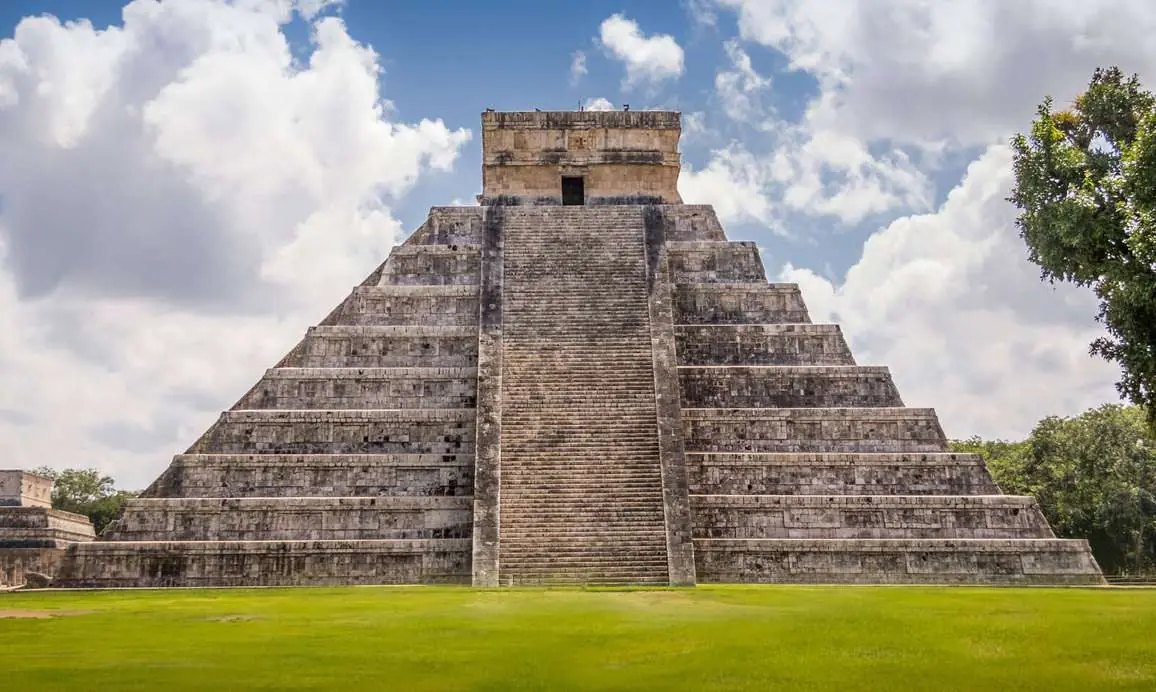
El Castillo: the Temple of Kukulkan
The pyramid at the centre of everything, and the building Chichen Itza is famous for. It stands 30 metres tall in total: a 24-metre stepped pyramid carrying a 6-metre temple on top, with a base of about 55.5 metres per side and nine terraced levels. Traditionally, its four staircases of 91 steps plus the summit platform are read as a 365-step calendar in stone; treat that as the traditional interpretation guides have long given it, not a proven fact.
Look for: the serpent balustrades at the foot of the north staircase, and how the pyramid's shadow changes through the morning. You view it from the plaza, a distance of about 15 metres from the base is enforced, and that roped distance is what keeps the classic photo clean.
Each part of the site repays a slower look, El Castillo, the Temple of Kukulcan takes it building by building.
The serpent on the pyramid is a calendar event, the Maya calendar at Chichen Itza explains the counts behind it.
-
The Great Ball Court
Walk north-west from El Castillo to the largest ball court in Mesoamerica: 168 × 70 metres of playing alley between two massive parallel platforms, with carved panels along the benches and stone rings set high on the side walls. The scale is the point, this was ceremony as much as sport, played before the whole city.
Look for: the carved panels showing players in heavy padding, and the ring high on the wall, then stand at one end and clap. The court is known for an acoustic quirk: a clap at one end can return as a chirp-like echo down the alley. Try it once; it is an on-site curiosity, not a guaranteed performance.
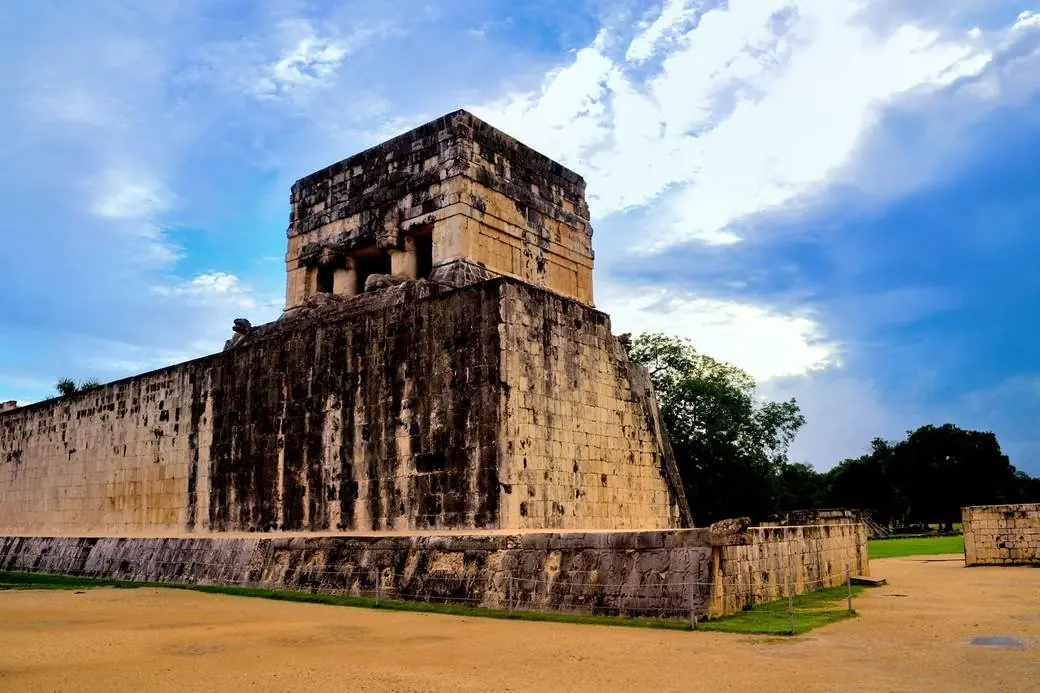
The court's scale is its own subject, the Great Ball Court takes it end to end.
-
Temple of the Warriors and the Group of a Thousand Columns
East of the main plaza stands the site's second great set piece: a stepped temple fronted and flanked by long colonnades of carved pillars, the Group of a Thousand Columns. "Thousand" is the conventional name, not a count; what is real is the forest of columns, each carved with warriors and figures, running in rows beside the temple. A Chac Mool figure reclines at the top of the temple stairs.
Look for: the detail on individual columns, no two read exactly alike up close. On the way here you pass two smaller stops worth five minutes each: the Tzompantli, the Wall of Skulls platform carved with rows of skulls, and the platforms of Venus and the Eagles and Jaguars beside the ball court.
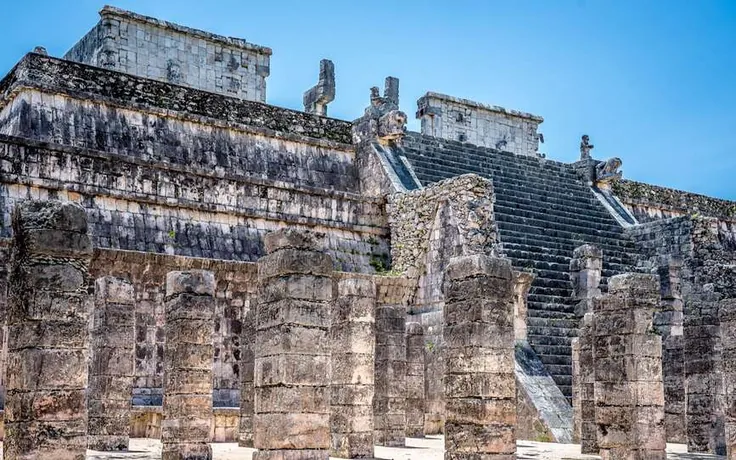
The colonnades repay the same slow treatment, the Temple of the Warriors and the Thousand Columns walks the complex row by row.
-
The Sacred Cenote
From the plaza, a sacbé, a raised Maya causeway, runs north to the Sacred Cenote, the great natural well the city was named for: "the mouth of the well of the Itza." It is roughly 60 metres across, a sheer-walled sinkhole whose still, green water sits far below the rim; the maximum recorded water depth is about 13.5 metres. This was a ceremonial offering site, where objects of gold, jade and copal were given to the water.
Look for: the small ruined structure on the rim and the steam-bath building nearby. And be clear about the rule: the Sacred Cenote is viewing only, nobody swims here. The swimming cenote on a Chichen Itza day is Ik Kil, a few kilometres away.
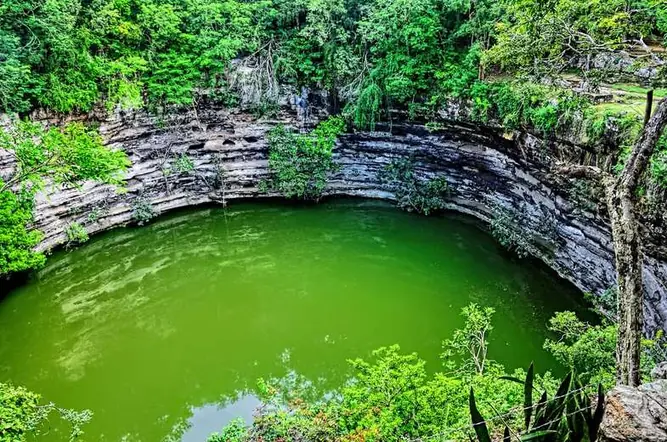
The wells themselves begin with an impact, the Chicxulub crater and the ring of cenotes explains the geology under the whole peninsula.
What happened at the Sacred Cenote is an evidence question, not a legend, Maya ritual and sacrifice: what the evidence shows grades what was recovered and what it proves.
-
El Caracol: the Observatory
Cross back to the southern group for the strangest building at Chichen Itza: a round tower on two rectangular platforms. "Caracol" means snail, for the spiral staircase inside. The tower's narrow window slits are associated with observations of Venus, Maya astronomers tracked the planet's cycles with famous precision, though exactly how the building was used is still argued, so take the full "observatory" story as the leading reading rather than settled fact.
Look for: how the round tower breaks every straight line around it, nothing else at the site is built like this.
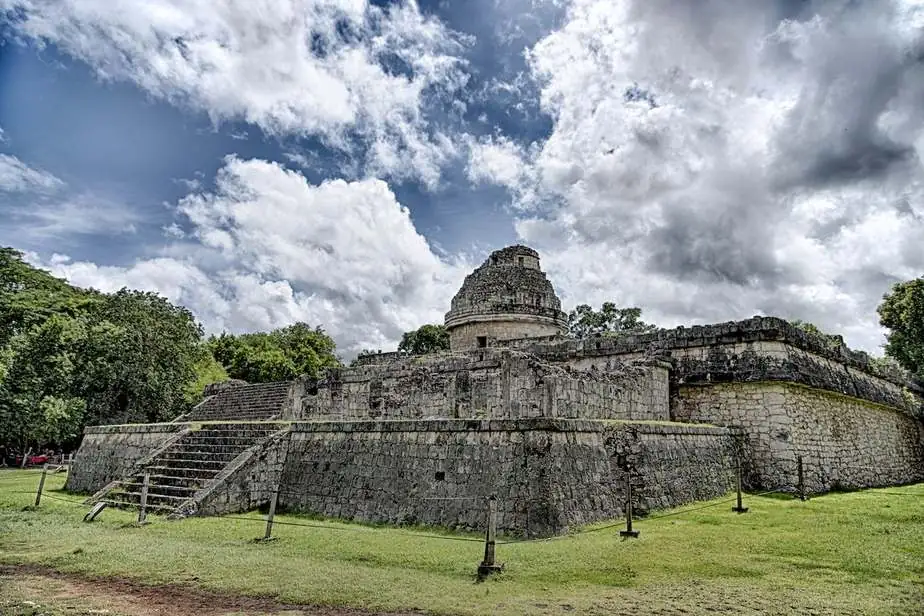
For the building that watched the sky, El Caracol, the observatory takes it sightline by sightline.
-
The Osario: the High Priest's Grave
A smaller stepped pyramid near El Caracol: four staircases, seven levels, and a shaft running down through its core. "Osario" means ossuary, and the traditional name claims a high priest's burial inside, the identity of any burial here is not verified, so read the name as a label from the site's early exploration, not a confirmed tomb. It is the quietest pyramid on the route and most visitors walk straight past it.
Look for: the serpent heads at the staircase bases, echoing El Castillo in miniature.
The platforms beside the court carry the site's hardest imagery, the Tzompantli, Platform of Venus and Osario takes them one by one.
-
Las Monjas: the Nunnery Complex
The route ends at the southern group's richest carving: a complex of Puuc-style buildings and courtyards covered in lattice work and Chaac rain-god masks with their long hooked noses. "Las Monjas", the Nunnery, is a colonial Spanish nickname; the complex was no convent, and the name survives only because the courtyard layout reminded the Spanish of one.
Look for: the east wing's facade, where the Chaac masks stack in rows, the finest stone carving at Chichen Itza is here, not at the pyramid.
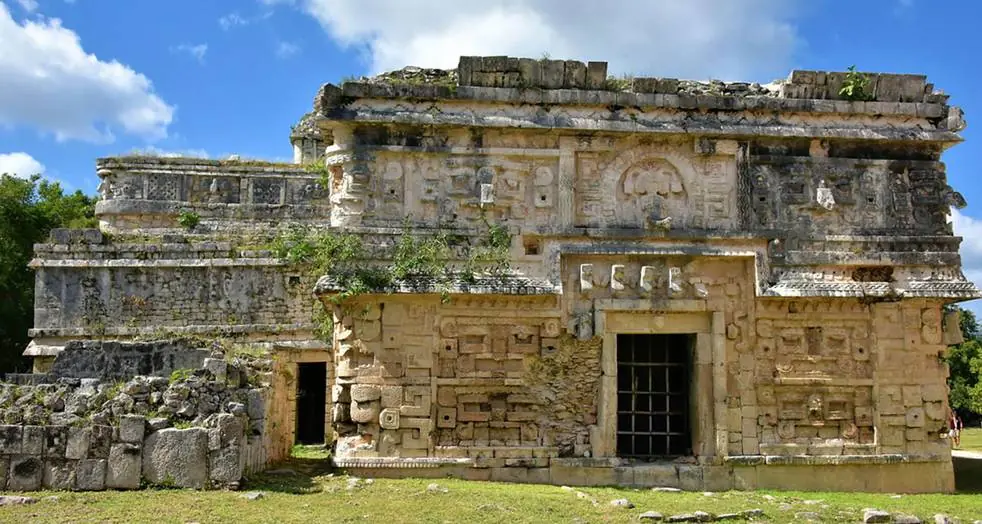
How much of what you see is Maya and how much Toltec is still argued over, the Toltec influence debate weighs the parallels building by building.
The famous title comes with fine print, what the New7Wonders title actually means separates the 2007 vote from the site's UNESCO inscription.
How Long Do You Need at Chichen Itza?
The standard visit is 2–3 hours on site: the full main circuit of all seven stops at a normal pace, with photo stops and water breaks. Highlights alone take 1.5–2 hours, and adding the southern group and the Gran Museo stretches the visit to 3.5–5 hours. The main circuit is roughly 3–4 km on foot, on limestone and gravel paths in almost entirely open sun. For the full breakdown by visit type, see how long you need at Chichen Itza.
Chichen Itza Rules: What Is and Isn't Allowed
No climbing is allowed on any structure at Chichen Itza, El Castillo included: everything is viewed from the paths outside, and you cannot go inside the pyramid either. Bags are the unsettled point: reports conflict on size limits and storage cost, INAH has published no bag rule, and bags are checked at entry, so travel light and keep your bag small. Food is prohibited on entry under INAH rules, but a water bottle is the practical exception everyone relies on in this heat. The complete rule-by-rule picture is on our Chichen Itza rules page.
What to Bring and What to Wear
Pack for sun, distance and cash: closed-toe walking shoes with grip, light breathable clothing in pale colours, a wide-brim hat, SPF 50+ sunscreen and 1–2 litres of water per person, plus pesos in cash, because the site is an open, unshaded walk of roughly 3–4 km and the card terminals at the ticket booths can drop offline. The full checklist, item by item, is on our what to wear and bring to Chichen Itza page.
Best Time of Year to Visit: Weather by Month
On the site’s own visitor figures (INAH 2025 totals), July is the busiest month of the year at Chichen Itza and October the quietest. November to February is the most comfortable window, though daily maxima still run around 31°C, so the hat and water rules apply in every month; June to October is the rainy season, when mornings are usually clear and the rain arrives as short, heavy afternoon downpours. The month-by-month breakdown of temperature, rainfall and crowds is on our best month to visit Chichen Itza page.
Arriving: Entry Through the CATVI Visitor Centre
Since 27 March 2026, every visit to Chichen Itza starts at the CATVI: the tourist attention and visitor centre opened by the Government of Yucatán beside the Gran Museo. This is where you buy the Boleto Único, the single ticket that replaced the old two-queue system: one payment of 697 MXN covering the 105 MXN INAH fee and the 592 MXN CULTUR fee for foreign visitors. Keep the ticket, it also includes the museum.
Bring pesos. Card terminals at the booths can drop offline, and when they do, the queue that moves is the cash queue. With roughly 517 parking spaces in the CATVI area, driving visitors park here too: parking costs 124 MXN per car under the CULTUR tariff of February 2026.
The vendors have moved. In 2026 the souvenir vendors who once lined the paths inside the ruins were relocated to the CATVI market. That relocation was the cause of the site's longest recent closure: Pisté artisans, merchants and tour guides blockaded the site in protest over the forced move to the new CATVI visitor centre, beginning the night of 18 May 2026, and INAH closed the ruins preventively from 19–31 May 2026 (13 days). The site reopened on 1 June 2026 under an agreement between INAH, the Government of Yucatán, the Municipality of Tinum and the artisans, and since that reopening access has been exclusively via the CATVI visitor centre (INAH Boletín 227, 31 May 2026). The practical result for you: the shopping now happens at the visitor centre, and there is no vendor gauntlet inside the ruins any more. The walk from the CATVI to the ruins themselves is close to a kilometre, so your visit's walking starts before the first pyramid.
Arriving by train? The Tren Maya station is about 5 km from the site, with an onward connection to the ruins, plan that leg before you arrive, not at the platform. Coming by road from any direction, the transport breakdown lives on our how to get to Chichen Itza page.
The Gran Museo Chichen Itza
The Gran Museo, beside the CATVI, is the museum of the site itself, and the part most visitors miss: entry is included free with your day ticket. Its exhibits cover the Maya history of Chichen Itza and display artefacts from the city, the context that turns the stonework outside from impressive into legible.
When to fit it in: at the end of your circuit, not the start. Walk the ruins in the morning, while the heat is low, then give the museum 45–60 minutes before you leave, it is built into the 3.5–5 hour "site + museum" plan in the table above, and it is air-conditioned, which at midday is its own argument. One honesty note: published museum opening hours conflict between sources, so rather than print one we could not stand behind, check the day's museum hours at the CATVI when you arrive.
If something goes missing during the visit, lost something on your visit sets out the order to work in, the tour thread first, then the site's own channels.
On-Site Practicalities
Shade: almost none. The plaza and the main paths are open to the sky; shade exists at the site edges under the trees, which is where everyone ends up resting. Plan your water and hat around zero shade, not some shade.
Water and facilities: services, toilets, food and drink, are concentrated at the CATVI visitor centre, outside the ruins. Inside the archaeological zone you are on your own with what you carried in, which is why the checklist leads with water. Benches and rest spots are scattered along the paths; the shaded edges of the plaza and the trees near the southern group are the natural pauses.
The ball court clap: the one on-site ritual worth doing, stand at one end of the Great Ball Court and clap once. The alley's acoustics can throw the sound back as a strange chirping echo. It does not work every time or for everyone, and that is fine: it is a curiosity of the architecture, not an attraction with a schedule.
The five first-timer mistakes
- Arriving at midday: peak crowds and peak heat in the same hour. Everything about this site is better at 8 AM.
- Carrying no water: there is no shade and no shop on the circuit; 1–2 litres per person.
- Wearing the wrong shoes: flip-flops on gravel and wet limestone are how visits end early.
- Carrying no cash: terminals drop offline; pesos do not.
- Trusting your coast clock: Yucatán runs an hour behind Quintana Roo, so the time on your phone is not the time at the gate. Set your watch to local time the night before an early start.
Is Chichen Itza worth it, after all these caveats? Yes, plainly. It is a UNESCO World Heritage Site and one of the New7Wonders of the World, and visitors who arrive early, carry water and give it the full circuit consistently say the same thing: the pyramid is bigger, the ball court stranger and the carving finer than the photos prepare you for. The caveats are not warnings against going; they are the difference between going well and going badly.
Once you are through the entrance, inside Chichen Itza: the practical guide covers toilets, water, shade and the museum in the order you meet them.
For the camera, the best photo spots at Chichen Itza works through the viewpoints and the rules that govern them.
Visiting with Kids, and Accessibility
With kids: the site works for children who can walk the circuit, roughly 3–4 km, with the ball court clap, the serpent shadows and the Sacred Cenote's drop doing most of the entertaining. The discipline is the adults' checklist, doubled: kids dehydrate and burn faster, so their hat, sunscreen and water matter more, not less. For small children, a carrier beats a stroller: the paths are limestone and gravel, uneven in places, and wheels lose to the ground here. Go at the opening, before the heat peaks, and the visit is sized to a family.
Families meet the same site with different constraints, visiting Chichen Itza with kids covers the gate rules, the shade problem and the cenote with children.
Accessibility: be honest with yourself about the terrain before you plan around it. The paths are limestone and gravel and uneven in places, and distances are real, the circuit runs to several kilometres with the CATVI walk on top. The main plaza area is the most step-free part of the site: El Castillo, the ball court and the Warriors can all be seen from the plaza level without climbing anything. The bigger barriers at Chichen Itza are not steps, they are heat and distance. An early start, the plaza stops alone (1–3, all plaza-level), and rest in the shade at the plaza edges make a highlights visit manageable for many visitors with limited mobility.
Step-free judgements here are graded, never blanket, visiting with a wheelchair or limited mobility works through the entrance, the paths and Ik Kil honestly.
Do You Need a Guide?
No, a guide is not required at Chichen Itza, and the walking route on this page is written to work self-guided: seven stops, in order, with what to look for at each. What a good guide adds is not access but meaning: the carved panels read aloud, the calendar and Venus stories attached to the buildings they belong to, and answers to the questions the stones raise. A guided walk of the main circuit typically runs 1.5–2 hours.
If you want one, hire properly: licensed guides work at the site, and the checks that matter, the federal SECTUR credential, INAH authorisation, and the going per-group rate, are laid out on our Chichen Itza guided tour page. On the shared tour below, whether a guide walks the site with your group is confirmed in writing on WhatsApp when you book, nothing about it is assumed.
Seeing Chichen Itza on the Shared Tour
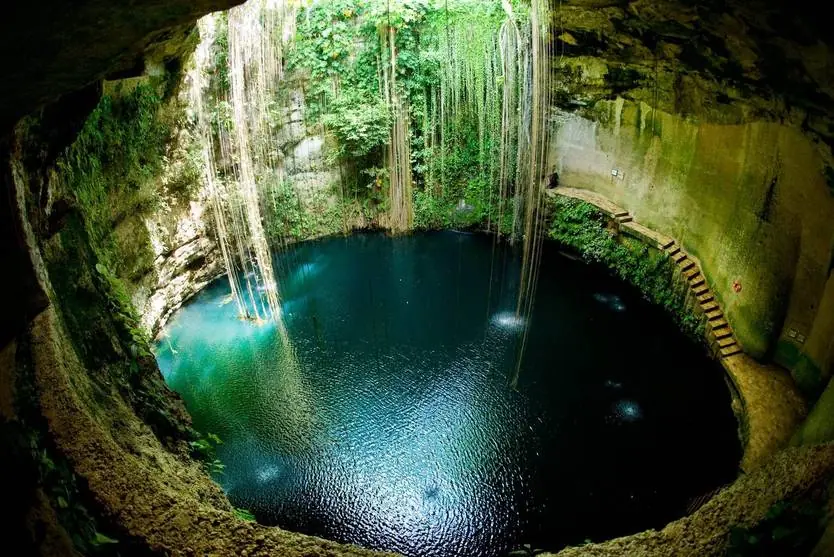
Everything this guide describes, handled for you. Our shared tour runs the day in the order this page recommends: Chichen Itza first, while the site is at its best, then the swim at Cenote Ik Kil: the cenote you can actually swim in, 3 km from the ruins, and Valladolid as the colonial stop of the day, covered in its own Valladolid guide.
- $130 per adult, $115 per child (children up to age 12)
- The 697 MXN Chichen Itza entrance fee is included in that price, no second queue, no surprise at the gate
- Pickup from your own hotel or point: the exact pickup time is confirmed on WhatsApp the night before
- 30% advance to reserve, balance on the day of the tour
- Free cancellation up to 48 hours before the tour, with the advance refunded in full
- Guide and lunch: the guide arrangement and lunch details are confirmed in writing on WhatsApp with your booking, ask in the chat and it is settled before you travel
Price your day
Shared tour: Chichen Itza + Cenote Ik Kil + Valladolid. Entrance fee included.
Chichen Itza Visitor Questions, Answered
What time does Chichen Itza open?
Chichen Itza opens at 8:00 AM every day of the year. Arrive for the opening if you can: the first two hours are the quietest of the day, with the heat at its lowest, well before the big tour buses arrive.
Can you climb Chichen Itza?
No. Climbing the structures at Chichen Itza is prohibited, you cannot climb El Castillo or any other building, and you cannot go inside the pyramid either. If climbing a Maya pyramid is on your list, Ek Balam and Cobá still allow it.
Can you go inside the pyramid at Chichen Itza?
No. The interior of El Castillo is closed to visitors, like every structure at Chichen Itza, everything is viewed from the paths outside. You see the pyramid from the plaza, and that view is the experience.
How many hours do you need at Chichen Itza?
Plan 2–3 hours for the main circuit, El Castillo, the Great Ball Court, the Warriors and the Sacred Cenote. Highlights alone take 1.5–2 hours; add the southern group and the Gran Museo and you need 3.5–5 hours.
What should I wear to Chichen Itza?
Closed-toe walking shoes with grip, light breathable clothing in pale colours, and a wide-brim hat. The site is almost entirely unshaded, so dress for full sun, long sleeves or UPF fabric if you burn easily.
What do I need to bring to Chichen Itza?
Water (1–2 litres per person), SPF 50+ sunscreen, a hat, sunglasses, insect repellent, pesos in cash, and your ID and booking confirmation. Keep the bag small, large backpacks are restricted and lockers are available at the entrance.
Is Chichen Itza open on Sunday?
Yes, Chichen Itza is open on Sunday like every other day. Free Sunday entry applies only to Mexican citizens and residents with ID, foreign visitors pay the full 697 MXN every day of the week.
Can you swim in the Sacred Cenote?
No. The Sacred Cenote at Chichen Itza is a ceremonial site and is viewing only, nobody swims there. The swimming cenote on a Chichen Itza day is Ik Kil, about 3 km from the ruins.
Is there shade at Chichen Itza?
Very little. The main plaza and the paths between structures are almost entirely in open sun, with shade only at the edges under the trees. A hat and water are not optional here.
Can you bring a backpack into Chichen Itza?
A small bag, yes, with a caveat. Bag rules were reported changed in April 2026 (an outright ban on backpacks and large bags), and an October 2026 update reports the ban lasted only 21–22 April before being lifted, with bags allowed but checked since; reports conflict on size limits and storage cost, and INAH has published no rule, so plan as if a large bag will not pass, travel light, and check the current position at the gate.
Can you bring food and water into Chichen Itza?
Food is prohibited on entry under INAH rules. A water bottle is the practical exception, everyone carries one in this heat, but the water-container policy is not clearly documented, so confirm at the entry if you are unsure.
Are drones allowed at Chichen Itza?
No. Drones are prohibited at Chichen Itza without prior INAH authorisation, and professional photography and filming also need authorisation in advance. Ordinary personal photos with a phone or camera are fine.
What is the best day to visit Chichen Itza?
A weekday. Weekdays are quieter than Sundays, when Mexican visitors enter free and the site is at its busiest, and on any day, arriving at the 8:00 AM opening beats arriving at midday.
How much walking is involved at Chichen Itza?
The main circuit is roughly 3–4 km of walking on limestone and gravel paths, and fuller circuits that add the southern group cover more. The ground is uneven in places, and there is almost no shade.
Is Chichen Itza worth visiting?
Yes. It is one of the New7Wonders of the World and a UNESCO World Heritage Site, and El Castillo, the Great Ball Court and the Sacred Cenote live up to it, go early, allow 2–3 hours, and it earns the trip.
Book the Tour on WhatsApp
Booking opens on WhatsApp, send your date, your pickup city and how many adults and children, and we confirm your pickup time, the guide arrangement and the lunch details in the chat. The 30% advance reserves your seats; the balance is paid on the day of the tour.
Chat on WhatsApp- Chichen Itza + Cenote Ik Kil + Valladolid in one day
- $130 per adult · $115 per child (up to 12)
- 697 MXN entrance fee included
- Pickup from your hotel or point, confirmed the night before
- Free cancellation up to 48 hours before the tour