El Caracol, the Observatory of Chichen Itza: The Complete Guide
A round tower in a city of rectangles, and a nickname, "the Observatory", that most pages simply repeat. This page tests it against the measurements instead: what Aveni's team actually measured in 1975 and published in Science, window by window, with the errors they published, the negative result they also published, and the one famous sightline that restoration has left genuinely unresolved.
The shared Chichen Itza tour described near the end of this guide is run by us, a new operator with a short review history. We say that plainly. Our account of El Caracol comes from the published sources named here, not from us. You can also read about the Itza who built Chichen Itza.
What El Caracol Is
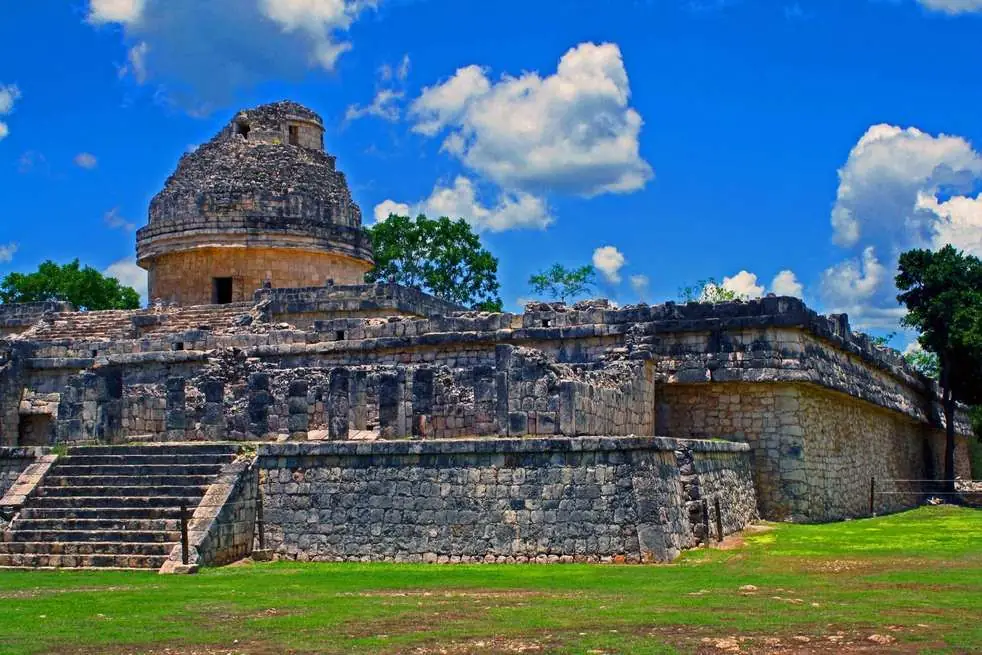
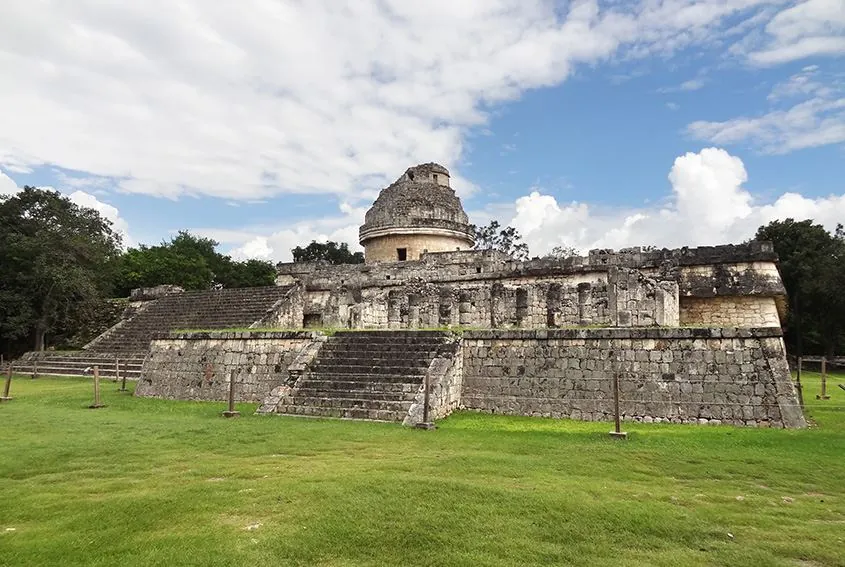
El Caracol is a circular tower standing on two rectangular platforms, in the southern monumental area of Chichen Itza, south of El Castillo and near the Casa Colorada group, to which a sacbé, a raised Maya road, connects (INAH; Aveni, Gibbs & Hartung 1975). Everything about the plan is unusual for the city: the platforms are rectangular, the tower on them is round, and the two platforms do not even share the same orientation.
That roundness is why the building draws astronomers. Round buildings are uncommon in Maya monumental architecture (INAH), and this one's upper chamber holds narrow window-like openings that point, roughly, at the western horizon, where Venus and the Sun set. Whether "roughly" is good enough is the whole question of this page, and it is answered with measurements, not adjectives. For the site as a whole, start with the Chichen Itza Visitor Guide; this page stays with the one building.
The Building: Platforms, Tower and the Spiral Stair
Read the building from the ground up, because its layers were built at different times and point in different directions. The lower platform came first; a later upper platform was set on it at a different orientation; and the tower stands on that. Buried inside the whole stack is an even earlier structure: a circular platform 11 m across and 3.70 m high, sealed under the later masonry (Aveni et al. 1975, after Ruppert). The round idea at this spot is older than the tower you see.
The tower itself has two parts. The lower tower contains two concentric circular chambers, a ring inside a ring, each pierced by four doorways. The inner and outer doorways are not exactly aligned with each other (Aveni et al.), a small fact that matters later: not every opening in this building was laid out as a clean sightline. In the solid central core, a spiral stair winds upward to the small round chamber at the top, the chamber whose windows carry the astronomical claims (§4–§7). The stair is entirely internal; you cannot see it from outside (§13).
How Big Is It, and the Height Nobody Can Give You
The platform measurements below are the ones the measurers themselves published, with their own caution attached. Aveni's team called the lower platform's size approximately 52 × 67 m, their word "approximately", kept here, because it was a field measurement, not a surveyor's exact. For the later upper platform, what they published is side lengths: 22 m on the west side and 24 m on the east (Aveni et al. 1975). Those are two sides of a platform, not a complete footprint, and this page does not turn them into one.
The Windows: Three Survive
Everything astronomical about El Caracol runs through the small openings in its upper chamber, so the first honesty test is how many there are. Three upper-tower windows survived well enough to be measured, and those three are what Aveni, Gibbs and Hartung worked with in 1975. The other numbers in circulation have traceable origins: the explorer Maudslay described what appeared to be six small upper doorways, a historical observation of a more ruined building, not a measurement. And the popular "four" appears to conflate the four doorways of each lower chamber (§2) with the upper windows. Publishable wording, and the wording this page uses: three upper windows survive; how many there were originally is uncertain.
One piece of method before the results, because it changes how you read them. Aveni's team measured the windows' diagonals, the line from one inner corner of an opening to the opposite corner, not their centrelines. A window is a slot, not a telescope tube: it frames a band of sky, and its two diagonals point in measurably different directions. Every direction in the next section is a diagonal, published as such, with the error the authors published beside it.
What Was Actually Measured
In 1975, Anthony Aveni, Sharon Gibbs and Horst Hartung published the building's orientations in Science (vol. 188), measured by transit. Table 1 of that paper is the source for every row below. Directions are the openings' diagonals (§4), given as degrees north or south of west or east, each with the error the authors themselves published.
| Element and direction measured | What it matches | Published error |
|---|---|---|
| Window 1, one diagonal: 28°53′ north of west | Venus setting at its northernmost extreme | 0°27′ |
| Window 2, one diagonal: 27°49′ south of west | Venus setting at its southernmost extreme | 1°00′ |
| Staircase / platform front: 27°24′ north of west | The same single direction matches both Venus's northern setting extreme and the summer-solstice sunset | Published as one direction |
| Upper platform diagonal: 25°30′ north of east | Summer-solstice sunrise | 0°37′ |
| Upper platform west front: 22°54′ north of west | Sunset on the solar zenith-passage dates | 0°31′ |
| Window 2, its other diagonal: 40°55′ south of west | No identified event, a negative result, published by Aveni as one | – |
Two disciplines this table keeps. First, the staircase row: because one direction matches two events, it is one line of evidence, not two independent proofs. Pages that count it twice are double-counting. Second, the last row: a measured diagonal that matches nothing is printed here exactly as the authors printed it. A building where every opening conveniently matched an event would be more suspicious, not less; the miss is part of the evidence. A few lower-doorway directions were also published with candidate stars, Canopus, Castor, Fomalhaut, Pollux, and they appear on this page only as what they are: published measurements with interpretive candidates, not purpose-built star sights.
Venus at Its Extremes
Start with the correction, in one line: popular summaries, including the Exploratorium's, say Venus was watched rising through these windows. Aveni's measurements are of Venus setting. The windows face the evening sky, and the two extreme directions they frame are where Venus goes down at the far north and far south ends of its setting range.
Why those extremes matter: Venus does not set in the same place every night. Across its cycle it swings north and south along the horizon, and the two turning points, the northernmost and southernmost settings, are fixed, predictable events a watching culture can build a calendar around. Venus's average synodic period is about 584 days, and five of those periods make 2,920 days, the same span as eight 365-day years. That 5:8 pattern is schematic: the real periods do not repeat perfectly, so read it as "approximately", the way the sources do. Venus carried ritual weight across Mesoamerica, not only here (Šprajc 1993), which is context for why anyone would frame its extremes in stone, not proof that this tower's builders did.
The Sun: Solstices, Zenith Sunsets, and the Equinox Problem
The measured solar rows are already in the table (§5): the upper platform's diagonal points to the summer-solstice sunrise (25°30′ north of east, error 0°37′), its west front to sunset on the zenith-passage dates, the days the Sun passes directly overhead at this latitude (22°54′ north of west, error 0°31′), and the staircase front shares its one direction between Venus's northern extreme and the summer-solstice sunset. Those are published measurements with published errors, and they stand as such.
The equinox is a detective story, and it does not close. Through Window 1's other diagonal as the window stands today, 0°57′ north of west, a sunset was photographed at the March equinox in 1974. That sounds like proof, until the building's repair history enters (§11): a jamb stone of that window is displaced. Recompute the geometry with the jamb where the restoration found it, and the original direction comes out at 2°27′ north of west, with a published error of 2°02′, too far off the equinox line to claim, too close to dismiss outright.
UnresolvedThe verdict this page publishes is Aveni's nuance, not either simplification in circulation: the equinox sightline is neither proven nor disproven. One AI answer calls it disproven; a museum summary calls it a plain alignment; both go further than the measurement allows. For the equinox as an event at Chichen Itza, above all the serpent on El Castillo, see the Chichen Itza Equinox Guide; this page's business is only the one window.
Was It Really an Observatory?
The positions, named, in the order they were staked out. Karl Ruppert (1935), who excavated and restored the building, treated astronomical use as a serious possibility, and also considered a watchtower; he held both. Ricketson proposed the upper windows as sighting devices and measured them. Aveni, Gibbs and Hartung (1975) favoured an astronomical function for several elements, while titling their paper as a question: "An Architectural Field Test of an Astronomical Hypothesis". Susan Milbrath (1999) developed the solar and Venus readings further. Ivan Šprajc (2021) supplies the method caution below. And Jan Szymański (2010) places round buildings in a broad functional category with many uses, the standing reminder that a round plan alone proves nothing.
Now the caution, in the scholars' own terms, because it is the part guidebooks leave out. Aveni's team measured platform edges, diagonals, stairways, doorways and window edges. Every extra edge is another direction; every extra body or event is another target, so with enough combinations, some close matches will occur by chance. That is the multiple-comparisons problem, and it is why Šprajc's rule matters: an apparent match, the equinox above all, must be tested, not assumed. Reference works on archaeoastronomy accordingly place the Caracol at the second of four credibility levels: architecturally suggestive, not proven use. No probability figure for this building exists in the sources, so none is printed here.
What proof would actually require, in plain terms: a repeatable observing station, an original (unrestored) sightline, a horizon reference to sight against, some way of recording what was seen, and repetition across cycles. El Caracol clearly offers some of these; the restored jambs (§11) compromise others.
Graded verdictThe alignment evidence is substantial and published; "observatory" is a well-established scholarly interpretation. That priests systematically observed and recorded cycles from this tower is not proven, and an astronomical role would not have excluded ceremonial use. Two claims fail this standard entirely and appear nowhere on this page as fact: eclipse prediction from this tower has no source, and no exclusive dedication of the building to a single deity is established, that is an interpretation, labelled wherever it is mentioned.
The Dresden Codex Is Not From Here
The most repeated supporting claim for El Caracol's astronomy borrows a document that does not belong to it. The Dresden Codex, the Maya manuscript holding the famous Venus table, on its pages 24 and 46–50 (Bricker & Bricker), is a Postclassic Maya manuscript, probably from northern Yucatán. It is not from Chichen Itza, and it was certainly not written in or excavated from this tower. Its documented journey is European: it reached Vienna in 1739 and the Dresden library from 1740 (SLUB Dresden). The Venus table is genuine Maya astronomy of the highest order; it is evidence for what Maya astronomers could compute, not for where this particular building's windows pointed.
A named theoryOne real scholarly link exists and is printed as exactly that: Aldana (2016) proposed a Chichen Itza origin for an astronomical development behind the Venus table. That is a named researcher's theory about an intellectual tradition, publishable as a theory, never as the codex's provenance. Venus cycles and the Maya calendar in depth belong to this site's calendar piece; this page keeps them at visitor depth (§6).
When Was It Built?
In stages, and the stages are the honest answer. INAH counts at least six remodelings of the building. Ruppert's excavated sequence runs from an initial rectangular platform, through the buried circular platform (§2), to the later platforms and the tower. In visitor terms: El Caracol was built up in stages across the late first millennium, Terminal Classic, roughly 800–1000 CE. Two cautions ride with that range. The waypoints of about 850 and about 1000 that appear in the alignment literature were Aveni's working assumptions for the mathematics, not excavated dates. And Bíró & Pérez de Heredia (2016) argue for earlier phases, around the 830s–890, attributed here as their argument, not as settled chronology. No single construction year is published on this page, because no source earns one.
The stela, handled honestly
A carved stela was found broken into pieces in the niche dividing the upper platform; it was discovered by Sylvanus G. Morley in 1924 and published by Ruppert (1935). A date conventionally described as about 906 CE is associated with it, and that phrasing is as far as the evidence goes: the exact reading is unverified, so this page publishes no Long Count for it. (A pairing of a specific Long Count with that year circulates in AI answers; it is internally inconsistent, and it is not repeated here.) Three hieroglyphic monuments are associated with the building in total (Bíró & Pérez de Heredia), and none of them gives the building a single secure date. Where the stela is now is not established in any verified source, the page says so plainly, in the FAQ below as well, rather than guessing a museum.
Excavation and Restoration: What Is Original?
The building you measure today passed through the hands of Karl Ruppert's Carnegie Institution team, and that passage is documented in his 1935 monograph (Carnegie Publication 454). Carnegie work at Chichen Itza began in the 1920s, a contemporary account dates the Caracol excavation from 1925. What they found: earlier building stages sealed under later masonry; tower walls partly collapsed, held up by the debris inside them; and fallen moulding blocks lying together where they had dropped.
What they did: the moulding was reset in 1926–27 (work first supervised by J. Eric Thompson); the north-east corner and parts of the lower platform were reconstructed; and the recesses around Windows 2 and 3 were repaired by 1930, partly following the historic appearance. Ruppert himself warned, in print, that the restored doorway-mask compositions cannot be guaranteed to match the originals: some masks incorporate cement casts of recovered sculptures. One collapsed moulding section was deliberately left exactly as found. No dated modern INAH campaign on the chamber was verified in this research, so none is claimed.
And here is the recursion this whole page turns on, stated once, plainly: the restored jambs are exactly why the equinox sightline cannot be settled (§7). The astronomy of El Caracol is uncertain partly because the building was lovingly rebuilt, by the very archaeologist who first took its astronomy seriously. Finally, the standing discipline: no percentage of original fabric exists for this building, so none is invented. The tower is neither entirely original nor entirely a reconstruction, and any page that gives you a number for either has made it up.
Why "El Caracol"?
El Caracol is Spanish for "the snail", and INAH's own wording gives the reason: "Llamado así por una escalera en espiral que se encuentra en su interior", "called so for a spiral staircase found inside it." The stair winds like a snail's shell through the tower's core (§2), and the name stuck. "The Observatory", by contrast, is a modern descriptive nickname, INAH uses it too, but it is our label for what the building may have done, not a translation of anything ancient. The building's ancient Maya name is not known, and none is published here: any Maya name offered for this tower, on any page, has been invented. The same discipline applies to dedication: an exclusive dedication to Kukulkán is an interpretation in circulation, never a fact, and round buildings as a class carried many functions (§8), so neither "all round buildings were observatories" nor "all were Venus temples" survives contact with the sources.
Visiting El Caracol Today
El Caracol is an exterior visit. The upper chamber is not entered on an ordinary visit (consistent recent reporting, stated qualified), and the spiral stair is internal, not visible from the ground, whatever a caption elsewhere implies. What repays attention is all outside, in this standing order:
- The two platforms and the western stair. Stand back first and read the stack: two rectangular platforms at visibly different angles, with the tower's stair front, the 27°24′ direction of §5, on the west.
- The tower's two storeys and its offset doorways. The twin ring-chambers below, the small chamber above, and the doorways that do not line up, the building's own warning against assuming every opening is a sightline.
- The three surviving window slits. Small, high, and easy to miss: these are the openings Aveni's team measured. Everything else on this page is commentary on them.
- The solstice diagonal. The upper platform's edge runs 25°30′ north of east, the summer-solstice sunrise line. You are standing inside the table in §5.
- The façade masks. Read them knowing §11: documented, restored, partly rebuilt around cement casts. Ruppert said so himself.
El Caracol sits in the southern group, which most visits reach after the Great Plaza, how the southern buildings sequence into a visit is covered in How Long Do You Need at Chichen Itza, and what you may and may not do at the site, climbing, restricted areas, equipment, on the Chichen Itza site rules page.
See El Caracol on the Shared Tour
Our shared day trip combines Chichen Itza, a swim at Cenote Ik Kil, and a stop in Valladolid. It costs $130 per adult and $115 per child up to age 12, with the 697 MXN Chichen Itza entrance fee included. We pick you up from your own hotel or pickup point and confirm the exact time on WhatsApp the night before. A 30% advance reserves your place, with the balance due on the tour day. Cancellation is free up to 48 hours before, with the advance refunded in full. We are a new operator and say so plainly.
City pages: Chichen Itza tour from Cancun · from Tulum · from Playa del Carmen
Price calculator
The Chichen Itza entrance fee of 697 MXN is included in these prices, so there is nothing extra to pay at the gate for entry.
El Caracol: Frequently Asked Questions
Why is El Caracol called El Caracol?
El Caracol is Spanish for 'the snail'. INAH's own wording: it is called that for a spiral staircase inside the building, a stair that winds up through the tower's central core to the upper round chamber. The stair is internal and cannot be seen from the ground on an ordinary visit.
Was El Caracol really an observatory?
'Observatory' is a modern nickname, and the honest verdict is graded: the alignment evidence is substantial and was published in Science in 1975 by Aveni, Gibbs and Hartung, who favoured an astronomical function for several elements. But that priests systematically observed and recorded cycles from this tower is not proven, and an astronomical role would not have excluded ceremonial use. The building's ancient Maya name is not known.
How many windows does El Caracol have?
Three upper-tower windows survive well enough to have been measured (Aveni, Gibbs and Hartung, 1975). Maudslay described what appeared to be six small upper doorways, and the popular 'four' conflates the lower chambers' doorways with the upper windows. How many windows there were originally is uncertain.
What do El Caracol's windows align with?
Two measured window diagonals frame Venus setting at its extremes: Window 1's diagonal, 28°53′ north of west, matches Venus setting at its northernmost extreme, and Window 2's, 27°49′ south of west, Venus setting at its southernmost extreme (Aveni, Gibbs and Hartung, 1975). Note: setting, not rising. Popular summaries often say rising, but Aveni's measurements are of Venus going down.
Can you go inside El Caracol?
On an ordinary visit, no: the upper chamber is not entered, and viewing is of the exterior. The spiral stair is inside the tower's core and is not visible from the ground.
How old is El Caracol?
It was built up in stages across the late first millennium, Terminal Classic, roughly 800–1000 CE. INAH counts at least six remodelings. A carved stela found broken in the building is conventionally described as dated about 906 CE, but the exact reading is unverified, this page publishes no Long Count for it.
Why is El Caracol round?
Round buildings are uncommon in Maya monumental architecture, and the honest answer is that the form alone settles nothing: Szymański (2010) treats round structures as a category with many possible functions. The roundness is part of why the observatory interpretation is tempting, but shape by itself is not proof of use.
Did the Maya predict eclipses from El Caracol?
No source supports eclipse prediction from this tower. A top-ranking competitor asserts it unsourced; this page does not. The measured evidence at El Caracol concerns Venus and the Sun at the horizon: solstices, zenith-passage sunsets and Venus's extremes.
What is the 27.5-degree angle at El Caracol?
It is the Exploratorium's rounded figure (27.5°) for the direction of the staircase and platform front. Aveni's published measurement is 27°24′ north of west. That one direction matches both Venus setting at its northernmost extreme and the summer-solstice sunset, one line of evidence, not two independent proofs.
Is the Dresden Codex from El Caracol?
No. The Dresden Codex is a Postclassic Maya manuscript, probably from northern Yucatán, not from Chichen Itza; it reached Vienna in 1739 and the Dresden library from 1740 (SLUB Dresden). Aldana (2016) proposed a Chichen Itza origin for an astronomical development behind its Venus table, a named theory, not provenance.
¿Por qué se llama El Caracol al observatorio de Chichén Itzá?
Porque en su interior hay una escalera en espiral, la formulación es del propio INAH: «Llamado así por una escalera en espiral que se encuentra en su interior». La escalera sube por el núcleo central de la torre hasta la cámara redonda superior; es interna y no se ve desde el suelo.
Where is the El Caracol stela now?
It was found broken into pieces in the niche dividing the upper platform, discovered by Sylvanus G. Morley in 1924 and published by Ruppert (1935). Its present location is not established in any verified source this research found, this page says so plainly rather than guessing.
Check Your Date on WhatsApp
Booking opens on WhatsApp: that is where your date is checked, your pickup point is set, and your exact pickup time is confirmed the night before the tour. Send one message with:
- Your tour date
- Your pickup city and hotel or pickup point
- How many adults and children (to age 12)
$130 per adult · $115 per child · 697 MXN entrance fee included · 30% advance to reserve · free cancellation up to 48 hours before.
Start with your date
One tap opens the conversation. Prices above are the full per-person prices, the entrance fee is already in them.