Shared day tour · $130 adults · $115 kids (to 12)Entrance fee includedWhatsApp us

Maya Ritual and Sacrifice at Chichen Itza: What the Evidence Actually Shows

No subject on this site attracts more invention than this one. Stories about the Sacred Cenote have been sensationalised for over a century, and the internet has added new ones, including a famous DNA study that is routinely attached to the wrong hole in the ground. This page separates four different things that are usually blurred into one: what the objects prove, what the bones show, what the carvings depict, and what the colonial texts claim, and it says plainly where the evidence runs out.

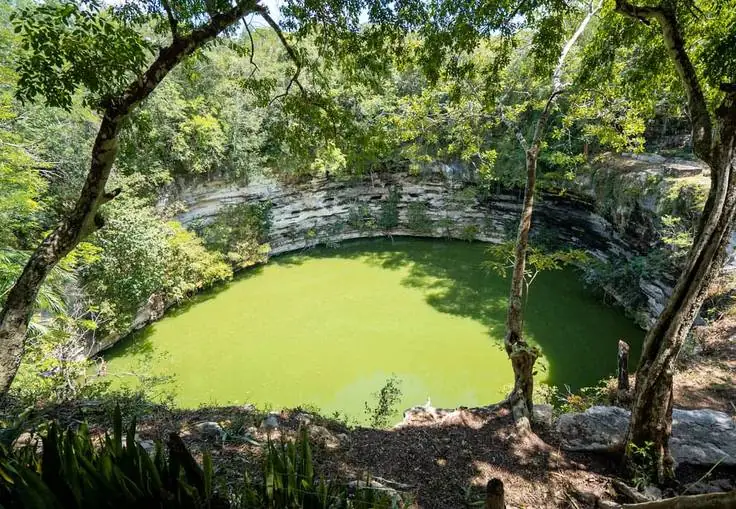
The Sacred Cenote at Chichen Itza seen from the rim through the trees, its green water far below the limestone walls
The Sacred Cenote from the rim. Everything this page says about offerings and human remains starts with what was recovered from this water, and with how it was recovered. For visiting the cenote itself, see the Sacred Cenote visitor guide.
The offerings are realGold, jade, copal and more, deposited over centuries from about 750 CE, much of it imported from far beyond Yucatán.
The remains are not the maiden storyThe studied bones include men, women and children. The “virgins in the cenote” narrative is a colonial-era retelling.
The 2024 DNA twins were not in the cenoteThe 64 boys of the Nature study came from a chultún, an underground water-storage chamber about 300 m away.

New-operator disclosure: this site is run by a new tour operator with a short track record. The scholarship on this page is drawn from the Peabody Museum, Nature, and the published archaeological literature named throughout, and every claim carries its grade and its source.

How to Read This Page

Claims about ritual at Chichén Itzá are not all worth the same, so this page grades them as it goes. Four grades are used, and the grade word appears in the text wherever a claim is made:

Established
Directly documented in the recovered material or the primary record: the objects themselves, the bones, the dated publications.
Supported interpretation
The reading most scholars would defend from that evidence, but still a reading: it goes one step beyond what the material says on its own.
Disputed
Argued both ways in the literature, or resting on a single attributed interpretation. Published here with its attribution, never as fact.
Not supported
Widely repeated but with no evidence behind it that survives checking. These appear only in the myths section, corrected.

One promise runs through everything below: this page prints no number the evidence does not support. Where a total does not exist, and for the cenote's contents, no reliable total exists, the page says so instead of filling the gap.

What Was Offered in the Sacred Cenote

Established

Over centuries, the Sacred Cenote received offerings of gold, jade and jadeite, copal, rubber, textiles, ceramics, wood, bone, shell, turquoise and obsidian. That inventory comes from the Peabody Museum, which holds the recovered collection, and from Clemency Coggins's catalogue, Artifacts from the Cenote of Sacrifice (1992). The Peabody records deposition beginning around 750 CE, mostly pre-colonial, and, as the pilgrimage section below describes, continuing long after.

Read the assemblage for what it is: a pilgrimage-and-offering record, not a treasure hoard. In the Peabody's account the offerings were spiritually powerful objects given to divine powers, not a treasury that happened to get wet. The “gold treasure of the cenote” framing belongs to the era of Edward Thompson's dredging in the early 1900s, and it has distorted the subject ever since. The Peabody also states that more than 3,000 offerings from the Sacred Cenote remain in the Peabody's collections today, the one collection figure this page prints, attributed to the museum that holds them. For the cenote as a place to visit, see the Sacred Cenote guide.

Where the Offerings Came From

Established: provenance

Much of what went into the water had travelled a long way to get there. The gold is lower Central American work, in the Panama–Costa Rica metallurgical tradition, and the jade came from the Motagua valley, the provenance work of Coggins and Shane (1984), summarised in the Metropolitan Museum of Art's 2018 synthesis of the cenote material.

That geography matters for everything else on this page. Objects arriving from hundreds of kilometres away, in a city whose own territory produced neither gold nor jade of this kind, are part of why scholars read Chichén Itzá as a pilgrimage centre drawing goods, and, as the isotope evidence below suggests, people, from well beyond the city itself.

The evidence on this page comes from objects recovered at specific places in the zone; the visitor guide shows where those places sit in the modern visit.

The “Killed” Objects

Established damage · Supported interpretation

Many offerings did not go into the water intact. The Peabody describes gold disks surviving “crumpled, broken, blackened”: objects deliberately broken, crumpled, blackened or burned before deposition. In the literature this treatment is read as the objects being ritually “killed”: destroyed as usable things at the moment they were given, which is why the reading is graded here as a supported interpretation rather than a fact.

The caveat is printed with it, because it is part of the evidence: breakage cannot always be separated from the damage of deposition itself, or from the damage done by dredging during recovery a century ago. Some of what looks like ritual destruction is; some of it may be the archaeology. Honest grading means saying both.

The Human Remains

Established · with an open question

The human remains recovered from the cenote include men, women and children: the studied remains include many children alongside adults of both sexes (Price, Tiesler & Freiwald, 2019). That single finding already retires the most repeated story about the cenote, which the next section takes up.

Isotopes: supported interpretation. Strontium and oxygen signatures in the remains show that many of the individuals were not local to Chichén Itzá. That is as far as this page goes: the study's full text was not the basis for a named-region origin list here, and the lists in secondary summaries conflict, so no list of home regions is published.

Bone marks: as reported. Guillermo de Anda Alanís's reanalysis of the cenote's bones reports marks of violence before and during death, and postmortem manipulation: disarticulation, defleshing, flaying and heat exposure (published in Arqueología Mexicana). Those findings are stated exactly as reported, not embellished into a named cause of death, a drowning, or a heart extraction, none of which the reanalysis establishes for the assemblage.

And the question the osteology often cannot settle is left open, because it is open in the scholarship: whether cenote deposition was of the sacrificed, of the already-dead, or of both. The remains prove that people, local and non-local, adult and child, entered the cenote's record over centuries. How each of them died is, in most cases, beyond what the bones can now say.

Were They Virgins?

Textual tradition: not bone evidence

The famous story, maidens thrown into the cenote, is a colonial-era retelling. Its root is Bishop Diego de Landa's Relación de las cosas de Yucatán (c. 1566), which reports what Landa was told, more than a century after Chichén Itzá's florescence. Later writers took the tradition and amplified it, until “the cenote of the virgins” became the version most visitors arrive with.

Published here, it is published as what it is: textual tradition. The bones do not show it. The recovered remains include men, women and children, and no study of the assemblage supports a single category of victim. The stronger, more dramatic claim sometimes attached to the story, thousands of them, is not supported at all, and appears on this page only in the myths section, corrected.

The 2024 DNA Discovery: in a Chultún, Not the Cenote

Established: and this page's central correction

In June 2024, Barquera and colleagues published a study in Nature (vol. 630, pp. 912–919) that made worldwide headlines, and was almost immediately attached to the wrong place. The study sequenced 64 subadult males. They did not come from the Sacred Cenote. Per the paper's own Methods, they came from a chultún, an underground water-storage chamber, about 300 metres northeast of the Sacred Cenote.

The chultún held a minimum of 106 skeletons, about half of them aged three to six. That figure belongs to the chultún, and it is never transferred to the cenote on this page. All 64 individuals analysed were male, and among them were two pairs of identical twins, along with other close relatives. Note what that means for the headlines: the study is not about “64 twins”. It is about 64 boys, two pairs of whom were identical twins.

Dating, as the paper gives it. The abstract places the remains around AD 500–900, and radiocarbon indicates burial both around AD 600 and around AD 1100. The authors discuss the deposit in terms of ritual sacrifice, and suggest the twin pairs “may be linked” to the Hero Twins' underworld journey in the Popol Vuh, published here as what it is in the paper: the authors' own interpretation, carrying their own hedge.

Finally, the boundary that matters most. The Nature paper says nothing directly about who was deposited in the cenote. Its numbers, its all-male profile and its twins belong to a chultún 300 metres away, and none of them migrate into the cenote's story on this page, however often they do elsewhere.

How We Know Any of This

Four kinds of source stand behind everything above, and they are not equal.

Landa (c. 1566): testimony. The Relación describes offerings at the cenote and, in Landa's account, people cast in during droughts. His context is part of the evidence: a Franciscan who also led the persecution of Maya religion, writing from informants more than a century after the events his account reaches back to. This page paraphrases his account and grades it as testimony: it does not quote phrases or cite chapter numbers that have not been verified against a critical edition.

The Books of Chilam Balam: Maya tradition in colonial manuscripts. These Yucatán Maya books carry the traditions of the Itza and their world; they are treated at depth on the page about the Itza, the people who built Chichen Itza.

Thompson's dredging (1904–1910): recovery that cost context. Edward Thompson's dredging of the cenote recovered the assemblage the museums now hold, but dredging destroyed the deposits' stratigraphy and provenience: which objects lay with which, and in what order, is largely unrecoverable. That loss is why today's science works on the museum collections themselves: the Peabody's holdings, and material from INAH's later excavations.

And a correction to a common ending. The story is often told as “everything was taken and never returned”. It is false: the Peabody records returns to Mexico, including 50 gold discs in 1959 and jade objects in 1976. The collections' history is more complicated than either the treasure story or the theft story allows.

What the Carvings Show: What They Don't Prove

Chichén Itzá's sculpture is full of ritual imagery, and it is real evidence, of something specific. A carving is evidence of ideology and ritual imagination: of what the city's art wanted viewers to see and believe. It does not by itself prove how often anything was done, and no frequency claim is ever drawn from imagery on this page.

The ballcourt relief. A relief in the Great Ball Court depicts a decapitated player. Depicts is the operative word: there is no consensus in the scholarship on whether the figure represents the winners or the losers, and the relief cannot tell us how any actual game ended. The court itself is covered in the Great Ball Court guide.

The tzompantli. The skulls covering the Platform of the Skulls are carved relief, not a rack of real skulls: exactly two real skulls were found inside the platform. The platform, the Platform of Venus and the Osario are covered in the Tzompantli, Venus Platform and Osario guide.

The chacmools. The reclining chacmool figures found across the site are read in art history as receivers of offerings (Miller & Taube, 1993), an interpretation, attributed as such, and a reasonable one; it is still a reading of a pose, not a label the figure carries.

Bloodletting at Chichen Itza: The Honest Answer

Disputed: thin evidence

Royal bloodletting is one of the best-documented rites of the Classic Maya south, in the art and texts of the southern lowlands, studied in depth by Schele and Miller. At Chichén Itzá specifically, the honest answer is that the evidence is thin by comparison. Searches of the scholarship return far less Chichén-specific material, and this page will not import southern-lowland practice north and present it as Chichén's record.

One lead exists, and it is published at its true grade. Carved imagery in the Chichén Viejo group, the building known as the House of the Phalli, has been interpreted as penis-perforation imagery (Taube and colleagues, in their work on the Initial Series Group). That is a Grade C lead: an attributed interpretation of imagery, inside a thin-evidence picture. And one negative is worth stating plainly: no Chichén stingray-spine or perforator offering cache was verified in the research behind this page, so none is claimed.

Rain, Chaac and the Other Sacred Waters

The power most consistently tied to water ritual at Chichén is Chaac, the rain power, present at the site in the carved masks on its Puuc-style buildings, and central to the offering world described below. But the site's water was never only the Sacred Cenote.

Cenote Xtoloc. The city's other great cenote was a working water source with its own ritual associations. Scholarship questions the tidy binary, one cenote purely sacred, the other purely domestic, so this page never prints it as a clean split. Both cenotes are covered as places in the Sacred Cenote guide.

Balankanché cave. In 1959 a sealed chamber was found in this cave near Chichén, holding Chaac and Tlaloc incense burners and offerings arranged around a joined stalactite and stalagmite read as a ceiba, the world tree (Andrews IV, 1970; INAH). Two disciplines apply here. Sources conflict on the cave's distance from Chichén, so no distance is published. And Balankanché is not Balamkú, a different cave, rediscovered in 2019, and nothing from one is ever attributed to the other.

A Pilgrimage Centre

Supported interpretation: converging evidence

Two independent lines of evidence point the same way. The offerings include gold from lower Central America and jade from the Motagua valley; the isotope signatures say many of the people were not local. Goods and people arriving from far beyond the city is the pattern of a pilgrimage centre, published here as an interpretation of converging evidence (Price, Tiesler & Freiwald, 2019; the Peabody Museum; Coggins), not as a claim that every non-local individual was a pilgrim, or a captive. The evidence does not sort them, and this page does not pretend otherwise.

The Peabody's record adds the long tail of that pilgrimage: deposition at the cenote continued after the conquest, into the colonial period, and the collection even holds a 20th-century rayon doll, an offering in modern material. Pilgrimage to the cenote did not end when the city fell; it faded across centuries, in material form.

As for purpose: in the Peabody's account, the offerings' world is reciprocity: gifts carrying essence (k'uh, ch'ulel) to divine powers, prominently the rain power Chaac in a dry land where rain was never guaranteed. That is the documented frame. Anything more specific claimed for the cenote's purpose has to carry its source, and the myths section below handles the claims that cannot.

What Archaeologists Still Cannot Tell You

This section is short because it is a list of absences, and it may be the most important section on the page.

Any account of this subject that fills those four gaps with confident detail is telling you more than the evidence holds. The gaps are part of the record.

Myths, Corrected

“Thousands of virgins were thrown into the cenote.” Not supported. The maiden story is a colonial-era retelling rooted in Landa; the recovered remains include men, women and children; and no total of any kind exists to attach a “thousands” to.

“Scientists found the twins in the Sacred Cenote.” Not supported. The 2024 Nature study analysed 64 boys from a chultún about 300 m northeast of the cenote, two pairs of them identical twins. Wrong place, and wrong arithmetic.

“Sacrifices happened daily.” Not supported. No frequency claim of any kind is established by the evidence; how often anything happened is one of the open questions above.

“Hearts were extracted at the cenote: that was the rite.” Not established for the cenote. De Anda's reanalysis reports violence and postmortem manipulation of the bones; it does not establish a single method of death, and heart extraction is not the cenote's proven rite.

“They sacrificed to Kukulkan at the cenote.” Not supported as the cenote's documented purpose. No scholarly source in the research behind this page documents that purpose; the documented frame is reciprocity toward divine powers, prominently Chaac.

“Hunab Ku, the supreme Maya god, received the offerings.” Not supported as prehispanic religion. Hunab Ku as a supreme god is a colonial-era construct, not a prehispanic deity of Chichén Itzá.

“Everything was stolen and never returned.” False. The Peabody records returns to Mexico, 50 gold discs in 1959 and jade objects in 1976, alongside the collections that remain in museum care.

The Tour

Our shared Chichen Itza tour covers the ruins, including the Sacred Cenote at the end of its sacbé, with a swim at Cenote Ik Kil and a stop in Valladolid, and hotel pickup from your own pickup point, with your exact time confirmed on WhatsApp the night before. The price is $130 per adult and $115 per child up to age 12, and the 697 MXN Chichen Itza entrance fee is included. Reserve with a 30% advance; the balance is paid on the day of the tour, and cancellation is free up to 48 hours before the tour, with the advance refunded in full.

Pickup cities, in order: Cancun, Tulum, Playa del Carmen, Riviera Maya and Merida.

$260Total: 697 MXN entrance fee included
$7830% advance to reserve
$182Balance on the day of the tour

Free cancellation up to 48 hours before the tour: advance refunded in full. Inside 48 hours the advance is kept.

Frequently Asked Questions

Did the Maya really sacrifice people at Chichen Itza?
The evidence supports ritual killing and offering at Chichén Itzá, but with limits this page keeps visible. The Sacred Cenote received human remains alongside centuries of offerings, the recovered bones include men, women and children, and a reanalysis by Guillermo de Anda reports marks of violence before and during death and postmortem manipulation. What the evidence does not establish is how often anything happened, or whether everyone deposited in the cenote was sacrificed rather than already dead.
Were the victims in the Sacred Cenote virgins?
The maiden story is a colonial-era retelling, not what the bones show. Landa's Relación, written around 1566 from what he was told more than a century after the city's florescence, is the source of the tradition, and later writers amplified it. The recovered human remains studied by Price, Tiesler and Freiwald (2019) include men, women and children, not a single category of victims.
What was thrown into the Sacred Cenote?
Over centuries the cenote received gold, jade and jadeite, copal, rubber, textiles, ceramics, wood, bone, shell, turquoise and obsidian, as catalogued by the Peabody Museum and in Clemency Coggins's Artifacts from the Cenote of Sacrifice (1992). Many objects were deliberately broken, crumpled, blackened or burned before deposition. The Peabody records deposition from about 750 CE, continuing after the conquest and even into the 20th century.
Where did the gold and jade in the Sacred Cenote come from?
Much of it was imported from far away. The gold is lower Central American work, in the Panama–Costa Rica metallurgical tradition, and the jade came from the Motagua valley, as established by Coggins and Shane (1984) and summarised in the Metropolitan Museum's 2018 synthesis. That distance is part of why scholars read the cenote as a pilgrimage destination.
How many people were sacrificed at Chichen Itza?
Honestly, it is unanswerable. No reliable count exists: the early dredging destroyed the deposits' context, no reconciled inventory of the human remains has ever been published, and this page does not print any total. Anyone who gives you an exact number for the cenote is repeating an unsourced figure.
Were the 64 twins found in the Sacred Cenote?
No. Barquera and colleagues (Nature, 2024) sequenced 64 boys from a chultún, an underground water-storage chamber about 300 metres northeast of the Sacred Cenote, not from the cenote itself. The 64 were all male and included two pairs of identical twins, not 64 twins. The paper dates the remains to around AD 500–900, and its findings say nothing directly about who was deposited in the cenote.
Did they extract hearts at the Sacred Cenote?
Not established for the cenote. De Anda's reanalysis reports marks of violence and postmortem manipulation: disarticulation, defleshing, flaying and heat exposure, but no single method of death is established for the cenote assemblage, and heart extraction is not published here as the cenote's proven rite.
What did Landa say about the Sacred Cenote?
In his Relación de las cosas de Yucatán (c. 1566), Bishop Diego de Landa described offerings cast into the cenote and, in his account, people cast in during droughts. He wrote from informants more than a century after Chichén's florescence, as a Franciscan who had also led the persecution of Maya religion, so his account is published here as testimony, graded as tradition rather than as bone evidence.
Is Cenote Xtoloc the same as the Sacred Cenote?
No. Xtoloc is Chichén Itzá's other great cenote: a working water source with its own ritual associations. Scholarship questions the simple split of one purely sacred cenote and one purely domestic one, so this page never prints Xtoloc as exclusively domestic.
What was found in the Balankanche cave?
A sealed chamber, found in 1959, held Chaac and Tlaloc incense burners and offerings arranged around a joined stalactite and stalagmite read as a ceiba tree (Andrews IV, 1970; INAH). Balankanché is a cave near Chichén Itzá, a different cave from Balamkú, which was rediscovered in 2019, and the two are never conflated here.
Were the losers of the ballgame sacrificed?
It is not established. A relief in the Great Ball Court depicts a decapitated player, but there is no scholarly consensus on whether the figure represents the winners or the losers, and a carving is evidence of ritual imagination, it does not by itself prove how often anything was done.
¿Hubo sacrificios humanos en Chichén Itzá?
Sí, la evidencia apoya la existencia de rituales con sacrificio en Chichén Itzá, con límites claros. El Cenote Sagrado recibió restos humanos junto a ofrendas durante siglos; los huesos estudiados incluyen hombres, mujeres y niños, y muchos no eran locales según los isótopos. Lo que la evidencia no establece es cuántas personas fueron ni con qué frecuencia ocurrió.
Check Your Date on WhatsApp

Booking opens on WhatsApp: tell us your date, your pickup city and how many adults and children, and we confirm your exact pickup time the night before the tour. A 30% advance reserves your seats; the balance is paid on the day, and cancellation is free up to 48 hours ahead.

Chat on WhatsApp

Shared tour · $130 adult / $115 child · 697 MXN entrance fee included · Chichen Itza + Cenote Ik Kil + Valladolid