Is Chichen Itza Worth It? The Honest Answer Before You Give Up a Vacation Day
This page is written by a tour operator that sells this trip, so it shows its working. Below is the real payoff, the real costs in time, heat, crowds and money, the cases where you should skip it, and the cheaper way to do it yourself. The verdict is conditional, because the honest answer depends on you: on what you care about, how many days you have, and how you feel about a 5 a.m. start in the Yucatán heat.
You are genuinely interested in Maya history, this is your first major Maya site, and you can give the trip a full day, 10 to 14 hours, door to door. On those terms, in our judgement, the day earns its place.
You dislike early starts, heat and long transfers, you have only one day in the area, or you mainly came for the beach. On those terms the same day is a poor trade, and the honest advice is to spend it differently.
One disclosure, up front, because this is a verdict page: we are a new operator with a short record, so this page carries no star ratings, no review counts and no borrowed praise as proof. What it carries is sourced fact, labelled judgement, and visitor reporting named as reporting.
The Short Answer
Our verdict, and it is a judgement, labelled as one, not a satisfaction statistic, is usually worth it for travellers who are genuinely interested in Maya history and can give the trip a full 10–14-hour day. It is probably not worth it for visitors who dislike early starts, heat and long transfers, who have only one day in the area, or who mainly want the beach. Everything after this section is the evidence for those two halves: the payoff, then each cost priced honestly.
Before you read further, run the four-question self-check. It predicts your answer better than any review can:
- Do you care about Maya history?Not "is it famous?", do standing in a thousand-year-old city actually interest you? If yes, the core of the day delivers. If the honest answer is "not really," no tour format fixes that.
- Can you give it 10–14 hours?That is the real day, door to door, from any of the resort cities. If that is most of a short trip, the exchange rate is against you.
- Is this your first Maya site?First-timers get the full effect. If you have already walked Tikal or Teotihuacan, read the repeat-visitor section below before deciding, the calibration there is different, and honest.
- Are you fine with heat and crowds?The site is open limestone under a strong sun, and from mid-morning it is busy. Both are manageable if you expect them; both ruin the day if you do not.
Mostly yeses: go, and go early, the way to do it section is yours. Mostly noes: the skip cases below name what to do instead, without a sales pitch attached.
If the honest answer for you is yes, the day itself is the Chichen Itza tour with cenote and Valladolid, $130 an adult with the entrance fee inside.
What You Actually Get
Strip away the word "iconic" and what remains is a specific set of buildings, each of which earns its place on the day for a different reason. One line each, the depth lives on their own pages.
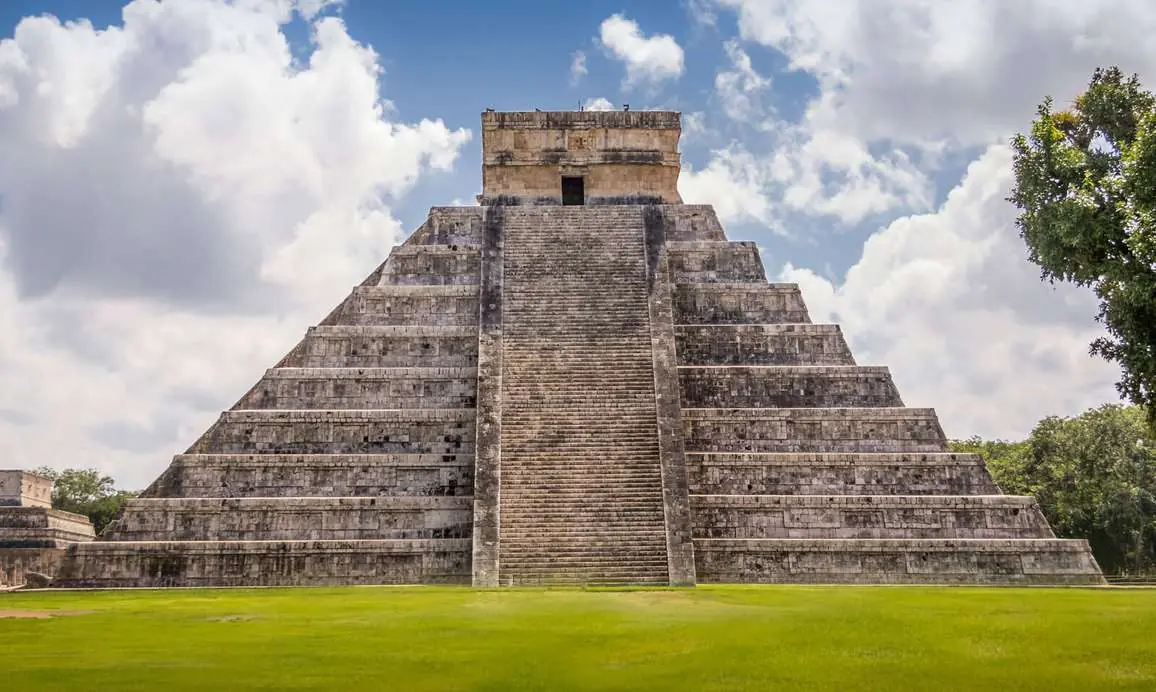
El Castillo
The pyramid of Kukulcan, roughly 30 metres tall, built as a working calendar in stone, the building the whole site is organised around, and the one whose handclap echo visitors test for themselves. See the El Castillo guide.
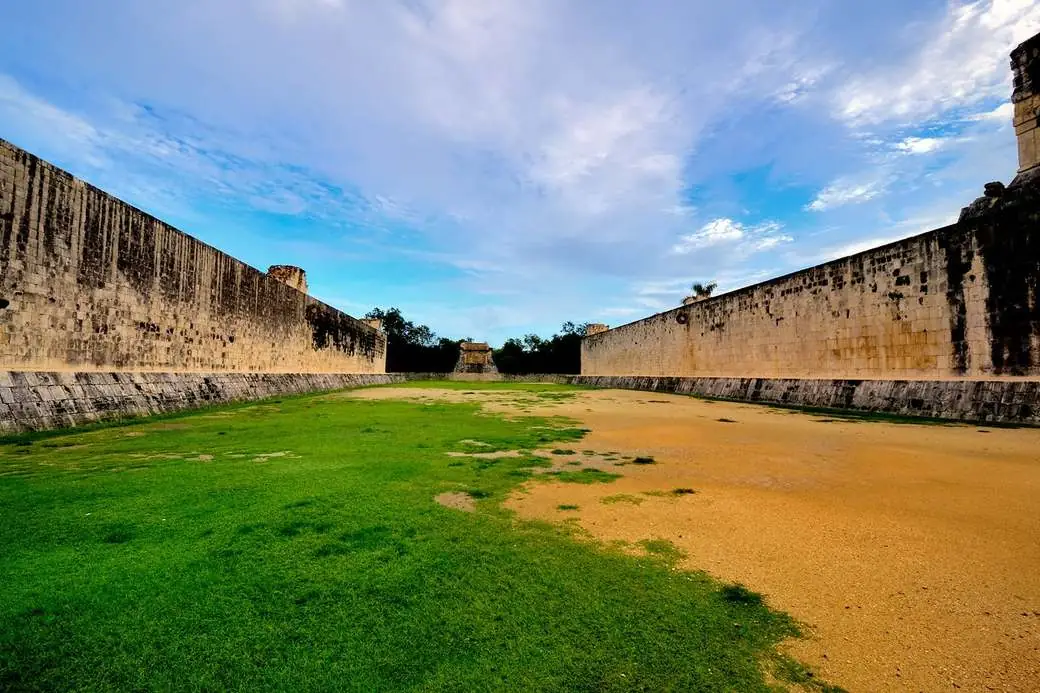
The Great Ball Court
At roughly 168 × 70 metres, the largest known ball court in Mesoamerica, a scale you feel in your legs walking its length, with carved panels that tell the game's story, including the part no honest guide skips. See the Great Ball Court guide.
The Warriors and the Thousand Columns
A temple fronted by rows of carved columns that once held a roof, the clearest picture on the site of Chichen Itza as a working ceremonial city rather than a single monument. See the Warriors and Thousand Columns guide.
The Sacred Cenote
The great natural well into which the Maya placed offerings of gold, jade and pottery over centuries, a quiet, green, unsettling place that reframes everything else you have just seen. See the Sacred Cenote guide.
The recognition, in one attributed sentence: Chichen Itza has been a UNESCO World Heritage Site since 1988 (listed under criteria i, ii and iii), and it was also a winner of the 2007 New7Wonders vote, a private popular vote, not a UNESCO title. The full story of that distinction is on our New7Wonders page.
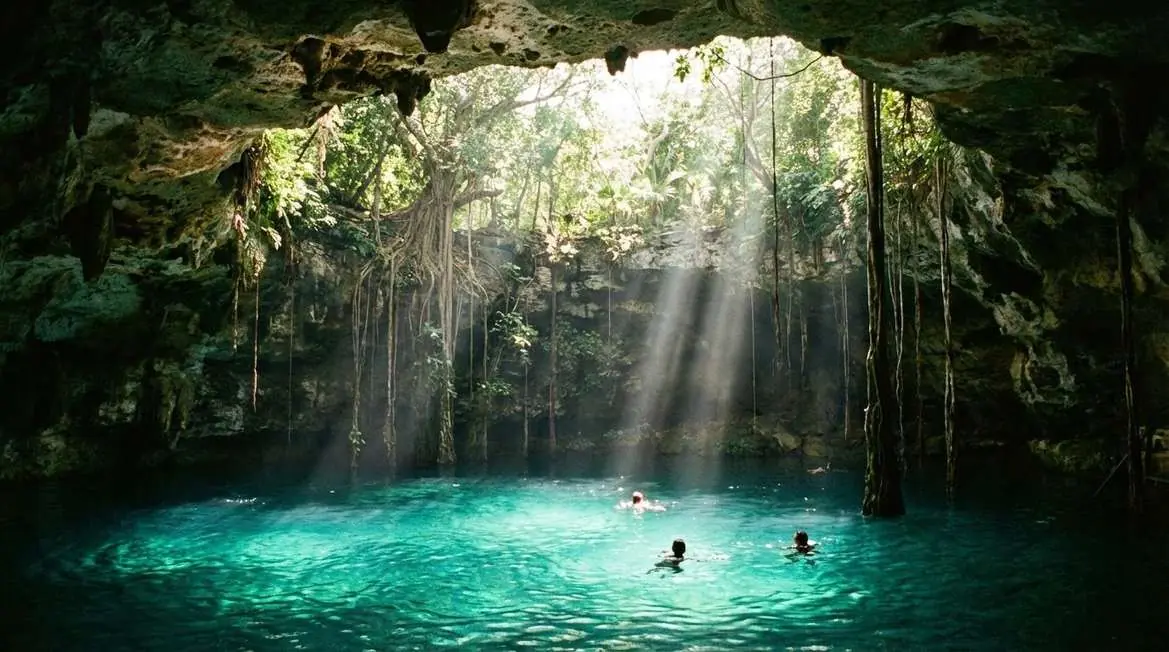
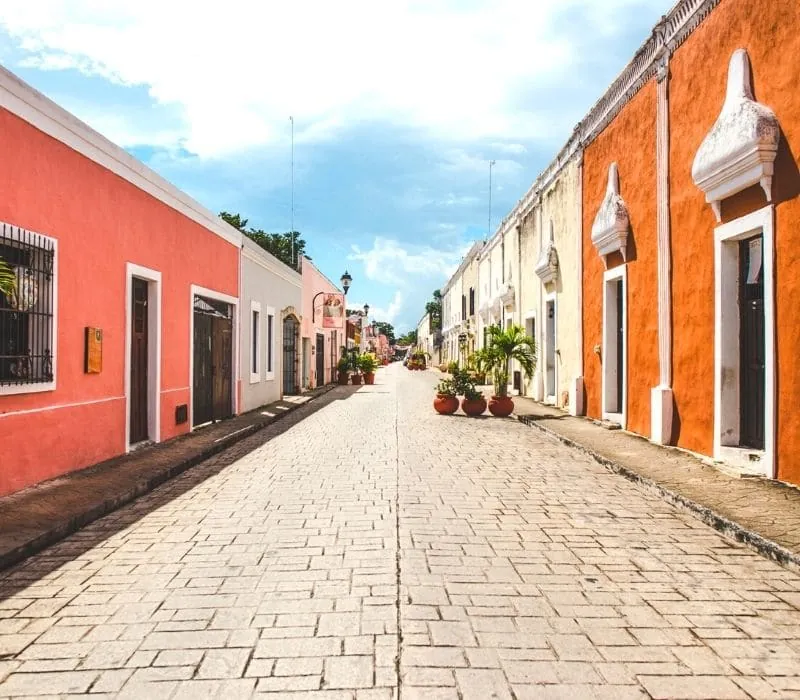
And the day is not only ruins. On the tour route, the other two legs are the swim at Cenote Ik Kil: cold green water after hot limestone, the reset the whole afternoon runs on, and Valladolid, the colonial town visitors in forum reporting repeatedly single out as the surprise highlight of the day. Neither is a filler stop; for many visitors, one of the two is what they talk about afterwards.
The Real Cost in Time
The first cost is the one no photograph shows: this is a 10–14-hour day, door to door. From Cancun, the drive is about 2.5 hours each way: five hours of road inside the day before a single ruin is seen. The other pickup cities sit at their own distances, each covered on its city page: Tulum, Playa del Carmen, the Riviera Maya and Merida.
Price that honestly against what it replaces. A Chichen Itza day is not an afternoon excursion bolted onto a resort day, it is the day: an early pickup, the ruins in the morning, the swim and the town, and a return in the evening. If your trip is a week, that trade is usually easy to make. If your trip is two or three nights, you are spending a third to a half of it on one excursion, and the maths in the skip section below deserves a fair hearing first.
The decision, stated plainly: you are not deciding whether Chichen Itza is good, by the evidence of its survival, scale and listing, it plainly is. You are deciding whether it is worth one of your days. Those are different questions, and only the second one is really yours to answer.
The Real Cost in Heat and Crowds
Chichen Itza is one of Mexico's most-visited archaeological sites, and INAH's own recorded figures for 2025 put the scale in numbers rather than adjectives: 2,182,034 visitors in the year. Within that year, July was the busiest month at 224,436 visitors and October the quietest at 128,270: October in 2025's record, stated as one year's data, not a promise about every October.
INAH visitor statistics, 2025, as published and summed on our Best Month page. The busiest month drew about three-quarters more visitors than the quietest.
The daily pattern matters as much as the monthly one. The site opens quiet; the tour-bus wave arrives around 10:00–10:30, and 11 a.m. to 2 p.m. is both the busiest and the hottest stretch of the day, the hours when the plaza photographs in travel brochures stop resembling the plaza in front of you. Arriving early is not a refinement of this trip; it is the difference between two different visits, which is why the arrival-time guide exists.
On heat: in the long Valladolid weather series published by the Japan Meteorological Agency and used on our Best Month page, May is the heat peak of the year. We print no invented temperatures here, the practical translation is enough: in May, and through the summer, the midday hours on open limestone are a genuine physical cost, and heat-intolerant visitors should weigh the skip cases below seriously.
The Real Cost in Money
The money question splits cleanly in two, because there are two honest ways to make this trip, and this page prices both, including the one that pays us nothing.
| Going independently | On this tour | |
|---|---|---|
| Entrance | 697 MXN per adult: 105 MXN federal (INAH) + 592 MXN state (CULTUR). Full breakdown on Tickets & Fees | Included in the price, no gate transaction |
| Transport | Yours to arrange and pay: rental car and fuel, bus, or train, each at its own fare, and yours to drive, at about 2.5 hours each way from Cancun | Included, hotel pickup from your own point, exact time confirmed on WhatsApp the night before |
| The day itself | Ruins only, unless you add the cenote and Valladolid under your own steam | Chichen Itza + Cenote Ik Kil swim + Valladolid in one routed day |
| Total per adult | 697 MXN at the gate, plus whatever your transport costs you | $130 per adult ($115 per child to age 12), fee included |
The honest summary: if you have a car and are happy driving, doing it yourself is genuinely cheaper: the gate fee plus your fuel undercuts any tour price, ours included, and the tour-versus-DIY section below says so without flinching. What the $130 buys is not a cheaper ticket; it buys the logistics away, the driving, the routing, the timing against the crowds, and bundles the swim and the town into the same day. Whether that removal is worth the difference is, again, your call to make with both prices in front of you.
Vendors and the “Tourist Trap” Question
Search this question for five minutes and you will meet the phrase "tourist trap." It deserves a precise answer rather than a defensive one, because two different things are being judged at once. The site is a major Maya city, UNESCO-listed since 1988, with the largest ball court in Mesoamerica, nothing about that is a trap. The commercial layer around a famous site is real: souvenir vendors are part of the site experience, concentrated where the crowds are, along the paths between the main buildings.
Published characterisations of that layer genuinely range: from visitors who found the vendors "everywhere, but not annoying" to visitors for whom the mid-morning press of stalls and tour groups defined the visit. Both reports describe the same site at different hours, which is the useful truth inside the disagreement: the vendor presence arrives with the crowds, so the early, quiet visit and the midday visit differ here too. We print no vendor count, because none is sourced, anyone who gives you an exact number of stalls is guessing.
Our judgement, labelled as such: "tourist trap" is the wrong verdict for the ruins and a fair warning about the midday commercial experience around them. Go early, and you mostly get the first; arrive with the wave, and you will understand the second. The genuinely trap-like pattern in this market is not at the site at all, it is the bargain excursion whose shopping stops quietly eat the ruins time, which the disappointment section below takes up directly.
You Cannot Climb It
Set this expectation before you book anything, because a steady share of visitors arrive expecting the opposite: you cannot climb El Castillo, or any of the main structures at Chichen Itza. Climbing has been closed to everyone for years, the dating of that closure is a two-source question handled on our site rules page, and the visit today is a ground-level one: you walk around the buildings, not up them. For some visitors that changes nothing. For visitors whose picture of a Maya site is standing on top of it, it changes the verdict, and it is better learned here than at the rope.
If climbing is the point for you, the honest alternative exists: at Coba, the Nohoch Mul pyramid's climbing reopened in December 2025 under managed access. That is a settled fact as of this page's checking, and it still carries a check-on-the-day caveat, because managed access can change, and no page can guarantee the climb on your date. Our Chichen Itza vs Tulum vs Coba comparison lays the three sites side by side for exactly this decision.
What Visitors Actually Say
We are a new operator with a short record, and we will not borrow a platform's numbers as proof. What this page can do honestly is report the themes in public visitor discussion, named to its source: the long-running thread "Is Chichen Itza worth it?" on Reddit's r/travel (January 2023, 79 comments), read in full for this page. Themes, not statistics, no percentage of satisfied visitors exists in that thread, and none is invented here.
What people praise
- The scale and significance of the site itself: the recurring short verdict in the thread is some form of "glad I went."
- The quiet early hour before the tour buses arrive, praised by name by visitors who timed it.
- A good guide transforming the visit: the single most repeated difference-maker between a flat visit and a good one.
- Valladolid as a surprise highlight: the town stop visitors expected least from, and wrote warmly about.
What people complain about
- The long, hot day: the drive and the midday heat, exactly the costs priced in the sections above.
- Arriving late and missing the site: visits cut short or spent entirely inside the crowded hours.
- Vendors and crowds from mid-morning: the commercial layer, arriving with the bus wave.
- The "manicured" feel: open lawns and restored stone, measured against jungle sites by visitors who prefer ruins half-hidden in forest.
One calibration from the thread is worth its own sentence: visitors who had already seen major ruins elsewhere, Tikal, Teotihuacan, tended to land on "still worth it, but not as impressive" as their comparison point. That is not a dismissal; it is what a second or third great Maya city honestly feels like, and the repeat-visitor section below builds on it rather than hiding it.
Why Some Visitors Leave Disappointed
Read the complaints closely and disappointment at Chichen Itza is rarely about the ruins. It clusters into three patterns, each named in visitor reporting, and each is avoidable once it has a name.
They arrived late
The visit that starts with the 10:00–10:30 bus wave gets the hottest, busiest version of the site and the least of its atmosphere. The ruins did not change; the hour did. This is the most common disappointment pattern in reporting, and the most fixable.
A cheap excursion ate the ruins time
Some bargain trips are built around commercial stops, shops and commissions, with the time quietly taken out of the ruins block. The visitor pays less, sees the headline buildings at a run in the worst heat, and concludes the site was overrated. What was actually short-changed was their hour count, not the archaeology.
They came to climb
The expectation of standing on top of the pyramid, fed by old photographs and other sites where climbing is allowed, meets a rope and a ground-level visit. Section 7 above exists so this disappointment happens on this page instead of at the site.
They had no context
Unguided and unprepared, the site can read as impressive stones with thin explanation; with a guide's context, or even an hour's reading beforehand, the same stones carry stories. Reporting names the guide as a transformation often enough that we treat context as part of the visit, not an upgrade.
Notice what is absent from the list: visitors do not, in the reporting we read, call the buildings themselves a letdown. The disappointments are about timing, format and expectation, which is genuinely good news, because all three are decided before you leave your hotel.
Who Should Skip It: or Do It Differently
An operator's page earns its verdict by printing this section in full. Each case below is fair, and each names the alternative we would point a friend to.
Very short stays
A 10–14-hour day out of a two- or three-night trip is a third to a half of your holiday on one excursion. Unless Chichen Itza is the reason you came, keep the day, the site will still be there on a longer trip, and it deserves to arrive as a highlight rather than a squeeze.
Heat-intolerant visitors
The ruins block is open limestone with limited shade, and May is the heat peak in the local weather record. If heat genuinely undoes you, either choose the coolest, earliest format you can, or take the honest pass. Our accessibility guide covers the physical day in full for visitors weighing it carefully.
Beach-first travellers
If the trip is really about the sea, Tulum's coastal ruins are the shorter, honest alternative, a half-day scale visit with the Caribbean in the frame, weighed side by side in our three-site comparison. Chichen Itza is the greater site; Tulum may be the better fit. Both sentences are true.
Climb-focused visitors
You cannot climb at Chichen Itza. Full stop. Coba's Nohoch Mul climbing reopened in December 2025 under managed access; if standing on top is the experience you are travelling for, go where it exists, and check its status on the day.
Cruise passengers
Feasibility here is port- and timing-specific: a 10–14-hour excursion has to fit your ship's actual hours in port, and no honest page can guarantee that fit from the outside. Check your port times first, and measure the excursion against them with margin, our pickups serve the five hotel cities, and a cruise day that does not fit is a cruise day to spend differently.
Families with very young children
The day is long, hot and early, and the Ik Kil swim is reached by a long flight of stone stairs, worth weighing honestly before you book with a toddler. The full family picture, age by age, is in our guide to Chichen Itza with kids.
Already Seen Other Ruins?
The repeat visitor's question is the sharpest version of this page's title, and the r/travel thread answers it with unusual consistency: travellers who had walked Tikal or Teotihuacan calibrated Chichen Itza against them and landed, in the main, on "still worth it, but not as impressive." We print that calibration as it stands. Chichen Itza is more restored, more open and more visited than Tikal's jungle sprawl; its strengths are different, the ball court's scale, the observatory tradition, the sheer legibility of a planned ceremonial city, rather than greater across the board.
For repeat Yucatán visitors, the honest routing is different again. If Chichen Itza is already done, Uxmal is the connoisseur's next site, a different style, a different mood, weighed head-to-head in our Chichen Itza vs Uxmal comparison. And visitor reporting names Ek Balam, Chichen Itza's quieter neighbour, as the repeat visitor's alternative when the draw is a smaller, calmer site. A page that only ever answered "yes, ours" would not be worth trusting on the occasions when the answer is yes.
A yes here usually starts a list rather than ending one, the ruins to pair with Chichen Itza covers what travellers add before and after.
If You Go: The Way to Do It
Suppose the verdict came out yes. The difference between the good version of this day and the disappointing one is three decisions, all made in advance:
- Arrive early, before the wave. The quiet first hours are a different site, cooler, calmer, and free of the mid-morning commercial press. The timing case is made in full on our best time to arrive guide.
- Go with context. A guide, or serious reading beforehand, is the difference reporting names most often between a flat visit and a transformed one. The buildings reward explanation; they do not supply it themselves.
- Treat the swim as the second payoff, not a bonus. On the tour day, Ik Kil comes after the ruins, and pacing the hot morning against a cold swim changes how the whole day feels. The full shape of the day is laid out in our one-day itinerary.
How long the ruins block itself deserves, two hours, three, a route through the buildings, is its own question, answered on How Long Do You Need at Chichen Itza. The short version: enough to see the four buildings in section 2 properly beats a march past everything.
If the verdict is yes, the next decision is placement, which day of a Cancun trip suits the tour best, and why the middle wins.
Tour or Do It Yourself?
The honest both-ways block, because this page's verdict is worthless if it only argues one side:
Do it yourself: the case for
It is genuinely cheaper if you can drive. The gate is 697 MXN per adult; add fuel and tolls for a rental car and the total still undercuts any tour. You set your own arrival time, early enough to beat the wave, if you are disciplined, your own pace, and your own stops. The routes, buses, trains and driving realities are covered on How to Get from Cancun and our driving guide.
Take a tour: the case for
It removes the logistics entirely. No driving five hours in a day, no routing between ruins, cenote and town, no timing arithmetic against the crowds. The price is higher and the schedule is fixed and early, and a tour cannot make the day shorter or cooler, only handled. That is the whole trade; everything else is marketing.
Our summary, as the operator: confident drivers on a budget should seriously consider doing it themselves, and this page has just handed them the numbers to do it. Travellers who want the day handled, and the context supplied, are who the tour below exists for. It is presented as one good way among the named options, after you have been given the means to judge, not before.
The Tour: One Good Way to Do This Day
Our shared tour is built around the verdict this page defends: Chichen Itza in the morning, a swim at Cenote Ik Kil, and time in Valladolid: with hotel pickup from your own point in Cancun, Tulum, Playa del Carmen, the Riviera Maya or Merida, and your exact pickup time confirmed on WhatsApp the night before.
- $130 per adult · $115 per child (child price to age 12). Two adults = $260; two adults and two children = $490.
- The 697 MXN Chichen Itza entrance fee is included in the price.
- 30% advance to reserve: no-shows block seats for ready customers; the balance is paid on the day of the tour.
- Free cancellation up to 48 hours before the tour: cancel 48+ hours ahead and the advance is refunded in full; inside 48 hours the advance is kept.
- New operator with a short record, stated here as plainly as in the hero. This page's verdict stands on its sourced costs and payoffs, not on praise alone.
City detail: from Cancun · from Tulum · from Playa del Carmen · from the Riviera Maya · from Merida
Price the day
Shared tour · fee included · 30% reserves your seats
The button composes your message with your party and pickup city. Your pickup time is sent the night before.
Frequently Asked Questions
Check Your Date on WhatsApp
Tell us your date and pickup city. We confirm availability and your exact pickup point on WhatsApp, take the 30% advance to reserve your seats, and send your pickup time the night before. Free cancellation up to 48 hours before the tour.
Still deciding? Send the message anyway and ask the hard questions, the answers will be in writing, and this page's verdict does not change either way.
Booking opens on WhatsApp
Shared Chichen Itza tour: Chichen Itza + Cenote Ik Kil + Valladolid. $130 per adult, $115 per child to age 12, entrance fee included.
Message us on WhatsAppOne tap opens a pre-filled message with your calculator choices. No payment is taken on this page.