Toltec Influence at Chichen Itza: The Complete Guide
The buildings really do look like Tula's, that much nobody disputes. Chacmools, feathered-serpent columns, colonnaded halls: the match between Chichén Itzá and a city some 1,000 km away in Hidalgo is real and specific. Everything after that sentence has been argued for 140 years, invasion, borrowing, a shared international style, influence running the other way, and since 2019 the argument has swung again. This guide lays out every position with its author, its year and its grade: observed, supported, contested, or tradition. It crowns no winner, because the evidence hasn't.
Chacmools, serpent columns, colonnades and warrior imagery match Tula feature for feature. Observed fact, the one thing every side agrees on.
No scholar can yet date both cities tightly enough to draw a one-way arrow from Tula to Chichén. The published ranges overlap, see §4.
Papers in 2019 and 2024 argue people from Tula did come after all, graded contested, and answered by other specialists. See §12.
About this site: we are a new tour operator and we do not yet have reviews. We would rather earn them. This guide is free whether or not you ever book with us. Tour details are in §16.
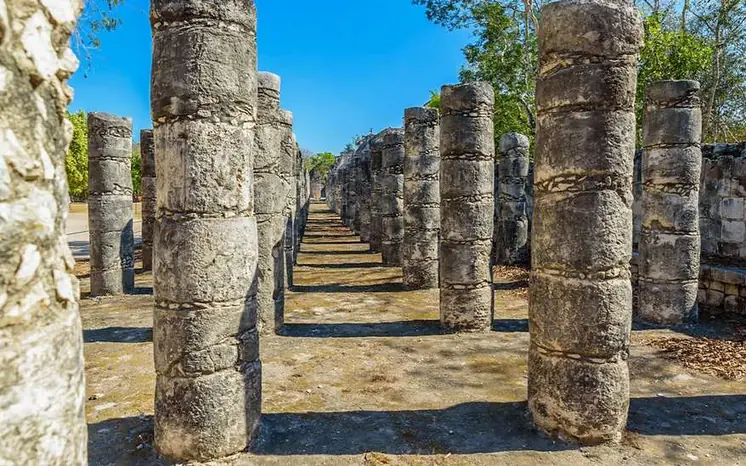
The Group of the Thousand Columns at Chichén Itzá. Columned halls like these stand at Tula too, the resemblance is where the debate starts, not where it ends.
1. Did the Toltecs Build or Conquer Chichen Itza?
The qualified verdict, up front. Everything on this page is graded in words, next to the claim it governs: observed (you can see it or measure it), supported (strong interpretation, widely held but an interpretation), contested (argued by named specialists, answered by others), and tradition (what the Maya books and colonial texts record, real as testimony, weaker as proof). Here is the whole argument in one table; the rest of the page earns each line.
| Claim | Grade | Why |
|---|---|---|
| The buildings resemble Tula's, specifically | Observed | The parallels (§3) are named figure types in named combinations, recognised since the 1880s. |
| Chichén was influenced from outside Yucatán, in some form | Supported | The parallels are too specific and too clustered to be coincidence; some connection existed. |
| Toltecs conquered Chichén | Contested | The old model's claim (§5). Never demonstrated, and the chronology (§4) cannot carry a one-way invasion. |
| Toltecs built Chichén | Contested | The city's inscriptions are Maya, its earlier phase is Puuc Maya; an ethnic label for its builders is unproven (§9). |
| Which direction the influence ran, and how | Open | Invasion, shared style, convergence, reverse influence and a recent arrival thesis are all in print (§§5–12). |
So: resemblances certain, conquest unproven, influence certain in some form, direction and mechanism open. A guide that gives you more certainty than that, in either direction, is giving you a position dressed as a fact. The buildings themselves, and the city that raised them, are introduced in our guide to the Itza, the people who built Chichen Itza.
2. What “Toltec” Means
Before the evidence, the word, because half the argument is hidden inside it. “Toltec” is not a name the people of Chichén are known to have used for themselves or for anyone else. It arrived later, carried by other peoples and then by archaeologists, and it drags its assumptions with it.
The terminology box
“Toltec” derives from the Nahuatl toltecatl: “person of Tollan”. In Nahua usage the word also meant “artisan, civilised person”: a compliment about craft and culture as much as a passport.
Tollan is not automatically Tula. Tollan is the place named in the traditions, the legendary city of the Toltecs. Tula, Hidalgo is the excavated city archaeologists identify with it. That identification is reasonable and widely used, but it is itself part of the debate, not a premise above it.
Nobody at Chichén is recorded calling themselves Toltec. The city's own hieroglyphic inscriptions are written in Maya. The label was applied to Chichén from outside, centuries later.
On this page, “Toltec-style” and “Mexican-style” are used only as attributed descriptive labels, shorthand for “the style that resembles central Mexico's”, and “Toltec invasion” is named as a hypothesis, never narrated as an event.
Hold those four points and the rest of the page reads differently: the question is never “were the Toltecs here?” in the abstract. It is always the narrower, answerable questions: which features match, what the dates allow, and what each kind of evidence can actually show.
3. The Parallels: What Matches Tula
The resemblances were recognised early: the French explorer Désiré Charnay was pointing them out in the 1880s, within years of the two cities being documented. They are not a vague “Mexican feel”. They are specific figure types, in specific combinations, turning up at both ends of Mesoamerica:
| Feature | At Chichén Itzá | At Tula |
|---|---|---|
| Chacmools: reclining figures holding a bowl on the belly | The summit of the Temple of the Warriors; the Great Ball Court area | Pyramid B and the Burnt Palace area |
| Feathered-serpent columns, balustrades, serpent-mouth portals, sun disks | The entrance of the Temple of the Warriors | Pyramid B |
| Warrior pillars and standard-bearers | The Temple of the Warriors and the Thousand Columns | The Atlantean figures of Pyramid B; the Coatepantli serpent wall |
| Columned halls | The Group of the Thousand Columns | The colonnades of the Burnt Palace |
| Tzompantli skull-platform imagery | The Tzompantli platform, carved with rows of skulls | Skull-platform imagery in central-Mexican art |
| Eagle-and-jaguar warrior imagery, heart-eating eagles | The Platform of the Eagles and Jaguars; the ball-court reliefs | Central-Mexican warrior imagery |
| Venus and warrior iconography | The Platform of Venus | Central-Mexican imagery |
One caution this page keeps, because the specialists keep it: resemblance is a shared vocabulary, not a shared blueprint. The Temple of the Warriors is a relative of Tula's Pyramid B, different proportions, different masonry, different detail, and no building at Chichén is a traced copy of one at Tula. The match is real; what it means is the argument.
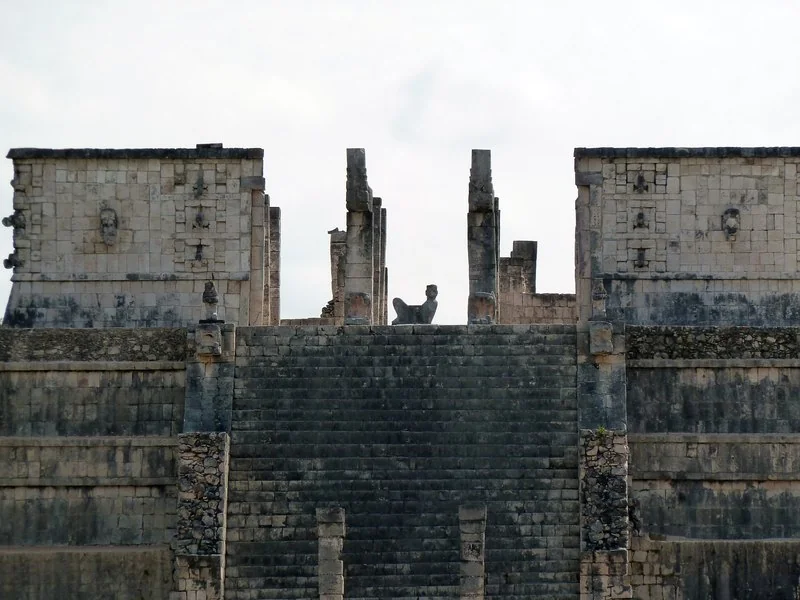
Chichén Itzá: the Warriors summit: the chacmool before the doorway, flanked by serpent columns.
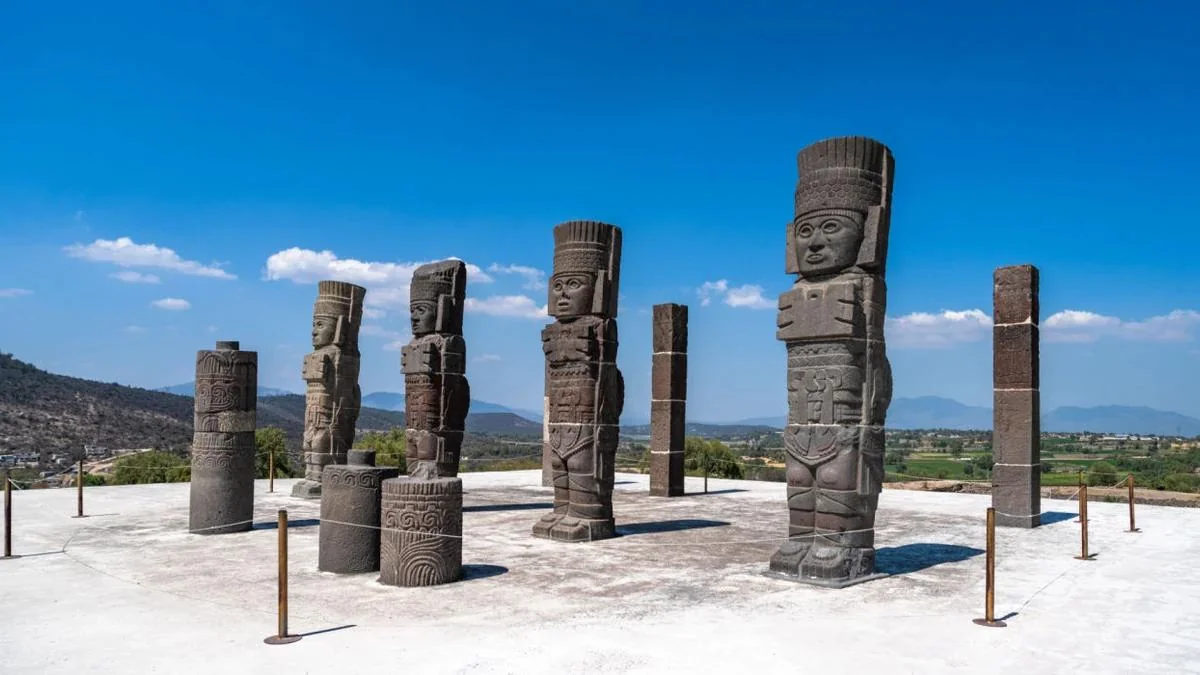
This photograph is Tula, Hidalgo, not Chichén: the Atlantean figures on Pyramid B. Photo: TheTravel.
The two buildings at the centre of the table have their own guides, with their own measurements and grading: the Temple of the Warriors and the Thousand Columns and the Great Ball Court.
4. The Dating Problem: Which City Came First?
Every version of the invasion story needs the same thing: Tula first, Chichén after. An influence arrow is a claim about time. And time is exactly what the two cities refuse to give up cleanly. Tula's Tollan phase is broadly dated c. 900–1150. Chichén's “Mexican-style” phase, the phase of the Warriors, the colonnades and the chacmools, carries not one scholarly chronology but two:
| City and phase | Published range | Source |
|---|---|---|
| Tula: the Tollan phase | c. 900–1150 | The standard published range |
| Chichén: the “Mexican-style” phase (model A) | c. 800–1100 | Ringle's model |
| Chichén: the “Mexican-style” phase (model B) | c. 950–1150 | The INAH/UCSD chronology, discussed by Ringle (2017) |
Read the table the way the specialists are forced to. On model A, Chichén's phase begins before Tula's. On model B, the two phases run side by side. On neither does Tula stand clearly earlier, finished and exporting, while Chichén waits to receive. The ranges overlap, and if the ranges overlap, or Chichén's phase is the earlier one, a one-way Tula→Chichén invasion cannot be read off the buildings. The stones show resemblance; only dates could show direction, and the dates will not separate.
The newest dating evidence cuts against the old direction too, and this page prints it with its caveat attached: a 2020 radiocarbon meta-analysis (Hare) leans toward Tula being later than Chichén's “Toltec” phase. A meta-analysis reweights dates other teams produced, and Hare's reading is published with its own methods caveat, graded here as one contested reading of the radiocarbon record, not a verdict. But it underlines the section's point: the chronology is a problem for the invasion story first, and for everyone else second.
5. The Old Model: Two Chichéns
Charnay noticed resemblances; the Carnegie-era archaeology of the early 20th century turned resemblance into a story with a plot. In Sylvanus Morley's scheme (The Ancient Maya, 1946), the city divides in two: an earlier “Maya / Puuc” phase, Old Chichén, and a later “Toltec / Mexican” phase, New Chichén, built after an incoming group arrived from central Mexico. Tozzer's synthesis (1957) gave the scheme its fullest form: the newcomers were “probably Mexican in origin”, and the later city was their work laid over the Maya one.
The model's famous date belongs to the model, and this page prints it that way every time: the arrival was set at 987, a year produced by converting the Maya books' katun tradition into Christian-era dates. Why that conversion cannot yield one trustworthy year is shown in the Itza guide: the katun cycle repeats, and its candidate years land centuries apart. 987 is where the model put its marker. It is never, on this page, an observed event.
The old model also carried a frame, and naming it matters because later sections argue with it directly: peaceful Maya, warlike Toltecs, a creative, gentle people overwhelmed by militarists from the highlands. That contrast did argumentative work for fifty years. It is part of the model, graded as the model's assumption, and §9 and §11 show two different critiques of it, one scholarly and one institutional.
6. The Putun Variant
J. Eric S. Thompson (1970) kept the arrival but changed its route and its people: the carriers of the “Mexican” traits were, in his proposal, Putun (Chontal) Maya, seafaring merchant-warriors of the Gulf coast, Maya already “Toltecized” by contact with central Mexico, who reached Yucatán by the canoe trade routes and took or refounded Chichén from the sea. It is one paragraph here because it is one variant of the old model, and because the hypothesis belongs to the Itza's story, where its present grading (a serious proposal, outdated and oversimplified in part) is set out in full: the Itza, the people who built Chichen Itza.
7. Kubler Reverses the Arrow
The first serious challenge to the old model did not deny the parallels, it reversed them. In 1961, George Kubler (“Chichén Itzá and Tula”, Estudios de Cultura Maya 1) argued the chronology could run the other way: Chichén first, Tula borrowing, the supposed pupil as the teacher. Kubler was also sceptical of a Toltec presence at Chichén at all, a doubt §9 picks up.
What made the reversal arguable was not a new building but the same weakness §4 lays out: the dates. Once Chichén's “Mexican-style” phase could be placed as early as Tula's phase, on some chronologies earlier, the direction of influence stopped being something the stones announced and became something the assumed chronology supplied. Kubler's paper is sixty years old and its central lesson has not expired: in this debate, whoever controls the dates controls the arrow. Nobody controls the dates.
8. The International Style
The position most often met in current textbooks starts from a different question: what if nobody invaded, because nobody needed to? Ringle, Gallareta Negrón & Bey (1998, “The Return of Quetzalcoatl”, Ancient Mesoamerica), developed by Ringle (2004; 2017, “Debating Chichen Itza”), propose an “international style”: a package of architecture, imagery and Feathered Serpent cult that spread across Mesoamerica through an elite network, shared by rulers who visited, allied, intermarried and out-built each other, the way courts share fashions. In this model Chichén is a participant and an innovator, not a colony, and both it and Tula may have drawn on older shared sources, the Epiclassic world of the Gulf coast and centres such as Xochicalco and El Tajín.
Grade it exactly: leading, and contested. It is the framework a visitor is most likely to hear from a modern textbook or museum label. It is not a settled consensus, §12 presents named specialists arguing, with new evidence, that people from Tula really did come. Any summary that upgrades “leading” to “settled” is overstating the record, and this page does not repeat the upgrade.
9. The Local-Development Critique
A second line of attack questions the label itself. Cynthia Kristan-Graham (in Kowalski & Kristan-Graham, eds., Twin Tollans, 2007) argues that “Toltec” is unproven as an ethnic or political fact at Chichén: no inscription names Toltec rulers, no text records a Toltec administration, and the supposedly foreign buildings' functions and meanings read as local, a caution our Warriors guide reaches independently about that temple's purpose. On this reading the style travelled; whether a people did is a separate claim, still waiting for its evidence.
Lindsay Jones (1993/1995) presses the continuity from the other side: Chichén's architecture develops out of what stood there before, its builders show Maya agency throughout, choosing, adapting and inventing rather than receiving, and the old frame of peaceful Maya versus warlike Toltecs is inadequate to the buildings either city actually raised. That last judgement is graded supported: the binary was the old model's assumption, and the evidence never required it.
10. Interaction, Not Invasion
Between “an army came” and “only ideas travelled” sit the positions that allow real people without a conquest. Jeff Karl Kowalski argues for genuine contact and exchange with central Mexico, possibly including Mexican merchants or warriors present at Chichén, sustained, consequential, and short of conquest: graded supported in part, contested in part, because the contact is easier to show than the headcount. Wren & Schmidt (1991), as INAH presents them, describe convergence: an eclectic art at Chichén that deliberately combines Maya and Central Mexican traditions, two streams meeting in one city's workshops rather than one replacing the other.
These middle positions matter for a practical reason: they are what the physical evidence most easily fits. Trade goods move, styles move, some people move, and none of it, by itself, amounts to a takeover. The conquest claim needs more than contact. It needs the chronology of §4 and the documentary proof of §13, and it has neither in settled form.
11. What INAH Says
INAH, Mexico's Instituto Nacional de Antropología e Historia, manages Chichén Itzá, and its essay on this exact question (Santos Ramírez, “Chichen Itza and the Toltec Question”, Lugares INAH) is the institutional summary. This page quotes it at that grade, the site authority's own wording, and prints both of its strands whole, because they sit side by side in the essay itself.
INAH's two strands
The network: Chichén and Tula “formed a pan-Mesoamerican network of politically and culturally prestigious centres”, peer capitals in contact, not metropolis and colony.
The arrival: INAH's phase wording has Toltecs from the Central Highlands arriving around 900 AD and combining with the Maya population, arrival and combination. The word the institution does not use is conquest.
The essay also carries a motive critique, printed here attributed to it: the conquest story, INAH argues, cast the Maya as passive victims of warlike foreigners, a Europe-centric frame, in which civilisation was imagined arriving by invasion because that was the story Europe told about itself. Whether or not a reader accepts that critique, it explains why the institution's wording is careful: the old model is not just a dating claim to INAH, it is a claim about who got to be an actor in Maya history.
12. The Revival: The Toltecs Return to the Argument
Most guides to this debate stop at §8, as if the argument ended with the international style. It did not. Since 2019, named specialists have argued, in print, with new readings of the evidence, that the older idea was closer to the truth, and any honest account has to carry their case at its proper grade.
Stanley Guenter (2019, The Mayanist) argues that the newest chronology, together with a fresh reading of the ethnohistory, brings back the older model: Central Mexicans from Tula as the source of Chichén's “Mexican” styles, adding that early-colonial Maya sources themselves recognise a conquest some five centuries before they were written. Guenter's claims are published here attributed, as what they are: a forcefully made argument, not a measurement.
Péter Bíró & Eduardo Pérez de Heredia Puente (2024, UNAM / SciELO) argue on epigraphic and architectural grounds for an arrival of people from Tula around 900–950, and propose an inscription date of 932 CE for the event's commemoration. That date is printed here exactly as they present it, a proposed interpretation of an inscription. A proposed reading is an opening move in an argument, never proof of a migration, and this page does not upgrade it.
The section's grade is explicit: contested, actively. The revival is answered by defenders of the chronologies and models in §§4 and 8, and the exchange is live. But a page that crowned the international style and omitted Guenter and Bíró & Pérez de Heredia would not be reporting the debate, it would be taking a side while pretending the other side had left the room.
13. What the Colonial Sources Actually Say
The old model was never built on stones alone; it had a documentary anchor, and the anchor deserves its exact grade. The Books of Chilam Balam and Bishop Landa's Relación record a Kukulkán tradition at Chichén, a lord who came from the west. The Florentine Codex, compiled in central Mexico, tells of Topiltzin Quetzalcoatl leaving Tollan and travelling eastward. Put together, those strands gave the invasion story its plot: a Toltec lord-king, an eastward journey, a city refounded.
Grade the strands separately, because they carry two different weights. As recorded tradition: strong: the texts exist, they say this, and they are the Maya's and the Nahua's own recorded memory. As proof of a migration: weak: they were written down in the colonial centuries, hundreds of years after the events they describe, in a conquered world. A tradition is evidence about what was remembered; turning it into a passenger list requires the archaeology of §14, which has not supplied one.
The narrower strand, whether Kukulkán the man was Topiltzin, is a scholarly proposal, unsettled, and it is not biography; the Itza guide carries Kukulkán the man at tradition grade. One later claim needs naming only to be dismissed: that Topiltzin was a white, bearded European appears in no pre-conquest source at all, it is a colonial-era invention, and it survives here as a named debunk, not as a tradition.
14. What Could Settle It
If the buildings and the books cannot settle the question, perhaps the laboratories can. Four kinds of physical evidence have been brought to the debate. Each is real science; each shows less than the headlines made of it. Here is what each test actually shows so far.
Ceramics: the break that blurred
The old model needed a cultural break at Chichén, and pottery seemed to supply one: the Cehpech and Sotuta ceramic complexes were read as sequential, one population's ware replaced by another's. Anderson (2008) found the two complexes overlapping stratigraphically at Yula: in the ground, they coexist. The clean break blurs. And the deeper point survives either way, even a perfect sequence of pots could not establish the ethnicity of the people who built the temples. Pottery is not a passport.
Obsidian: provenance is not control
Chichén drew its obsidian from multiple sources, and the mix changed over time (Cobos). Green obsidian from Pachuca, in central Mexico, is present at the city, and its presence has been read as Tula's hand on Chichén's trade. That reading makes a banned inference: provenance is not institutions. A traded stone proves exchange happened. It does not prove who governed the exchange, let alone the city.
Isotopes: chemistry that cannot name a hometown
Price, Tiesler & Freiwald (2019) analysed human remains from the Sacred Cenote, reading the strontium and oxygen signatures that record where a person grew up. The geochemistry itself is graded observed, the measurements are sound. But a signature consistent with “not local to Chichén” is not a signature that reads “Tula”: attributing any individual in that sample to Tula specifically is contested, and the study's own care on that point is part of its value.
Ancient DNA: continuity, and a sample's limits
The 2024 Nature study sequenced 64 subadult genomes from a burial context near Chichén and found kinship and regional continuity, graded observed, for what the study found. What it cannot do, from that sample, is confirm or deny a 10th-century arrival of adults from central Mexico: the children in one burial are not a census of a city's founders. Claims that the DNA result closes the question are refused on this page in both directions, because in both directions they would be false.
The honest close: no single technique settles the question, and the debate is live. What would move it is what §4 identified: tighter, independent dates for both cities' building phases, firm enough to order them. Until that chronology exists, every position in §§5–12 remains arguable, and the correct posture toward all of them is the one this page has kept: attributed, dated, and graded.
15. What You Can See on the Ground
The debate is not abstract once you are standing in the northern precinct, the parallels are the buildings themselves, a few minutes' walk apart. Read them in this order, and keep §4 in mind as you go: what your eyes prove is resemblance; the direction is the argument.
Start at the Temple of the Warriors: climb your eyes up the west stair to the chacmool on the summit, reclining before a doorway framed by feathered-serpent columns, then turn to the colonnades of the Thousand Columns running beside it, the full inventory in the Warriors guide. A few steps north, the Great Ball Court carries the same world in relief, eagles, jaguars, warrior processions, with chacmools in its temples; its own graded guide is the Great Ball Court guide.
Beside the court stand the Tzompantli, its walls carved with rows of skulls, and the Platform of Venus, with the Platform of the Eagles and Jaguars alongside, the imagery cluster of §3 in one glance, covered in the Tzompantli, Venus Platform and Osario guide.
Finish at El Castillo, where the feathered serpent runs down the north balustrade in stone, the cult image at the centre of Ringle's network model, in the El Castillo guide. And for the comparison this page deliberately leaves to its own owner, the Puuc cities to the west make the counterpoint: Chichen Itza vs Uxmal.
Whichever side of the debate you land on, the buildings are read best in the order you meet them, the Chichen Itza visitor guide walks the site that way, structure by structure.
16. Walk the Evidence on the Shared Tour
Our shared tour runs Chichen Itza + a swim at Cenote Ik Kil + Valladolid in one day, at $130 per adult and $115 per child (to age 12), the 697 MXN Chichen Itza entrance fee is included in that price. We pick you up from your own hotel or pickup point; your exact pickup time is confirmed on WhatsApp the night before. To reserve, a 30% advance holds your seats, no-shows are common and a blocked seat stops a ready customer from going, and the balance is paid on the day of the tour. Free cancellation up to 48 hours before the tour: cancel 48+ hours ahead and the advance is refunded in full; inside 48 hours the advance is kept.
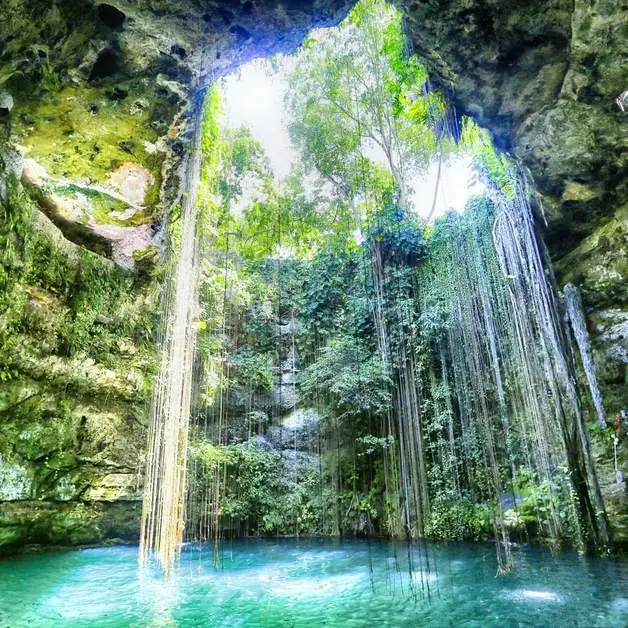
Cenote Ik Kil: the swim stop on the tour. Photo: Moon Travel Guides / iStock.
Walk the northern precinct with this page in mind and the argument becomes physical: the chacmool is not a textbook diagram, the colonnades are not a rumour of Tula, they are stone you can stand inside. What they prove, and what they cannot, you now know better than most visitors ever will.
Pickup cities, in order: Cancun · Tulum · Playa del Carmen · Riviera Maya · Merida. Each city page carries its own pickup zones and drive times.
Work out your total
City pages: Cancun · Tulum · Playa del Carmen · Riviera Maya · Merida