The Tzompantli, the Platform of Venus and the Osario: The Complete Guide
Three smaller structures, three famous claims, and three corrections this page makes in the open. The skulls on the Tzompantli are carved, not real. The celebrated chacmool was never found on the Platform of Venus. And the Osario's "high priest" is a 1938 book title, not a buried man. But one marvel here is entirely real: the cave under the Osario, and it was dug and documented in 1896, not detected by instruments.
We run the shared Chichen Itza tour described near the end of this guide. We are a new operator with a short track record, and we say that plainly. The information about the three structures comes from the published sources named here, not from us.
Three Structures, Two Plazas
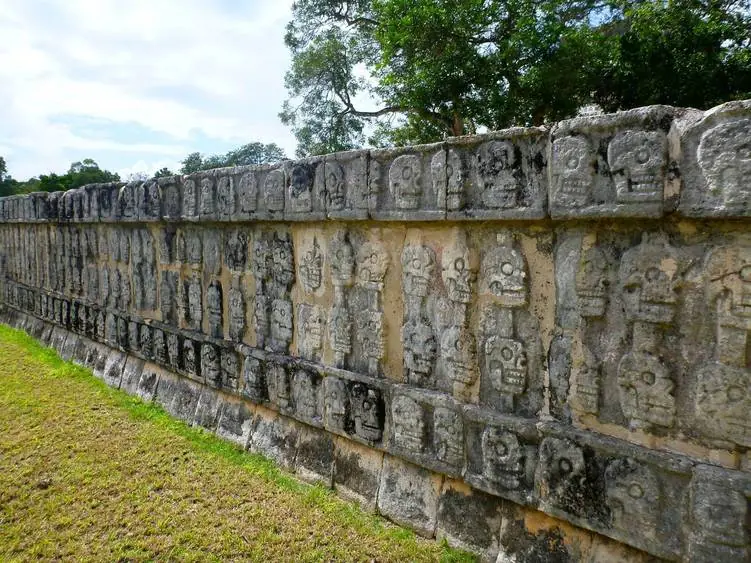
Two of these structures stand on the Great North Platform, the ceremonial terrace that also holds El Castillo and the Great Ball Court. The Tzompantli sits beside the Ball Court, a long, low wall of carved skulls you pass on the plaza's north side. A short walk away, directly north of El Castillo, stands the Platform of Venus, a square platform with a stair on each side and nothing left standing on top. The third structure is in a different world: the Osario is a small stepped pyramid in the southern Osario Group, quieter, less crowded, and wrapped in the biggest legend of the three.
They share a page because they share a problem. Each is usually introduced to visitors through one dramatic claim, a rack of real skulls, a chacmool, a high priest's tomb, and in each case the claim outruns the evidence. This page gives each structure its own sections and grades every famous claim against the sources that actually support it. For the site as a whole, start with the Chichen Itza Visitor Guide; this page stays with these three.
The Tzompantli: A Wall of Carved Skulls
The Tzompantli is a low, T-shaped platform, 55 × 12 m, set beside the Great Ball Court on the Great North Platform and oriented 17° east of north, with a 6.5 m staircase on its east side (Virginia E. Miller, Arqueología Mexicana). Popular sources often give its length as 60 m; Miller's 55 m is the scholarly figure and the one this page leads with, the variant is noted here rather than silently swapped in.
What covers it is the point of the building: four horizontal rows of skulls carved in low relief, row upon row along the platform's faces. Look closely and the carving carries a cultural signature: the skulls are shown pierced vertically, the Maya manner of display; Mexica skulls, centuries later and far away, were pierced side-to-side (§5). Around the skulls the programme continues: about 20 male figures in profile, 16 eagles grasping human hearts, carved imagery, and published here as imagery only, rattlesnake mouldings, feathered serpents at the corners, and traces of the original blue and red paint still surviving on the stone.
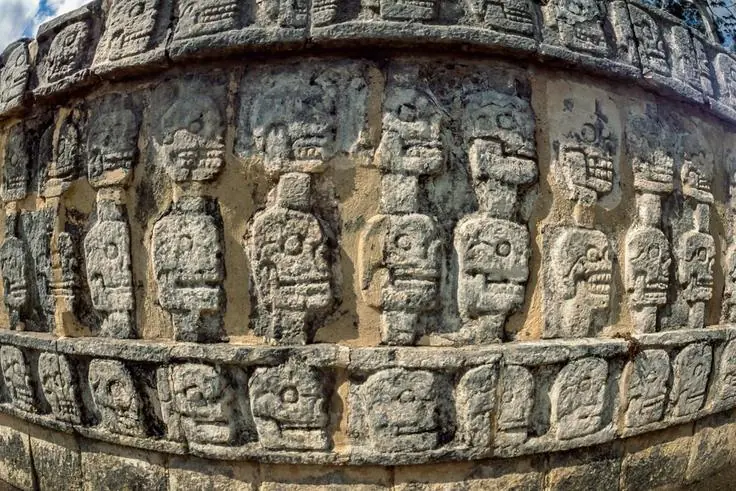
Were the Skulls Real?
So the honest picture is stranger than the legend, and better documented. A Maya platform whose walls picture a skull display in permanent stone; inside it, a single deliberate deposit of two real skulls with precious goods. Miller's framing, attributed to her: this is the earliest permanent skull-display structure known in the Maya world, built centuries before Tenochtitlan raised its own (§5). What the deposit of two skulls meant is not recorded, and this page does not invent a meaning for it; what the evidence supports about the practice itself is graded on the Chichen Itza human sacrifice evidence page.
Why "Tzompantli"? A Nahuatl Name on a Maya Platform
"Tzompantli" is a Nahuatl word, the language of the Mexica, meaning roughly "wall of skulls". Archaeologists applied it to this Maya platform; the platform's own Maya name is not recorded, and none is invented here. The word travelled because the idea, a structure for displaying skulls, was recognised across Mesoamerica, even though at Chichén the display was carved in stone rather than mounted in fact (§3).
The study history is short and checkable. Eduard Seler noted the platform in 1909, calling it "Mausoleo II"; Erosa Peniche worked on it in 1927 and Cirerol in 1940; and the platform you see today is substantially the reconstruction of 1951 by Acosta and Salazar, which is why its carved rows read so cleanly. Miller dates the platform to about 800–1100, the Terminal Classic into the Early Postclassic. It is a Maya building of that era, full stop: the Nahuatl name is a label archaeologists brought with them, not a clue about who built it.
Not the Huey Tzompantli
The contrast is worth holding onto because it cuts the other way too. Chichén's platform came first: Miller's point (§3) is that the permanent skull-display structure appears in the Maya world centuries before the Mexica built theirs. Where the remains evidence at Chichén genuinely is overwhelming, it is not at this platform at all: it is in the Sacred Cenote, whose offerings and human remains are a separate, documented story.
The Platform of Venus
Directly north of El Castillo stands a low, square platform with four staircases, one on each side, their balustrades ending in serpent heads, and no building surviving on top (INAH's description). A side of about 25 m circulates for it; that figure is a secondary one, flagged as such here, and no verified height for the platform exists, the neat height in many guides is not a published measurement, so none is printed here as one.
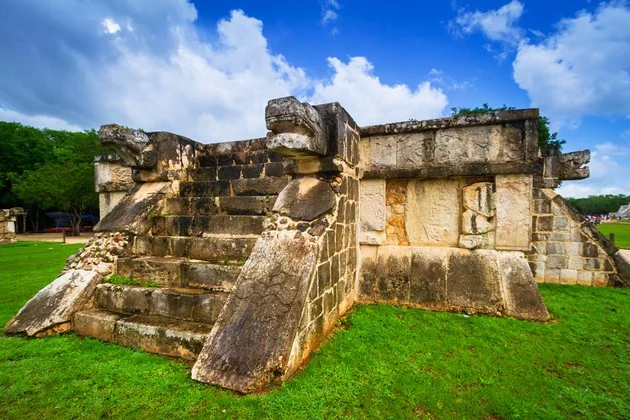
Why "Venus"? The name comes from the carving, not from an observatory log. Its panels carry half-star signs identified with Venus as the morning star (INAH), set among feathered-serpent imagery and year-bundle, "knot of years", signs. Venus mattered intensely across Mesoamerica, and the signs are real. But claims that a specific rising was observed from this platform, or that wars were timed from it, are interpretations: no source records such an event here, and this page prints none. What the platform was for is graded the same way: interpretation "probably a podium for rites, ceremonies and dances": the "probably" belongs to the claim, and it stays attached.
The Chacmool That Wasn't Here, and the Second Platform
The platform does have one genuine excavation story, and it is published here attributed and brief: Augustus and Alice Le Plongeon excavated here in November 1883, and their own accounts report finds that included a stone urn with jade and crystal pieces. That is the excavators' report, printed as theirs: no fuller inventory exists in the sources, so none is supplied. And a warning that saves confusion on the ground: INAH's monument lists name a second Platform of Venus in the Osario Group, a different platform carrying similar signs, down in the southern group near the Osario itself (§8). Two platforms, one name; the famous one is El Castillo's neighbour, and the two should not be merged.
The Osario: A Small Pyramid With a Large Legend
The Osario is a stepped pyramid in the southern Osario Group that reads like a small El Castillo: seven stepped tiers and four staircases (INAH, a popular page's "nine blocks" is a variant, noted here because you may meet it), balustrades of interlaced serpents, and an upper temple carried on two feathered-serpent columns, with carved panels. One pilaster carries an inscription associated with 998 CE, an inscription date, not a construction date, a distinction this page repeats every time the year appears (§13). And on size, the same discipline as the Venus platform: no reliably published total height for the Osario exists. A round figure in some guides is not a measurement, and none is printed here as one.
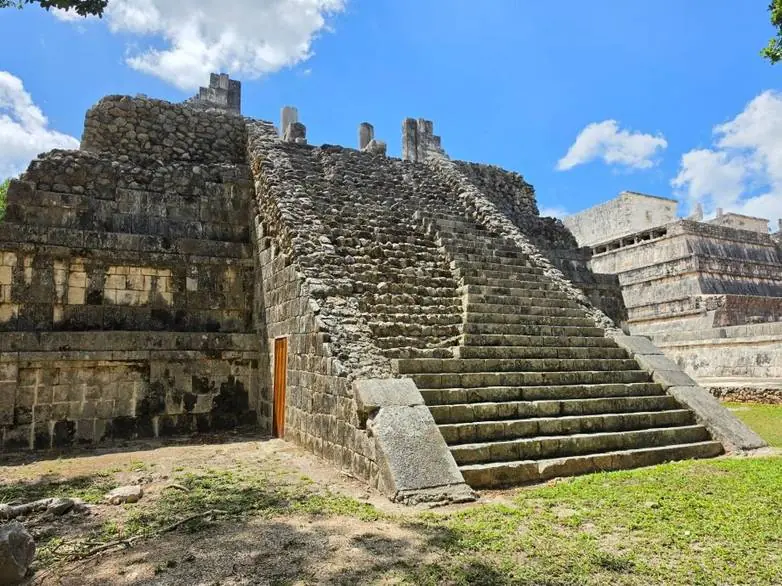
One neighbour, kept separate on purpose: the Platform of the Tombs stands in the same group and is a different structure: its vaulted chambers are its own, and they are never merged with the Osario's shaft graves (§10) on this page or, if you can help it, in your notes.
The Name Problem: There Is No High Priest
Both of this pyramid's names are modern labels. "Osario", Spanish for ossuary, a bone repository, is a nickname the building's bone finds earned it. "High Priest's Grave" is more specific and less true: it is the title of Edward Thompson's 1938 book about the building, not the identification of anyone buried in it. No priest, named or otherwise, has been shown to be buried here. The "high priest" is a character a book title created, repeated by a century of guidebooks until he sounded like a find.
Thompson went one step further, and it is published here exactly as far as it goes and no further: his speculation Thompson himself guessed the tomb might be Kukulkán's. That is his labelled guess, printed with his name on it and no evidence claimed for it, not a tradition, not a finding, and not a reason to call this pyramid anyone's tomb. The modern reassessment's verdict on the whole framing is in §11; its title alone tells you where the scholarship landed.
Down the Shaft: What Thompson Found in 1896
Here is what is genuinely extraordinary about the Osario, needing no legend. From the floor of the summit temple, a masonry shaft descends through the body of the pyramid into a natural cave below. Edward Herbert Thompson excavated that shaft in 1896, dug it, descended it, and documented what he found, and published the work in 1938 as The High Priest's Grave (Field Museum; edited by J. Eric Thompson).
What Thompson reported, in his terms: seven graves, cists, built into the shaft, containing ceramics, jade, rock-crystal beads and copper bells, with human bone in some of them. Note the wording, because §11 turns on it: seven cists, bone in some, reported by the excavator in 1896 and published four decades later. That report is the foundation everything else stands on, and, as the modern team found, it does not say quite what the legend made of it.
What Modern Archaeology Says Instead
In 2019, Cobb and colleagues published a reassessment in Arqueología Mexicana (no. 157) whose title is literally "The demystification of the high priest's tomb", and the demystification is itemised, which is what makes it useful. Going through Thompson's cists, they found that cists 4 and 7 had no documented human bone. The cave passages Thompson described did not survive re-survey either: his "seven extensive passages" were not confirmed; the longest passages the modern team measured run about 4 m.
| Measurement | Thompson (1896, published 1938) | 2019 reassessment (Cobb et al.) |
|---|---|---|
| The masonry shaft | Not reported | 10.51 m |
| Drop from the connecting chamber into the cave | 15.85 m, his figure, superseded | 10.90 m |
| Main cave chamber | Not reported | About 16 × 6 m |
| Cave passages | "Seven extensive passages" | Longest about 4 m; the seven not confirmed |
The modern reading reverses the building's logic. The cave pre-dates the pyramid and was its reason: a sacred cave portal, an ancestral shrine, an axis mundi, over which the pyramid was raised (Cobb et al.). INAH archaeologist José Francisco Osorio León, reported by SIPSE in December 2025, put it in one sentence: the cave "was not a tomb, nor an observatory, but a ritual space" for agricultural rites about a thousand years ago. The reassessment dates the pyramid's final form toward the end of the 10th century, attributed to Cobb's team, as is everything in this paragraph.
One delicate item, with both of its hedges printed because both belong to it: Cobb's team also examined Thompson material held at Chicago's Field Museum, including cranial remains of at least four young children, possibly associated with one of the graves: the association is not firmly established. And a standing honesty note: no complete custody or display history for the Osario remains exists in the sources, so this page does not tell you the remains sit in any particular museum. Ritual practice at Chichén in scholarly depth, what sacrifice claims the evidence supports, site-wide, belongs to this site's forthcoming rituals piece; the neighbouring Great Ball Court guide grades its own famous carving debate the same way.
Does the Cave Reach Cenote Xtoloc?
Two different connections get confused here, so they get two different sentences. Documented A surface sacbé, a raised Maya road, connects the Osario Group to Cenote Xtoloc (INAH). You can walk the line of it; it is a road, above ground. Not proven An underground connection between the Osario's cave and the cenote: a 2017 survey looked for water connections, and Thompson's long passages, the only route such a link could take, were not confirmed by the modern survey (§11).
That leaves the tour-blog versions, long tunnels running from the Osario to the cenote, or even to El Castillo, exactly where the evidence leaves them: unproven, and published here as unproven. No survey in the sources confirms any tunnel out of this cave. The sacbé is the real connection, and it has the advantage of existing.
When Were They Built?
Three structures, three answers, each with its source attached. The Tzompantli: about 800–1100, per Miller: Terminal Classic into Early Postclassic, with the platform you see substantially Acosta and Salazar's 1951 reconstruction of it (§4). The Platform of Venus: dated by context: it belongs to the Great North Platform's building programme alongside El Castillo, and no inscription or excavation gives it a year of its own; this page assigns it none. The Osario: the 998 CE figure is an inscription date on a pilaster, the date a text carries, not the year the pyramid rose; the 2019 reassessment places the pyramid's final form toward the end of the 10th century (Cobb et al., attributed), over a cave that is older than the pyramid itself.
Visiting Today
All three structures are read from outside, at plaza level: there is no interior to enter at any of them, and the Osario's shaft and cave are not open. What repays attention is on the surfaces, in this standing order:
- The Tzompantli's rows. Walk the long face slowly: four rows of carved skulls, the vertical piercing on each, the eagles and figures between them, and the surviving flecks of blue and red paint.
- The Venus platform's four stairs. Circle it, a stair on every side, each balustrade ending in a serpent head, then find the half-star Venus signs in the panels that gave it its name.
- The Osario's summit. From the plaza, read the seven tiers and the serpent columns of the upper temple, and remember what is under your sightline: the shaft, the cists, and the cave the pyramid was built to crown.
- The two plazas as a pair. The northern pair belongs to the great ceremonial terrace; the Osario to the quieter southern group. Most visits reach the north first and the south if time allows.
What you may and may not do at the site, climbing, restricted areas, equipment, is covered on the Chichen Itza site rules page.
See All Three on the Shared Tour
Our shared day trip includes Chichen Itza, a swim at Cenote Ik Kil and a stop in Valladolid. It costs $130 per adult and $115 per child up to age 12, including the 697 MXN Chichen Itza entrance fee. We pick you up at your hotel or pickup point and confirm the exact time on WhatsApp the night before. A 30% advance reserves your place, with the balance due on the tour day. Cancellation is free up to 48 hours before the tour, and the advance is refunded in full. We are a new operator, and we say so plainly.
City pages: Chichen Itza tour from Cancun · from Tulum · from Playa del Carmen
Price calculator
The 697 MXN Chichen Itza entrance fee is already included in these prices, so there is nothing extra to pay for entry at the gate.
The Tzompantli, Venus Platform and Osario: Frequently Asked Questions
Are the skulls on the Tzompantli at Chichen Itza real?
No. The skulls covering the platform are carved in low relief in the stone. Excavation inside the platform found exactly two real human skulls, deposited with jade, shell beads and pyrite-mosaic mirrors. No excavation evidence supports a standing rack of real skulls here.
How many skulls are carved on the Tzompantli?
The count is a conflict, printed as one: Virginia E. Miller counts approximately 2,400 carved skulls, while INAH's visitor brochure gives 1,880. Both figures count carved reliefs, neither is a count of victims.
What is the difference between the Tzompantli at Chichen Itza and the Huey Tzompantli?
They are in different cities, built by different cultures centuries apart. The Tzompantli at Chichen Itza is a Maya platform covered in carved skull reliefs. The Huey Tzompantli at Tenochtitlan, the Mexica capital, was a display of real skulls: INAH's 2015–2018 excavations found real skull towers there, with totals that vary between published accounts.
Why is it called the Platform of Venus?
Because its carved panels carry half-star signs that INAH identifies with Venus as the morning star, alongside feathered-serpent imagery and year-bundle signs. The name comes from the carvings, not from any documented observation made from the platform.
Was a chacmool found on the Platform of Venus?
No. That claim is not established. It circulates on tour websites, but the documented chacmool finds at Chichen Itza belong to the Tzompantli area and the neighbouring Platform of Eagles and Jaguars (Miller). The Venus claim appears to trace to a nickname confusion on tour sites.
How many Platforms of Venus are at Chichen Itza?
Two, according to INAH's monument lists: the famous one directly north of El Castillo, and a second, different platform with similar signs in the Osario Group. They are separate structures. Do not confuse them.
Who was the high priest buried in the Osario?
No high priest has been shown to be buried there. 'High Priest's Grave' is the title of Edward Thompson's 1938 book about the building, not an identified person. Thompson also guessed the tomb might be Kukulkan's, published here only as his labelled speculation, with no evidence claimed.
What was found inside the Osario?
Edward Thompson excavated a masonry shaft through the pyramid in 1896 and reported seven graves (cists) built into it, containing ceramics, jade, rock-crystal beads and copper bells, and human bone in some. The 2019 reassessment (Cobb et al.) found that cists 4 and 7 had no documented human bone.
Does the Osario cave connect to Cenote Xtoloc?
No underground connection is proven. A surface sacbe, a raised Maya road, connects the Osario Group to Cenote Xtoloc (INAH). A 2017 survey looked for water connections, and Thompson's long cave passages were not confirmed by the modern survey.
Can you go inside the Osario?
No. The Osario, like the Tzompantli and the Platform of Venus, is read from outside at plaza level on an ordinary visit; the shaft and cave are not open to visitors. The site rules page covers what is open at Chichen Itza.
¿Qué es el tzompantli de Chichén Itzá?
Es una plataforma maya baja, de 55 × 12 m, junto al Gran Juego de Pelota, cubierta de cráneos tallados en relieve, unos 2.400 según Virginia E. Miller; el folleto del INAH da 1.880. En su interior solo se hallaron dos cráneos reales. 'Tzompantli' es una palabra náhuatl: el nombre maya original de la plataforma no se conoce.
When was the Osario built?
The 998 CE date attached to the Osario is an inscription date on a pilaster, not a construction date. The 2019 reassessment (Cobb et al.) dates the pyramid's final form toward the end of the 10th century, and the cave beneath it is older than the pyramid.
Check Your Date on WhatsApp
Booking opens on WhatsApp: that is where your date is checked, your pickup point is set, and your exact pickup time is confirmed the night before the tour. Send one message with:
- Your tour date
- Your pickup city and hotel or pickup point
- How many adults and children (to age 12)
$130 per adult · $115 per child · 697 MXN entrance fee included · 30% advance to reserve · free cancellation up to 48 hours before.
Start with your date
One tap opens the conversation. Prices above are the full per-person prices: the entrance fee is already in them.