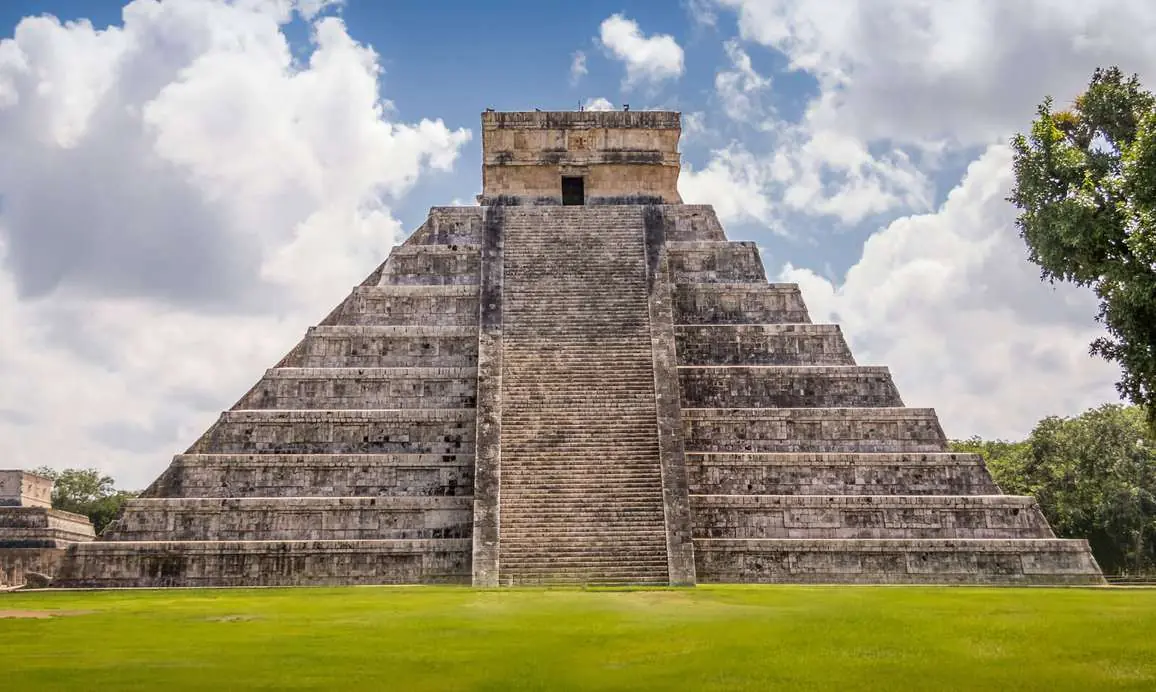
Chichen Itza Rules: What Is Prohibited
The rules themselves are simpler than the internet makes them: don't climb, don't touch, don't fly a drone, stay on the paths. But two of the most-searched rules, the personal camera charge and the 2026 bag change, are not settled on any official page, and most guides print them as settled anyway. This page does something different: every rule carries its grade in words, stated by INAH, widely reported, or conflicting reports, so you can see exactly how much weight each one can bear before you plan around it.
A note on who is writing this: we run a shared Chichen Itza tour, and this page is written for every visitor, including travellers who will never book it. We are a young operator with a short record. One boundary is stated now and repeated where it matters: the same rules apply on our tour, a booking exempts nobody from any rule on this page, and we secure no permits for anyone. Where the sources conflict, the conflict is printed, not smoothed over.
How to Read These Rules: Three Grades
Start with the fact that shapes everything below: INAH's own zone page for Chichen Itza publishes the opening hours and the $105 MXN federal entry component, and no rules list at all. Almost every famous "rule" you will read elsewhere is therefore secondary reporting: operator pages, ticket guides and visitor accounts repeating each other, sometimes for years after the position changed. That does not make the rules unreal, most of them are enforced at the gate every day, but it does mean they do not all deserve the same confidence. So this page grades each one, in words, and applies the grades consistently:
- Stated by INAHStated by INAH: the rule, or the procedure behind it, appears on an INAH page itself: the zone page, or INAH's authorisations (tramites) portal. This is the strongest grade anything on this page can carry.
- Widely reportedWidely reported: no INAH page states it, but independent sources agree and nothing credible contradicts it. You can plan around these rules with confidence, while knowing whose word you are taking.
- Conflicting reportsConflicting reports: the sources disagree: on the amount, on the dates, or on whether the rule is in force at all. These are published as conflicts, with the sources named, and the practical advice is written to work under every version.
Two topics on this page sit in the third grade and are worth naming before you meet them: the personal camera/video charge (section 4), where INAH confirms a fee exists but publishes no amount, and reported figures run from 45 to 63 MXN; and the 2026 bag change (section 6), where dated sources disagree about whether a ban is even still in force. Everywhere else, the grades do quieter work, including on the one enforcement story in section 12, where a single documented case is published as exactly that, and no more.
Climbing and Touching: The Ban, and Its Two Dates
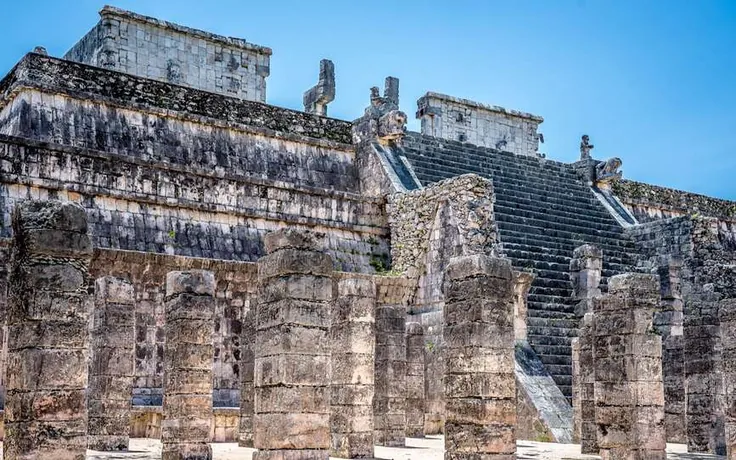
The Warriors group. Everything built of stone at Chichen Itza is look-only, the paths are where visitors belong.
Widely reported: unanimous
Climbing any structure at Chichen Itza is prohibited, and so is touching or leaning on the stonework. Every source behind this page agrees, without exception. The same unanimity covers the companion rules: stay on the marked paths, and do not enter restricted areas. These are the site's oldest and firmest visitor rules, and the guards' attention concentrates exactly here, above all around El Castillo.
The dating is dual, and this page publishes both dates with the reconciliation, because printing either year alone tells half the story. The pyramid was physically closed in 2006, after a climbing-related death. The ban was then formalised in 2008, after the "Lady Kukulkán" incident. So "closed since 2006" and "banned since 2008" are both circulating because both are partly true: access ended first; the formal prohibition followed. One further figure circulates and is labelled for what it is: one guide reports a 15-metre keep-back distance from structures, a single source, published here as one guide's report, never as an INAH rule. Keep a respectful distance and you will be inside every version of it.
The release valve: if climbing a Maya pyramid is the experience you came for, Chichen Itza is simply not the site for it, but the wish itself is legitimate, and it currently has a home. Cobá's Nohoch Mul pyramid reopened for climbing in December 2025. The comparison of the three sites is set out on the Chichen Itza vs Tulum vs Coba page; the rule here is plain: at Chichen, you look.
Drones: Flying One Is Prohibited
Widely reported: unanimous
Flying a drone at Chichen Itza is prohibited. Every source agrees, and the position has no visitor-sized exception: there is no recreational permit, no form, fee or gate conversation that turns a holiday drone flight into an allowed one. If a drone is part of your travel kit, it has no role in this day; the packing consequences are handled on the what to wear and bring page, and the rule itself is simply this: do not fly one here.
The one route that exists is professional, and it is cumulative: a specialist source describes aerial filming as needing INAH authorisation and aviation authorisation together, the INAH procedure in section 5 plus the aviation side, which is a production process measured in paperwork, not a visitor option. One precision matters, because an AI assistant consulted for this page worded it more strongly than any source supports: the prohibition published here is on flying a drone at the site. No source behind this page states a ban on merely carrying one, and this page does not print one.
Cameras, Tripods and the Video Charge
Personal cameras and phones are allowed at Chichen Itza, the site is photographed by everyone who visits, and ordinary holiday photography needs no one's permission. The interesting part of this section is not whether you may film; it is what filming may cost, because that is where the official record runs out and the reporting splits.
Stated by INAH
The anchor, the one Grade-A source on this topic, is INAH's own authorisations portal, which states that personal photo and video taken with non-professional devices needs no authorisation, subject to paying the site's current fee (cuota vigente). Read that carefully: INAH confirms a fee exists. INAH publishes no amount. Everything beyond that sentence is reporting, and the reporting does not agree:
Conflicting reports
| Reported charge | Source |
|---|---|
| 45 MXN | One operator's photography guide; the same figure appears on a January 2024 tours page. |
| 50 MXN | The same operator's September 2026 fee page, stated for GoPros. |
| 60 MXN | A June 2024 forum report, describing a "cell-phone video permit". |
| 63 MXN | Two operator pages. |
Four figures, one of them contradicted by its own publisher's later page. This page prints the map and no winner: there is no single camera or video fee that can honestly be stated, and any guide that gives you one figure without a source is guessing in print. The practical advice survives every version: carry small cash in pesos, and treat the fee charged at the booth on the day as the one that applies. The settled entrance-fee picture, including the 697 MXN fee our tour price includes, is owned by the tickets and entrance fee page; this page owns the conflict, and the conflict is the honest answer.
Widely reported Tripods and monopods are not permitted without authorisation. That is the consistent reporting, and it is why professional-looking support gear belongs to the permit world of section 5, not the day bag. Selfie sticks sit one grade lower: Conflicting reports, they are reported prohibited, but tolerance conflicts: one page says a selfie stick passes only with express permission, another suggests a compact one may be tolerated. No permission mechanism is published by any official source found, so the only honest advice is: do not count on a selfie stick passing the gate.
The rules say what you may carry; where to take the photos: the best spots says where the carrying pays off.
Professional Filming and Permits
Stated by INAH
Cross the line from personal to professional or commercial work and the position changes: an INAH authorisation procedure for filming and photography exists, published on INAH's tramites (authorisations) portal. The existence of the procedure is Grade A, it is on the authority's own site. This page links the depth rather than duplicating it: productions start from that portal, and visitors should note the boundary from section 4, personal devices need no authorisation; commercial work does.
Conflicting reports
What the authorisation costs is another conflict, published as one. Reported figures: around 5,900 MXN per day on an operator page; 6,000–8,000 MXN from an AI assistant consulted for this page; around 7,958 MXN per day on a studios page. Lead times of about 10 business days are reported alongside them. No single price or lead time is settled, and none is printed here as one, a production budgeting from these numbers should confirm the current figure through the tramites portal itself. One further line is reported and belongs with permits rather than behaviour: ceremonies, weddings and rituals inside the zone are not authorised without INAH approval. The site is a protected archaeological zone first and a backdrop second; the paperwork is how that ordering is enforced.
Bags at the Entrance: The 2026 Change
Conflicting reports: status today unsettled
This is the rule most likely to catch you out, and the one where honesty matters most, because the sources do not merely differ in detail, they disagree about whether the headline rule is still in force. INAH has published no bag rule on any page found, so everything here is dated reporting, and it is presented as a timeline rather than a verdict:
| When | What was reported |
|---|---|
| 21 April 2026 | Multiple dated sources report backpacks and large bags barred or restricted at entry from this date. The Yucatán Times carried the change on 23 April 2026. |
| 7 May 2026 | chichenitza.com reported security checks reactivated at the entrance. |
| September 2026 | A ticket guide of that month lists backpacks among the banned items. |
| October 2026 | One strong source, updated 14 October 2026, reports the outright ban lasted only 21–22 April 2026, imposed after the Teotihuacan shooting, and was then lifted, with bags allowed again but checked. |
Three open points sit inside that timeline, and none is resolved here. Status today: ban in force, or lifted after two days, the reporting supports both readings and this page chooses neither. Size threshold: one line of reporting says only a waist pouch passes; another says compact daypacks are still fine. Storage: bag storage at the entrance is reported both as free and as costing 40–100 MXN, published as a conflict, never as a price.
The practical advice, written to work under every version: plan as if a large bag will not pass. Carry a small waist pouch or cross-body bag for documents, money and phone, and be ready to store a larger bag at the entrance if the day's enforcement asks for it. That is the whole strategy. It costs nothing if the ban is lifted, and it saves your morning if it is not. The packing built around it lives on the what to wear and bring page.
Food, Drink, Alcohol and Smoking
Widely reported
Food and drink, except water, are not permitted inside the zone, and alcohol is not permitted. The reporting on this is consistent, and it extends one step further: visitors who arrive intoxicated are barred, so the rule governs the state you arrive in, not just what you carry. Water is the standing exception, carry it, and eat before you enter or after you leave. The ruins are an archaeological zone, not a picnic ground, and the day's eating belongs to the entrance area, the road and Valladolid.
Smoking and vaping carry an honest grade rather than a borrowed certainty. Widely reported One strong rules source, and Google's own overview of the question, report smoking as prohibited across the grounds; the clear federal rule, meanwhile, covers enclosed public spaces, which the open-air ruins are not. Published plainly: smoking is treated as prohibited throughout the site, do not rely on finding a smoking area inside, because no source behind this page promises one.
Pets: Not Permitted, Service Animals Allowed
Widely reported
Pets are not permitted at Chichen Itza. Service animals are allowed. That is the consistent reporting, and it is the whole rule as this page can honestly state it. One precision, kept because precision is this page's job: a "with documentation" requirement for service animals appears in one source only, so it is not published here as a condition. If you travel with a service animal, the settled part, that service animals are the exception to the pet ban, is what you can rely on; anything beyond it, ask about before the day rather than at the gate.
Swimming: The Sacred Cenote Is Viewing-Only
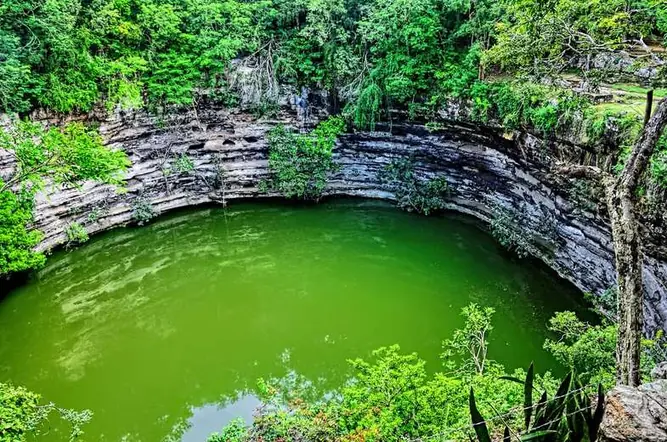
The Sacred Cenote. The most famous water at Chichen Itza is looked at, not entered, the swim belongs to a different site entirely.
Widely reported: unanimous
The Sacred Cenote is viewing-only, and there is no swimming anywhere in the archaeological zone. No exceptions, no season, no quiet corner: the cenote inside the grounds is a sacred and archaeological feature, visited from its rim. Visitors who picture the day's swim happening here are mixing two different places, understandably, because the names travel together.
The swim that tour days are built around happens at Cenote Ik Kil, a separate site about 3 km outside the zone, with its own entrance, its own admission and its own house rules, which are that site's to state, and are covered on the Chichen Itza and cenote tour page. Inside the zone: look at the water. Outside it, at Ik Kil: swim in it.
Litter, Plastics and Wildlife
- Widely reported: unanimousLittering is prohibited. Every source agrees. What you carry in, you carry out, or to a bin, and this is the rule whose enforcement is mostly your own conscience between guards.
- Widely reportedSingle-use plastics are reported prohibited. A rules page and a February 2024 visitor review both carry the prohibition. What exactly counts at the gate, bottles, bags, wrapping, is unverified, and this page does not invent the scope. A refillable bottle is the carry that is safe under every reading.
- Widely reportedFeeding wildlife. Reported in Google's overview of the site's rules and stated here at that grade, in one line: do not feed the animals at the site.
The pattern across this section is the page's pattern in miniature: one rule everyone states, one rule whose scope nobody has pinned down, and one line carried at a single source's weight. Graded honestly, all three are easy to follow: carry out your litter, bring the refillable bottle, and leave the wildlife's diet to the wildlife.
Vendors and Guides Inside the Zone
Widely reported
Buying and selling are not permitted inside the zone. The commerce you will see around a visit is real, but it sits outside the archaeological grounds: the artisan market is outside, by the CATVI visitor centre. Inside the fence, nobody should be selling you anything, and anyone who tries is working outside the rule, not around a technicality.
Guides are the regulated exception to the no-commerce picture, and their regulation is checkable: guides working inside the zone must hold SECTUR credentials and INAH authorisation, verifiable by QR code and through the RNT app. That verifiability is the point, a legitimate guide's status is not a matter of trust but of a scan. How guided visits work, and what a credentialed guide adds, is set out on the guided tour page; this page carries the rule and the check, which together take under a minute at the gate.
Rules are only half of being inside; the practical guide to inside the site covers water, toilets, shade and the museum.
What Happens If You Break a Rule
Enforcement at Chichen Itza is physical before it is financial: guards patrol the site, El Castillo is watched, bags are checked at entry, and breaking the rules can mean removal from the site and detention, with handover to local authorities. That is the enforcement reality the sources support. What they do not support is the thing most guides print next: a schedule of fines. No fine schedule is published by any official source found, no table of offences and amounts exists on the record behind this page, and none is invented here.
What does exist is one documented case, published in its bounded form. In November 2022, a visitor, Abigail Villalobos, climbed El Castillo and danced at the top. Yucatán Magazine, on 24 November 2022, reports that she paid 5,000 pesos in Tinum. The same article is not consistent with itself: its figures differ elsewhere in the piece, so this page states only the reported payment, as one documented case, with the article's own contradictions named rather than resolved. Anything larger, any maximum, any range, any "penalty under Mexican law" figure, circulates without a cited statute behind it, and is excluded here for exactly that reason.
The practical conclusion needs no numbers at all: the realistic cost of breaking the headline rule is your day, removal from a site you travelled across the world to see, with detention the documented escalation. The rules in sections 2 to 11 are all cheap to keep. Keep them.
Checked vs Unverified: The Open List
Everything this page could not settle, in one place, because a rules page that hides its gaps teaches you to trust the wrong sentences. Each item below is open for a named reason, and each is handled above by publishing the conflict rather than a choice:
| Open question | Why it is open |
|---|---|
| The camera/video charge amount | INAH's portal confirms a current fee (cuota vigente) exists but publishes no amount; reports run 45, 50, 60 and 63 MXN, one of them contradicted by its own publisher. |
| The bag rule's status today | Dated April–September 2026 sources report a ban in force; one strong October 2026 source reports it was lifted after two days. INAH publishes no bag rule. |
| Entrance bag-storage price | Reported as free by one line of sources and as 40–100 MXN by another; neither is printed as settled. |
| A fine schedule for breaking the rules | No official source found publishes one. One documented case (November 2022) is reported in section 12, bounded as a single case. |
| Selfie-stick tolerance | Reported prohibited, but reports conflict on whether a compact stick may be tolerated; no permission mechanism is officially published. |
| The scope of the plastics prohibition | The prohibition is reported; what counts as single-use plastic at the gate, bottles, bags, wrapping, is unverified. |
If any of these settles on an official page, the settlement belongs on this page in place of the conflict. Until then, the conflicts are the content, and the advice threaded through the sections above is written to hold under every version of each one.
The Tour, Under the Same Rules
Our shared tour visits the same zone under the same rules, and the point is worth making without decoration: the same rules apply on our tour, a booking exempts nobody. We secure no permits, carry no exemptions, and walk the same paths under the same guards as every independent visitor. What the tour changes is the logistics around the rules, not the rules: pickup from your own hotel or point, Chichen Itza with the 697 MXN entrance fee included, the swim at Cenote Ik Kil, outside the zone, where swimming belongs, and a stop in Valladolid, then back to your pickup point. It costs $130 per adult and $115 per child (children up to age 12).
Booking is by WhatsApp: your written confirmation comes first and restates the whole position, date, party, pickup point, total price, the advance and balance split, and the cancellation position for your date, and only then is the 30% advance paid to reserve, with the balance on the day of the tour. Cancellation is free up to 48 hours before the tour, with the advance refunded in full; the full position lives on the cancellations page. Your exact pickup time is confirmed on WhatsApp the night before. We are a young operator with a short record; that is stated rather than dressed up. The tour from each pickup city is set out on its own page: the tour from Cancun and the tour from Tulum, with the Playa del Carmen, Riviera Maya and Merida pages linked from there. The calculator prices the day exactly.
Price it for your party
The button below composes a WhatsApp message with this party and pickup city already written in.
Book on WhatsAppChichen Itza Rules: Questions
Can you climb El Castillo at Chichen Itza?
No. Climbing El Castillo, and every other structure at Chichen Itza, is prohibited, and so is touching or leaning on the stonework. The pyramid was physically closed in 2006 after a climbing-related death, and the ban was formalised in 2008 after the 'Lady Kukulkán' incident. Stay on the marked paths. If climbing a Maya pyramid is the experience you want, Cobá's Nohoch Mul pyramid reopened for climbing in December 2025. Chichen is not the site for it.
What is prohibited at Chichen Itza?
The core list: climbing or touching the structures; leaving the marked paths or entering restricted areas; flying a drone; tripods and monopods without authorisation; food and alcohol inside the zone (water is the exception); smoking and vaping across the grounds; pets (service animals are allowed); swimming anywhere in the zone, including the Sacred Cenote; littering; and buying or selling inside the zone, the artisan market is outside, by the visitor centre. Two famous items are not settled and are graded as conflicts on this page: the personal camera/video charge and the 2026 bag change.
Can you fly a drone at Chichen Itza?
No. Flying a drone at Chichen Itza is prohibited, and there is no recreational permit that changes that. Professional aerial work sits behind cumulative authorisations, INAH's authorisation procedure plus aviation authorisation, which is a production process, not a visitor option. Leave the drone out of the day's kit.
Is there a camera or video fee at Chichen Itza?
Personal cameras and phones are allowed, and INAH's own authorisations portal states that personal photo and video with non-professional devices needs no authorisation, subject to paying the site's current fee (cuota vigente). INAH publishes no amount, and reported figures conflict: 45 MXN on one operator's photography guide, 50 MXN on the same operator's September 2026 fee page (for GoPros), 60 MXN in a June 2024 forum report, and 63 MXN on two operator pages. Carry small cash; the fee charged at the booth on the day is the one that applies.
Can I bring a tripod or selfie stick to Chichen Itza?
Tripods and monopods are not permitted without INAH authorisation, that is widely reported. Selfie sticks are reported prohibited, but reports conflict on tolerance: one page says they pass only with express permission, another suggests a compact one may be tolerated. The practical answer is the same for both: do not count on a tripod, monopod or selfie stick passing the gate.
Are backpacks allowed at Chichen Itza?
That is genuinely unsettled, and this page publishes the conflict rather than a verdict. From 21 April 2026, multiple dated sources reported backpacks and large bags barred or restricted at entry. One strong source updated in October 2026 reports the outright ban lasted only 21–22 April 2026, imposed after the Teotihuacan shooting, and was then lifted, with bags allowed again but checked. Reports also conflict on the size threshold and on whether entrance storage is free or costs 40–100 MXN. Plan as if a large bag will not pass: carry a small waist pouch or cross-body bag.
Can you swim in the Sacred Cenote?
No. The Sacred Cenote at Chichen Itza is viewing-only, and there is no swimming anywhere in the archaeological zone. The swim on a tour day happens at Cenote Ik Kil, a separate site about 3 km from the ruins, outside the zone.
Can I bring food or alcohol into Chichen Itza?
No. Food and drink, except water, are not permitted inside the zone, and alcohol is not permitted; visitors who arrive intoxicated are barred. Eat before you enter or after you leave, and carry water as the one exception.
Are dogs allowed at Chichen Itza?
No. Pets are not permitted at Chichen Itza. Service animals are the exception and are allowed.
What happens if you climb the pyramid at Chichen Itza?
Guards patrol the site, El Castillo is watched, and breaking the rules can mean removal from the site and detention, with handover to local authorities. No official fine schedule is published by any source found. The one documented case: in November 2022 a visitor climbed El Castillo and danced at the top; Yucatán Magazine (24 November 2022) reports she paid 5,000 pesos in Tinum, though the same article's figures are inconsistent elsewhere in the piece, so only that reported payment is stated here, as one documented case.
¿Se puede subir a la pirámide de Chichén Itzá?
No. Está prohibido subir a El Castillo y a cualquier otra estructura de Chichén Itzá, y también tocar o apoyarse en la piedra. La pirámide se cerró físicamente en 2006 tras una muerte relacionada con la escalada, y la prohibición se formalizó en 2008. Permanezca en los senderos marcados. Si quiere subir a una pirámide maya, la de Nohoch Mul en Cobá reabrió a la escalada en diciembre de 2025.
Do I need a permit to film at Chichen Itza?
For personal photos and video with a phone or a non-professional camera, no authorisation is needed, INAH's authorisations portal states that directly, subject to the site's current fee. For professional or commercial filming and photography, yes: an INAH authorisation procedure exists on its tramites portal. Reported prices conflict, around 5,900 MXN per day on an operator page, 6,000–8,000 MXN from an AI assistant, around 7,958 MXN on a studios page, with lead times of about 10 business days reported, so no single price is settled. Ceremonies, weddings and rituals inside the zone are not authorised without INAH approval.
Check Your Date on WhatsApp
The rules are now the easy part of the day: stay on the paths, carry the small bag, bring small cash for whatever the booth's current camera fee is, and leave the drone behind. If your date is chosen, send us your date, your party and your pickup city, and you will get the written confirmation first: price, pickup point, advance and balance, cancellation position, before any money moves. Your exact pickup time is confirmed on WhatsApp the night before.
$130 per adult · $115 per child to age 12 · 697 MXN entrance fee included · free cancellation up to 48 hours before the tour.