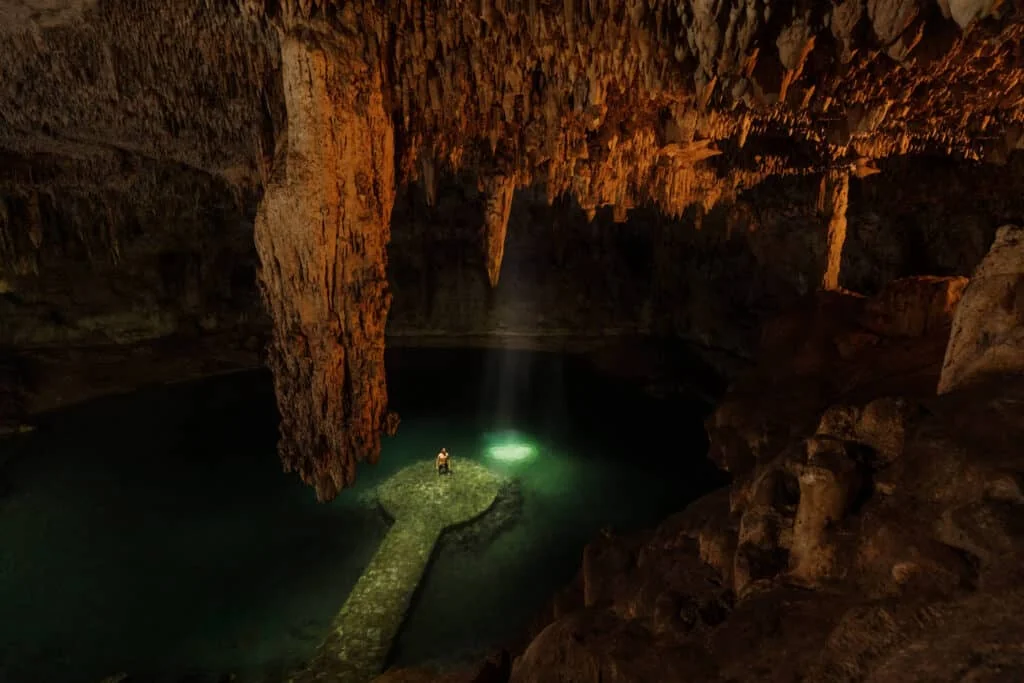
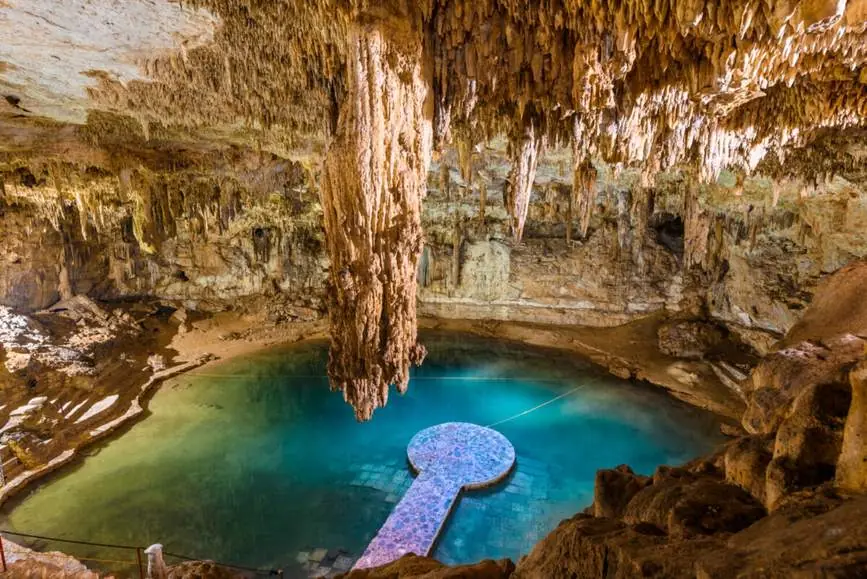
Suytun is the underground cenote near Valladolid, a circular stone platform in shallow, clear water beneath a vaulted cave roof, known worldwide for a single shaft of light that can fall through the opening above it. This guide is built on the park's own official record, and it starts with the one thing most pages about Suytun never tell you plainly: that light beam is a possibility, not a promise, the park itself says so. Si buscas el cenote Suytun, su precio y su horario van primero: la entrada en línea cuesta 250 MXN por adulto y 200 MXN por niño, y el parque abre de 9 AM a 5 PM, con último acceso a las 4 PM.
Every price below is the park's official advance-online figure from cenotessuytun.com, note the plural; a similarly named third-party site is not the park. Where a fact rests on independent guides rather than the park, it is graded as reported, and where sources conflict, on the depth, on the drive from the ruins, on the second cenote, this page prints the conflict instead of quietly picking a side.
Choosing between Suytun, Ik Kil and the quieter cenotes is a different question, it lives on Best Cenotes Near Chichen Itza. How a cenote swim pairs with the ruins inside a tour day is on the Cenote Combo page.
Not every famous well near the ruins is a swimming cenote, the Sacred Cenote inside the archaeological zone is a ceremonial site you look into, never enter.
Yes, if you go for what it actually is. Suytun delivers one extraordinary image: you descend into a dark, vaulted cave, walk out onto a stone platform in glowing shallow water, and, on a good day, a shaft of sunlight stands on the water beside you. As a photograph and as a moment, very little in the Yucatán competes with it. The setting is real, and it survives even an overcast visit better than the marketing suggests, because the cave itself is the spectacle.
What Suytun is not is a great swim. The water is shallow, reported at only a few metres, and the visit is organised around the platform, not around time in the water. Travellers who arrive expecting a long, deep swim tend to leave underwhelmed, and their reviews say so; travellers who arrive expecting the picture and a cool paddle tend to leave delighted. Both reactions are honest reports of the same place, measured against different hopes.
So the verdict, plainly: worth it for the photograph, the cave and a short swim, paired with Valladolid; not worth it as a swimming destination on its own. If a deep swim is the point of your cenote day, that is Ik Kil's strength, the comparison is drawn out in the Suytun or Ik Kil section below.
These are the park's official prices (cenotessuytun.com), bought online in advance, the only price source this page uses. One ticket covers both cenotes on the property, Suytun and Kaapeh, plus bathrooms and showers. Children are priced by age, 5–11, that is Suytun's own rule; other cenotes price children differently, and the rules are never interchangeable. What the park charges a child under 5 is not published in any complete schedule we could find, so it is not guessed here.
| Ticket | Adult | Child (5–11) | What it includes |
|---|---|---|---|
| Entry, advance online | 250 MXN | 200 MXN | Both cenotes (Suytun + Kaapeh), bathrooms and showers. |
| Ticket + food | 400 MXN | 350 MXN | Entry as above, plus a meal at the park. |
| Day Pass | 420 MXN | 370 MXN | Both cenotes, the pool, 1 meal and the Ruta del Alux. |
| Guided visit, add-on | +50 MXN per person | A guided visit. The guided visit plus the Ruta del Alux together cost +100 MXN per person; the Ruta runs about 70 minutes, departing at 10:00, 12:30 and 15:00. | |
The online-ticket trap: read before you buy. The park's online tickets are non-refundable, valid for one year, and not valid on the day you buy them. The discount exists online only, and a same-day online purchase is charged at the gate price anyway. So the advance price is real money saved, but only if you buy at least a day ahead, with a date you are sure of. Buying the morning of your visit, online, is the one way to get neither the discount nor a refund.
One absence, stated as an absence: the park does not publish its gate (“standard”) price on its official site. A walk-up figure circulates in search results and third-party guides, but it has no official source, so this page prints no gate price at all. Older, lower Suytun prices also circulate widely, including on a leading Chichen Itza guide whose headline figures are years out of date, and any page quoting admission well below the official figures above is quoting history, not the ticket office.
Suytun is open 9:00 AM to 5:00 PM daily, with last access at 4:00 PM, the park's official hours. A “last entry 4:30” figure appears on third-party pages; where it conflicts with the park, the park wins, so plan against 4:00. In high season the park caps maximum occupancy at 150 people (official), a real constraint on busy days, and one more reason the timing advice below matters.
One stale rule deserves a proper burial: guides still cite a 60-minute limit inside the main cenote. The park has removed it. There is no published time limit on your visit within opening hours, if a page tells you that you will be moved along after an hour, it is repeating an old rule the park itself no longer states.
How long do people actually stay? At reported grade, typical-visit accounts, not a rule, most visits run as a Valladolid half-day pairing: the main cenote and its photograph, a paddle, then Kaapeh and, for many, the Ruta del Alux or a meal. The honest planning shape is to give the property the better part of a morning or afternoon rather than a rushed hour between other stops, and to fold it into the town time covered by the Valladolid guide.
Suytun is usually half of a Valladolid day; Valladolid in depth, including Cenote Zací plans the town half of it.
Here is what the photograph promises: a solid-looking column of sunlight falling through a hole in the cave roof onto a lone figure on the platform, the image that made Suytun famous. Here is what the park itself says, and what this page is bound to print before any marketing version: the light is natural, and it depends on the season, the position of the sun, clouds and the climate. In the park's own framing, the beam is not guaranteed.
What can honestly be said: around midday is when the beam can appear, because that is when the sun is high enough to pass through the opening and reach the platform. Beyond that, every precise claim in circulation conflicts with another: published “best windows” disagree by hours, and published “strongest seasons” have, between them, nominated most of the year. When sources contradict each other that completely, the truthful sentence is the short one: midday is the chance; no month and no clock time is a promise, and this page makes none.
There is a second reality the famous photo hides. The water level fluctuates, and at times it can submerge the platform completely, unpredictably, on the park's own account. On those days there is no dry platform to stand on, beam or no beam. Neither condition is a reason not to go; both are reasons to go for the cave itself and treat the beam as a gift if it comes.
Almost everyone at Suytun wants the same photograph, from the same platform, and the platform holds one party at a time. A queue for the platform forms at busy times, that much is reported consistently by visitors and guides. How long that queue takes is another matter: precise minute figures circulate (one guide's among them), but they are unsourced, and queue length plainly swings with the day, the season and the 150-person cap. This page publishes the queue as a reality to plan around, not a number of minutes it cannot stand behind.
Two related absences, stated plainly because travellers search for them: no official platform time allowance exists in any source found, nobody official has published how long you may stand there, and no official tripod, drone or photo-fee rule exists either. Figures for both circulate in AI-generated answers; they are invented, and planning around them would be planning around nothing. The practical advice that survives scrutiny is timing: the queue is a midday, high-season phenomenon, and the 9 AM opening is the simplest way around it.
The one verified photography rule at the park is a small, specific one: the Alux figure on the Ruta del Alux may not be photographed (official). It is also a useful reminder that the park does publish rules when it has them, which is exactly why the missing platform rules above are reported as missing, not filled in.
Set the expectation before the water does it for you: Suytun is a photo-led cenote with a swim attached, not a swimming cenote with a photo attached. You descend into the vault, the water is clear and shallow, and the swim is a paddle and a float in extraordinary surroundings: drifting under the stalactites, watching the light move, cooling off. Fish are reported in the water. As an experience it is closer to floating inside a cathedral than to swimming lengths, and judged on those terms it is superb.
On depth, this page publishes words, not a figure: the cenote is reported at only a few metres deep. The numbers in circulation span roughly 1.2 to 5 m and may well be measuring different spots; the park publishes no official measurement, so no single figure is printed. What that means practically is standing-and-wading depth in much of the pool for most adults, which is precisely why this is a paddle, and why nobody should arrive planning to dive. On temperature, the honest position is a gap: no reliable Suytun-specific water temperature exists: several different figures float around the sources with nothing authoritative behind any of them, so none is printed here. Expect cenote-cool; verify nothing more precise from anyone.
Your ticket buys two cenotes, and most visitors barely hear about the second one. Kaapeh sits on the same property: a semi-open cenote, daylight reaches it, unlike Suytun's closed vault, reached by tunnel stairs, with a hand-carved Kukulkan sculpture as its signature. It is included free with every entry ticket (official); there is no separate Kaapeh charge to budget for, and a listing that prices it separately is misreading the park's own ticket.
One point this page will not smooth over: whether you can currently swim in Kaapeh is reported conflictingly. Most descriptions present it as part of the visit without settling the question, and one honest review found it closed. So Kaapeh is described here as part of the visit, walk down, see it, take in the sculpture, and never promised as a second swim. If a swim there matters to your day, ask at the gate on the day; conditions at cenotes change faster than guide pages do.
Practically, Kaapeh is also the answer to Suytun's one-note problem: when the main vault is busy or the platform queue is long, the second cenote, the pool and the Ruta del Alux spread the visit out. Travellers who treat the ticket as “Suytun plus whatever else is here” consistently rate the day higher than those who came for one photograph and left.
Suytun's rules are repeated everywhere and sourced almost nowhere. Each item below carries its grade in words: what the park itself states, and what only guides report. The cenote day also involves packing decisions, those belong to What to Wear & Bring; this section is the park's rulebook only, with its gaps left as gaps.
The park's own safety wording: the steps down are wet, so hold the handrails and do not use your phone while descending. It is the least glamorous rule on this page and the one most likely to decide how your visit goes. The park also states, in its own wording, that visitors over 60, with reduced mobility, or with cardiac or respiratory conditions visit at their own responsibility, printed here as the park frames it, neither softened into a ban nor inflated into an access claim; this page publishes no step-free or wheelchair access claim for Suytun, because the park publishes none.
Outside food and drinks are not allowed, and the park states that violations can mean expulsion without a refund, unusually blunt wording, and quoted here at full strength because it is the park's own. Pets are generally not allowed; the stated exception is assistance and emotional-support animals with a vet certificate, and even those never enter the water.
Four widely repeated “rules” rest on guides alone, and this page keeps them at that grade. Life jackets are reported as provided, and in some accounts as mandatory, the park's current pages do not state it here, so neither word is upgraded. A shower before swimming is likewise reported, not published by the park on the pages we could verify. Sunscreen positions conflict between guides, one says it is usable, others ban sprays, so the conflict is what gets published: follow staff direction on the day rather than any page, this one included. A jumping and diving ban is also reported only; in a cenote reported at a few metres deep, the depth itself is the more reliable guide.
Suytun is a developed park, and its facility list is mostly the park's own (official site), with the grade noted where it is not:
And one extra worth planning a different kind of day around: the park advertises a night swim on selected dates, 6–8 PM (official banner). The dates vary and the park publishes no fixed schedule or price for it that this page could verify, so none is printed, if an evening swim in the vault appeals, the park's own channels are the only honest place to find the current dates.
The two most famous cenotes in this part of the Yucatán are famous for opposite things, and choosing between them is mostly choosing which of those things your day is for. Suytun is photo-led: an underground vault, a platform, a beam of light when the day cooperates, and a shallow paddle. Ik Kil is swim-led: an open-air pool beside the ruins where the swim itself is the event. Travellers who try to make Suytun be Ik Kil, or the reverse, are the ones who leave disappointed; each cenote is excellent at its own job.
Geography votes too. Ik Kil sits beside Chichen Itza and pairs with a ruins morning; Suytun sits beside Valladolid and pairs with the town. Many travellers with two free days simply do both, one with each anchor. The full side-by-side, with the quieter alternatives, lives on Best Cenotes Near Chichen Itza, and Ik Kil has its own complete guide: the Cenote Ik Kil Guide.
The other pair travellers weigh against Suytun is Hubiku and Saamal, the other Valladolid-area pair, each with its own reported prices and rules.
Start from the pairing that makes Suytun easy: Valladolid is about 8 km away, roughly a 10–15 minute drive (reported grade, consistent across sources). Suytun is a Valladolid-side trip. Bolt it onto a town morning, the market, the convent, lunch, and the logistics almost disappear; try to bolt it onto a ruins day from the coast and it becomes the longest leg of the day. Town depth is on the Valladolid guide.
There is no version of reaching Suytun that involves our tour, the tour's swim is at Ik Kil, as the next section states in full. Suytun is reached independently, and from Valladolid it is genuinely simple.
Suytun sits on the Valladolid side of the ruins, and most visits pair the two, getting to Chichen Itza from Valladolid covers the colectivo and taxi legs.
Stated once more, in the tour's own section, so no reader can leave this page confused: this tour swims at Cenote Ik Kil, not Suytun. Our shared tour runs Chichen Itza, the Ik Kil swim and Valladolid at $130 per adult and $115 per child (up to age 12), with the 697 MXN Chichen Itza entrance fee included. You are picked up from your own hotel or pickup point, your exact pickup time is confirmed on WhatsApp the night before. Suytun appears nowhere in that day; if swimming at Suytun is what you want, the sections above are your plan, and Valladolid is your base.
Booking takes a 30% advance to reserve your seats, with the balance paid on the day of the tour; cancellation is free up to 48 hours before the tour, with the advance refunded in full. City by city: Cancun, Tulum, Playa del Carmen, Riviera Maya and Merida.
The 697 MXN Chichen Itza entrance fee is included in these prices, it is not added at the gate. Free cancellation up to 48 hours before the tour.
Bought online in advance from the park's official site (cenotessuytun.com), entry is 250 MXN per adult and 200 MXN per child aged 5–11, and that one ticket covers both cenotes, Suytun and Kaapeh, plus bathrooms and showers. A ticket with food costs 400/350 MXN and the Day Pass 420/370 MXN. The park does not publish its gate price on its official site, so no walk-up figure is printed here.
9:00 AM to 5:00 PM daily, with last access at 4:00 PM, the park's official hours. In high season the park caps occupancy at 150 people. The old 60-minute limit inside the main cenote has been removed, so there is no published time limit on your visit within those hours.
Around midday is when the beam can appear, when the sun is high enough to pass through the opening in the vault and strike the platform. Beyond that, the park itself promises nothing: the light is natural and depends on the season, the sun's position, clouds and weather, and the water level can sometimes cover the platform completely. Treat the famous photograph as a best case, not a schedule.
Yes, but set the right expectation: Suytun is a shallow, photo-led cenote, a paddle and a float in clear water under the vault, with fish reported in the water, rather than a deep swimming hole. People come for the platform, the light and the setting first, and swim second. For a full swim near Chichen Itza, Ik Kil is the stronger choice.
Shallow, reported at only a few metres. Sources span roughly 1.2 to 5 m and may be measuring different spots, and the park publishes no official measurement, so this page gives no single figure. Practically, it is a wading-and-floating depth for most visitors, not a diving depth.
Yes, if you go for what it actually is: one extraordinary photograph and a cool, quiet paddle in a vaulted cave, paired naturally with Valladolid, about 8 km away. It is worth less if you expect a long, deep swim, that is Ik Kil's strength, not Suytun's. Go at the 9 AM opening or late in the day and the platform queue that shapes most complaints largely disappears.
Suytun sits about 8 km east of Valladolid, roughly a 10–15 minute drive, the easiest pairing in this guide. A taxi from Valladolid is reported at 100–150 MXN, and the colectivo azul toward Tikuch is reported at about 25 MXN; both fares are reported, not guaranteed, so confirm before you ride. ADO buses serve Valladolid itself, not the cenote.
Sources put it at 45–53 km from the ruins, roughly 40–50 minutes by road, about three quarters of an hour. The figures conflict slightly between sources, so this page publishes the range rather than one number. Suytun is a Valladolid-side trip, not a walk-up stop from the ruins.
Kaapeh is the second cenote on the same property, included free with every Suytun ticket. It is semi-open, reached by tunnel stairs, and has a hand-carved Kukulkan sculpture. Whether swimming is currently allowed there is reported conflictingly, one honest review found it closed, so treat it as part of the visit rather than a guaranteed second swim.
No. The shared Chichen Itza tour sold on this site swims at Cenote Ik Kil, not Suytun: its three stops are Chichen Itza, Ik Kil and Valladolid. This guide exists for travellers choosing between the cenotes or adding Suytun to their own day; nothing on this page should be read as the tour visiting Suytun.
Comprado en línea con anticipación en el sitio oficial (cenotessuytun.com), la entrada cuesta 250 MXN por adulto y 200 MXN por niño de 5 a 11 años, e incluye los dos cenotes, Suytun y Kaapeh, además de baños y regaderas. El boleto con comida cuesta 400/350 MXN y el Day Pass 420/370 MXN. El parque no publica su precio de taquilla en su sitio oficial.
At the gate, yes, but not online at the advance price. The park's online tickets are non-refundable, valid for one year, and not valid on the day of purchase: buy at least a day ahead, or a same-day online purchase is charged at the gate price. The advance discount exists online only.
Booking opens on WhatsApp, that is where seats are confirmed. Tell us your date, your pickup city and how many adults and children, and we confirm availability and your exact pickup point and time the night before the tour. The tour day is Chichen Itza, Cenote Ik Kil and Valladolid, Suytun is a separate, independent trip, as this guide sets out.
30% advance reserves your seats; the balance is paid on the day. Free cancellation up to 48 hours before the tour, advance refunded in full.
First message, ready to copy: your date · pickup city · adults · children (ages to 12).