The Great Ball Court of Chichen Itza: The Complete Guide
This is the largest ball court in Mesoamerica, and a building about which guides repeat more than the stones can prove. This page separates the two: the measurements with their conflicts printed, the game as the reconstruction it honestly is, the carvings panel by panel, and the famous sacrifice question graded claim by claim.
We run the shared Chichen Itza tour described near the end of this guide. As a new operator, we have a short review history and prefer to say that plainly. Our account of the court comes from the published sources named here, not from us.
What the Great Ball Court Is
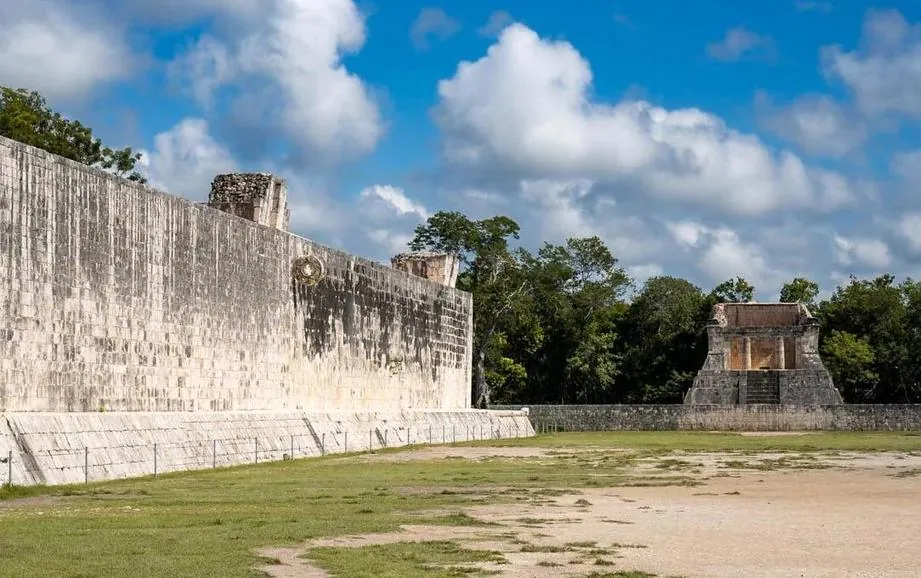
The Great Ball Court, the Gran Juego de Pelota, is the largest of the thirteen ballcourts at Chichen Itza (INAH), and INAH describes it as the largest ball court in Mesoamerica. It stands north-west of El Castillo, in the Great Plaza group, and it is less a stadium than a walled ceremonial precinct: a long open alley flanked by two massive parallel platforms, with temples at its ends and built into its sides.
Its plan is the classic I-shape: a long central alley with expanded end zones to the north and south (INAH plan; Marquina). What those end zones were used for is not verified in the sources, this page does not assign them functions, because no source this research found settles it. For the site as a whole, start with the Chichen Itza Visitor Guide; this page stays with the one complex.
How Big Is It?
Every figure below is defined before it is given, because most of the confusion about this court's size comes from numbers that measure different things being quoted as if they were rivals. They are not all rivals, but two of them genuinely conflict, and both conflicts are printed.
| What is measured | Figure | Source / note |
|---|---|---|
| The whole complex, end to end and wall to wall | ~168 × 70 m | INAH heritage listing; UNESCO/INAH. A second INAH publication gives ~165 × 70 m, a boundary difference, footnoted here rather than hidden. |
| The side platforms (each long platform flanking the alley) | ~95–96.6 m long | Wikipedia's survey of the sources; Asociación Tikal. |
| The great side walls | ~8 m high | Open Heritage 3D; consistent with Morley's 27 ft. Remember this figure: it matters in §3. |
| The playing floor (the open alley itself) | ~120 × 30 m, or ~96.5 × 30 m | A genuine conflict of definitions: Arqueología Mexicana / INAH (July 2026) give ~120 × 30 m; other summaries give ~96.5 × 30 m. The difference is what each source counts as the floor. Never one bare figure. |
Two disciplines this table keeps: the ~168 × 70 m figure is the whole complex, not the open playing rectangle: any page that presents it as the size of the pitch is misreading it. And the height and width of the benches at the walls' bases are not verified in any scholarly source this research found, so they are not published here at all.
The Stone Rings
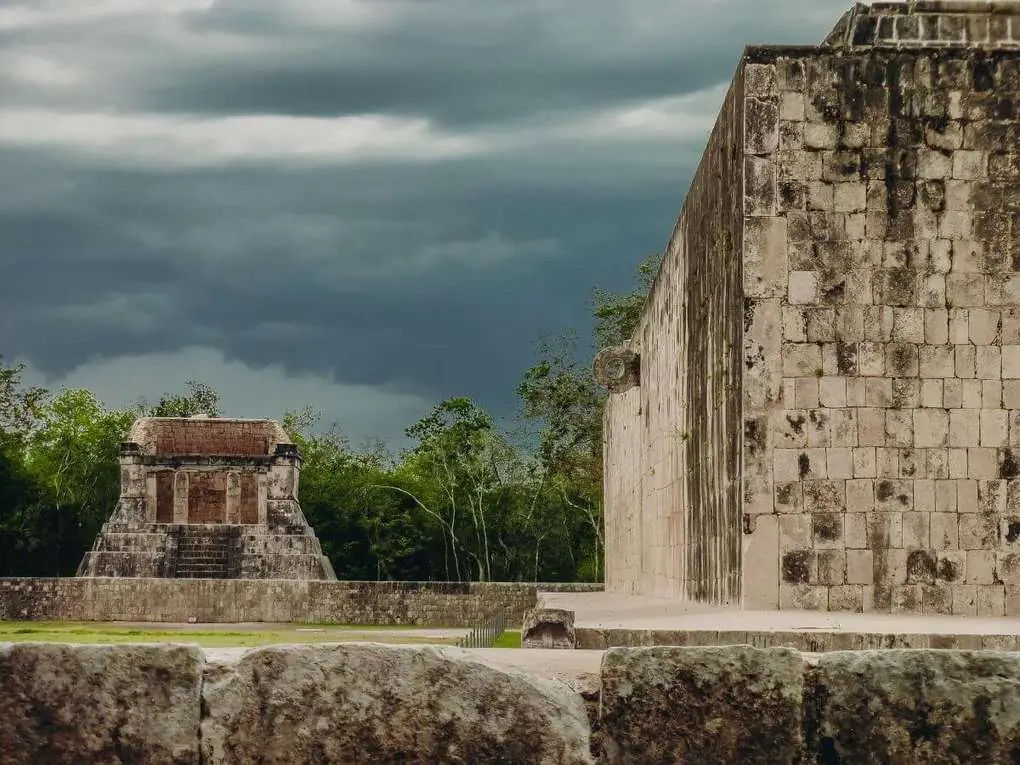
Set into the centre of each of the two side walls, facing each other across the alley, are two stone rings, mounted vertically. INAH describes each ring as carved in the form of intertwined feathered serpents, in six concentric circles. The vertical mounting is itself a development: at earlier courts the targets were sloped markers set low; here the ring stands upright, high on a vertical wall, which is part of what made scoring through it so difficult (§4).
The ring's opening is given as about 48 cm in one scholarly compilation, labelled approximate: that is the wording and the confidence level it carries here. The rings' outer diameter is not verified in the sources, so it is not published. One more honesty note, which applies to the carvings in §6 as well: whether the rings and panels a visitor sees today are originals or copies is not established in the sources, and this page says so plainly rather than guessing either way.
How the Game Was Played
Reconstruction: stated up frontNo rulebook survives. Everything in this section is reconstructed from images, artefacts, colonial accounts and later forms of play (the Met). Read it as the best-supported reconstruction, not as a rulebook recovered.
The ball was solid natural rubber (the Met). No size or weight specific to Chichen Itza is verified in the sources, so none is printed here: figures quoted elsewhere belong to other places or to guesswork. Play was with the hips and torso, not the hands or feet, as the norm; the carvings show the equipment that made that survivable: heavy padding around the midsection and protection at the knees. The famous U-shaped stone yokes were probably ceremonial: too heavy to have been played in (the Met).
Scoring, stated as carefully as the sources state it: INAH presents a ball through the ring as an interpretation that "may have concluded a contest", not that it always ended the game, and not that it was the only way to score. Other scoring used markers (the Met). Through an opening of roughly 48 cm, at that height, on a vertical wall, a ring score was exceptionally difficult, that is said in words, because no honest number for its frequency exists. Team sizes varied: "two or more" across depictions; the number of figures in a carved panel is a composition, not a team-size rule.
The Names of the Game
Three names circulate for this game, and they are not interchangeable. Pitz is documented in Classic Maya vocabulary, it is the historically grounded word. Pok-ta-pok, the name most visitors arrive knowing, is a modern popular term, taken up in modern publications (including a 2012 presentation INAH cites), it is not the ancient name of this court. Tlachtli is Nahuatl, the word from central Mexico, and it is never presented on this page as this court's own name. The name used here is simply the Maya, or Mesoamerican, ballgame.
The game is far older than this court. Ballgames predate it by well over a millennium: an early formal court at Paso de la Amada dates to about 1400 BCE, and rubber balls at El Manatí to about 1600 BCE (the Met). So this court's importance is not its age, courts had been built for some two thousand years before it, it is its scale. Nothing else in Mesoamerica was built this big for the game.
What the Carvings Show
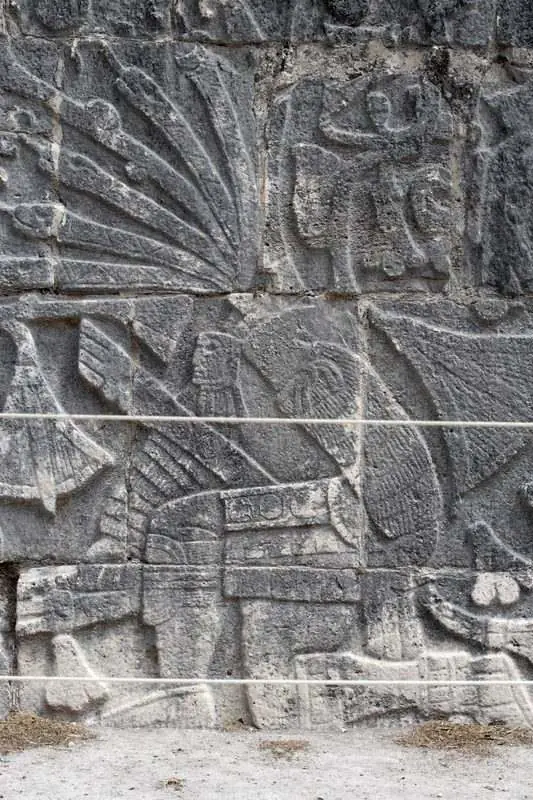
At the bases of the two side walls run six principal bench panels (Herrera Torres 2015, INAH Revistas), the court's visual record of itself. They show teams of players in elaborate gear: the heavy belts, padding and headdresses of the game, carved in procession along the benches.
The most famous panel shows a kneeling decapitated player, with serpents and vegetation rising from the severed neck. InterpretationScholars read those serpents and growth as blood and regeneration, that reading is labelled here as what it is, an interpretation of the imagery, not a caption the carvers left. Another panel element sets a skull inside a disk or ball motif. ContestedWhose skull it is, the player's own head, a death deity, the night sun, is contested; this page prints the contest and adopts none of the candidates.
One boundary, kept firmly: the panels are not the record of a named historical match. No source identifies a specific game, date or player in them, and any telling that presents them as the illustrated report of one real afternoon has gone beyond the evidence.
The Temples Around the Court
North Temple: the Temple of the Bearded Man
The temple closing the court's north end is named for a carved figure whose chin carving resembles facial hair, the "bearded man." Inside is a carved panel with more than 40 figures (Arqueología Mexicana). It was not a judges' box, and no source names a ruler's seat in it; those labels are not used here.
Upper Temple of the Jaguar
On the court's east side, facing into the court: serpent-form columns, friezes of serpents, jaguars and shields, and interior battle and procession murals, much destroyed, now under modern INAH conservation. No specific historical battle or date is identified for those murals in the sources, ever, on this page.
Lower Temple of the Jaguar
Also on the east side, but a different building: the Lower Temple of the Jaguar faces outward, away from the court, and holds an elaborately carved chamber of warriors, priests, animals and aquatic vegetation (INAH). In one line, so the two are never merged: Upper faces in, Lower faces out.
South Temple
A small, ruined temple closes the south end. And a promise this page does not make: visitor entry to any of these temple interiors is not promised: what you can rely on seeing is the court, the panels and the temples' exteriors.
Were the Winners or Losers Sacrificed?
This is the question every visitor asks at this court, and it is this page's signature section because it is where guidebook certainty and the evidence part company. Start with what is actually sourced:
Depiction: sourcedThe relief depicts a decapitated player (§6). That much INAH and the Met support. A post-match rule, that a game at this court ended with a sacrifice as a matter of course, is a different claim, and it is not sourced. The positions in circulation, named:
- "The losers were sacrificed": the popular guide claim. No reliable evidence shows it was a standard rule.
- "The winners were sacrificed, as an honour": equally popular, in the opposite direction. No reliable evidence at this court supports it either.
- "Captives were sacrificed": one scholarly position. (An AI answer's claim of scholarly consensus for it is an overstatement, and is rejected here.)
- Christophe Helmke (University of Copenhagen), via Live Science: players were often sacrificed, but whether they were winners or losers is unclear.
- The Met: scholars cannot establish exactly who was sacrificed, when, or how it related to an actual game.
There is no consensus on winners vs losers. That sentence is the finding. Both popular versions are printed above as claims, with their evidence level attached, neither is stated as fact anywhere on this page. For what physical evidence of ritual death at Chichen Itza actually looks like when it is excavated and published, see the Sacred Cenote guide; sacrifice scholarship in depth belongs to the human sacrifice evidence guide.
The Acoustics: Whispers, Claps and Echoes
The court's high, parallel walls make it a natural echo chamber, and the effects are real: the grading is in what has actually been measured. The walls produce flutter echoes: repeated, closely spaced reflections of a single sound. Acoustics researcher David Lubman documented them in 2006 (Acoustical Society of America), with his own qualification kept attached: his observations were provisional, because no permission for controlled tests was granted. A handclap's flutter here lasts about 2.5 seconds, at a little over 4 Hz (Lubman, qualified as above).
Low-voice communication across the court, a distance of about 140 m (about 460 ft), has been reported since Morley in 1925 and is described by Lubman; visitors at one end genuinely can be heard from the other in the right conditions. LoreThe famous "seven echoes" has no measured study behind it, it is widely repeated visitor lore. The physics (hard parallel walls) makes repeated echoes plausible, which is how the story sustains itself; plausibility is not a measurement. And that the builders designed the acoustics is Lubman's hypothesis, not a finding, his jaguar-growl analogy is speculation, and is labelled so here.
Do not confuse any of this with the chirped echo at El Castillo, a different mechanism, on a different building, covered on its own page.
The Hero Twins and the Underworld
The story most often told at this court comes from the Popol Vuh, the account in which the Hero Twins descend to Xibalba, the underworld, and contest its Lords in a ballgame that is a story of death and renewal (the Met; Schele & Freidel). It is a magnificent story, and it needs its framing kept: the Popol Vuh is a K'iche' highland Maya account, from a different Maya people and region. It is not a Chichen Itza match report, and the reliefs on this court are not published as illustrations of a specific Popol Vuh episode, retellings that walk the panels as if they were frames of the Twins' game have merged two sources the scholarship keeps apart.
InterpretationThat ballcourts were associated with the underworld, the court as a threshold between the world of the living and what lay below, is a scholarly interpretation, widely held and labelled as one here. It explains why the game carried ritual weight far beyond sport; it does not turn any particular match at this court into a documented rite.
When Was It Built, and Who Restored It?
The court belongs to the site's later monumental phase, dated broadly to about 900–1200 CE, the Terminal Classic to Early Postclassic transition. That range is printed qualified and attributed, because the sources support a range, not a year; precise single-year dedication claims in circulation are unverified and are not repeated here.
The modern study of the court begins with Miguel Ángel Fernández, who published its foundational study in the Anales del INAH in 1925. The Carnegie Institution's programme ran at the site from 1924, and Maudslay had documented the ruins earlier still; INAH's integrated conservation continues, including a structural study in 2026. Scoped carefully: no single institution or individual is credited here with rebuilding the whole court, because the work was cumulative across a century. And the standing caveat, in one line: no verified percentage of original fabric exists for this complex, so none is invented: what stands today is ancient masonry, documented, conserved and partly restored, in proportions no source quantifies.
What to Look for Visiting Today
The court rewards a standing order: work from the ground up, because the details are at ground level and the famous objects are not:
- The bench panels first, at plaza level. Walk the bases of both side walls before you look up: the players' gear, the kneeling figure, the skull in its disk (§6). This is the court's own testimony, and most visitors walk straight past it.
- Then the rings. Stand mid-alley and find both rings, one in each wall, and hold the height question (§3) in mind while you judge the distance for yourself.
- The North Temple at the end of the alley, the Bearded Man's temple, and the best vantage for grasping the full length of the complex.
- The two Jaguars, kept separate: Upper on the east side facing in, Lower facing out (Upper faces in, Lower faces out).
- The acoustics, practised honestly: a sharp handclap mid-court returns the flutter echo (§9), real, and unmeasured in its famous "seven" form. Try it; enjoy it; grade it as this page does.
What you may and may not do at the site, climbing, tripods, restricted areas, is one passage here, with the full set on the Chichen Itza site rules page.
See the Great Ball Court on the Shared Tour
Our shared day trip visits Chichen Itza, Cenote Ik Kil for a swim, and Valladolid. It costs $130 per adult and $115 per child up to age 12, including the 697 MXN Chichen Itza entrance fee. We pick you up at your hotel or pickup point and confirm the exact time on WhatsApp the night before. A 30% advance reserves your place, with the balance due on tour day. Cancel free up to 48 hours before and the advance is refunded in full. We are a new operator, and we say so plainly.
City pages: Chichen Itza tour from Cancun · from Tulum · from Playa del Carmen
Price calculator
These prices include the 697 MXN Chichen Itza entrance fee, so there is nothing extra to pay at the gate for entry.
The Great Ball Court: Frequently Asked Questions
How big is the Great Ball Court at Chichen Itza?
About 168 × 70 m overall, the whole complex, per INAH's heritage listing; a second INAH publication gives about 165 × 70 m. That figure is not the playing rectangle: the playing floor itself is given as about 120 × 30 m by Arqueología Mexicana / INAH (2026) and about 96.5 × 30 m in other summaries, a conflict of what is being measured.
How high are the stone rings at Chichen Itza?
The sources disagree, and no single figure is settled: most guides say about 6 m above the floor, one INAH account says about 8 m, and a Wikipedia photo caption says 9 m. The 8 m figure is plausibly the height of the wall itself, conflated with the rings.
How was the Maya ball game played?
No rulebook survives, so this is a reconstruction: a solid natural-rubber ball was kept in play with the hips and torso, not the hands or feet, by padded players. A ball through the stone ring may have concluded a contest, in INAH's wording, and other scoring used markers (the Met).
What is pok-ta-pok?
Pok-ta-pok is a modern popular term for the Maya ballgame, taken up in modern publications. The documented Classic Maya word is pitz; tlachtli is the Nahuatl word from central Mexico, not this court's own name.
Were the losers of the ball game really sacrificed?
There is no consensus. The carvings depict a decapitated player, that is sourced, but no reliable evidence shows that the losers, or the winners, were routinely sacrificed as a rule of the game. Scholars quoted on this page, including Christophe Helmke and the Met, say exactly who was sacrificed, and how it related to an actual game, cannot be established.
What do the carvings at the Great Ball Court show?
Six principal bench panels at the bases of the two side walls show teams of players in elaborate gear, a kneeling decapitated player with serpents and vegetation rising from the severed neck, and a skull set inside a disk. What the skull means is contested; the panels are not the record of a named historical match.
Can you really hear a whisper across the Great Ball Court?
Low-voice communication across the court, about 140 m, has been reported since Morley in 1925 and is described by acoustics researcher David Lubman. The high parallel walls produce real flutter echoes; his observations were provisional, because no permission for controlled tests was granted.
What are the seven echoes at Chichen Itza?
A famous claim with no measurement behind it, visitor lore. No measured study supports exactly seven echoes; the hard parallel walls make repeated echoes plausible, which is how the story sustains itself.
What is the Temple of the Bearded Man?
The North Temple at the end of the Great Ball Court, named for a carved figure whose chin carving resembles facial hair. Inside is a carved panel with more than 40 figures (Arqueología Mexicana).
Which is the Upper Temple of the Jaguar, and which is the Lower?
They are two different buildings on the court's east side. The Upper Temple of the Jaguar faces into the court, with serpent-form columns and interior murals, much destroyed. The Lower Temple of the Jaguar faces outward, away from the court, and holds an elaborately carved chamber.
¿Cómo se jugaba el juego de pelota en Chichén Itzá?
No sobrevive ningún reglamento: todo es una reconstrucción. Se jugaba con una pelota maciza de caucho natural, impulsada con las caderas y el torso, no con las manos ni los pies. Pasar la pelota por el anillo de piedra pudo haber concluido un partido, según la formulación del INAH; otros puntos se marcaban con marcadores (the Met).
How many ball courts are at Chichen Itza?
Thirteen, per INAH. The Great Ball Court is by far the largest of them, and the largest ball court in Mesoamerica.
Check Your Date on WhatsApp
Booking opens on WhatsApp: that is where your date is checked, your pickup point is set, and your exact pickup time is confirmed the night before the tour. Send one message with:
- Your tour date
- Your pickup city and hotel or pickup point
- How many adults and children (to age 12)
$130 per adult · $115 per child · 697 MXN entrance fee included · 30% advance to reserve · free cancellation up to 48 hours before.
Start with your date
One tap opens the conversation. Prices above are the full per-person prices, the entrance fee is already in them.