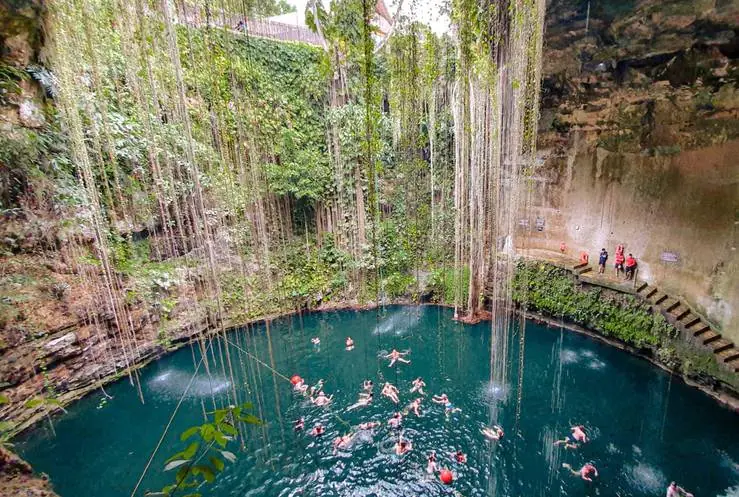
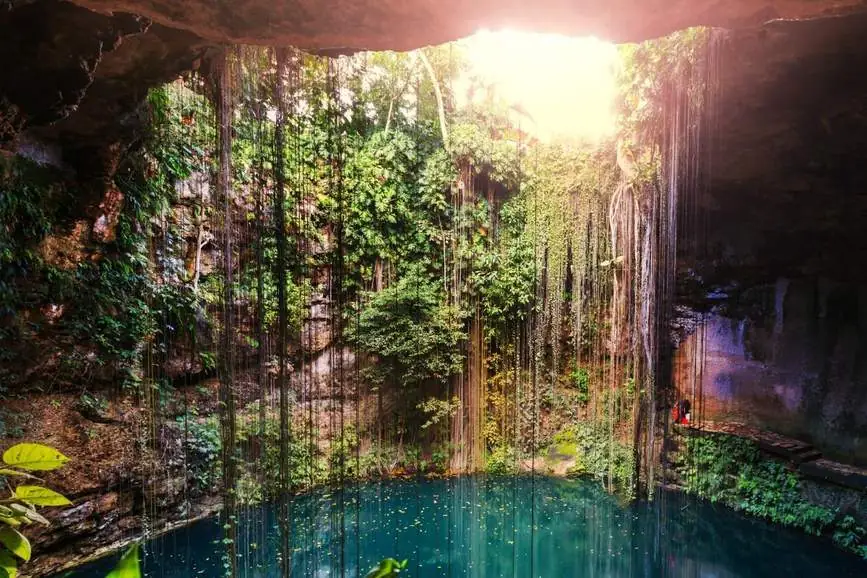
Ik Kil is the swimming cenote beside Chichen Itza, an open-air pool about 60 m across, its water some 26 m below the rim, reached by a carved stone staircase through hanging vines. This guide is built on the park's own official record, and it starts by correcting the three things the internet gets wrong here: stale prices still quoted as current, an 8 AM opening that does not exist (the park opens at 9), and a sunscreen rule that no official source has ever published. En español: cenote Ik Kil precio, horario y ¿se puede nadar en el cenote Ik Kil? Las tres respuestas están abajo, con las cifras oficiales del parque.
Every price below is the park's official 2026 figure from cenoteikkil.com, with its inclusions itemised. Where the park's own site contradicts itself, and it does, once, on the child ticket, this page prints the contradiction instead of quietly picking a side. Where a fact rests on independent guides rather than the park, it is graded as reported. That grading is the point of the page: Ik Kil is heavily written about and lightly fact-checked, and the difference matters at the ticket office.
Choosing between Ik Kil and the quieter cenotes is a different question: it lives on Best Cenotes Near Chichen Itza. How the swim pairs with the ruins inside a tour day is on the Cenote Combo page.
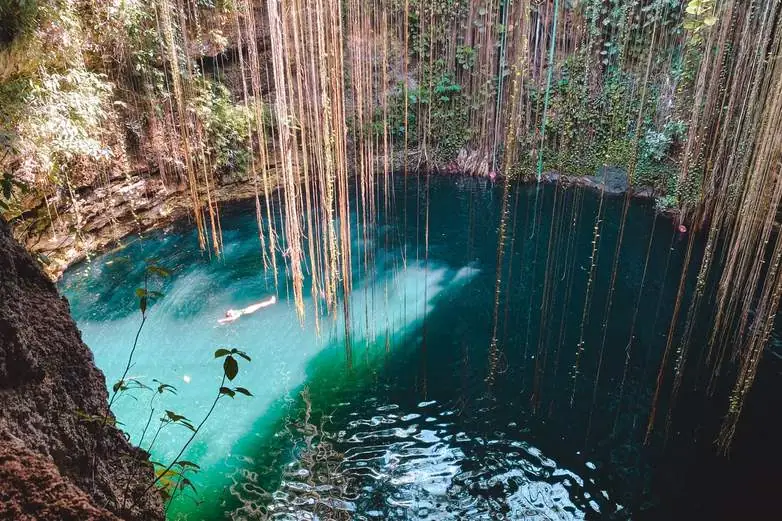
Yes, with one honest condition. The swim itself is genuinely singular: you descend through rock and roots into a circular pool open to the sky, vines hang to the water, fish move in clear blue-green water, and a shaft of light cuts down through the opening. Nothing else on a Chichen Itza day looks or feels like it, and the setting survives even a busy hour. If you visit one cenote on this trip, the case for this one is the strongest there is.
The condition is timing. Ik Kil is the cenote almost every tour from the coast pairs with the ruins, and it fills accordingly: the busy stretch runs roughly 11:30 AM to 2:00 PM (advice grade, from dated guides; no authoritative hourly visitor data exists). A minority of travellers come away calling it a tourist trap, and their complaint is almost never the cenote: it is the midday crowd, the queue and the sense of being processed. Arrive at the 9 AM opening or after about 2:30 PM and that complaint largely dissolves; arrive at noon and it has a point.
So the verdict, plainly: worth it for the swim and the setting; skippable only if a midday crowd would ruin it for you and you cannot shift your timing. Travellers who want quiet above spectacle are better served by the smaller cenotes compared on Best Cenotes. Ik Kil's trade is scale and drama against solitude, and it makes that trade openly.
Two more wells sit on the Valladolid side of the ruins, Hubiku and Saamal, two more cenotes near Valladolid covers the pair and their reported prices.
These are the park's official 2026 prices (cenoteikkil.com), the only price source this page uses. Older figures still circulate widely; treat any page quoting a lower admission as out of date, because the price has risen in recent years and the stale numbers are never labelled as history.
| Ticket | Price | What it includes |
|---|---|---|
| General admission: adult | 240 MXN | Admission, life jacket, locker and parking, all included in the one price. |
| General admission: child | 150 MXN | Priced by height, not age: under 1.20 m enters free; 1.20–1.40 m pays the child rate; 1.40 m and taller pays the adult rate. Bring the measuring wall at the gate, not the birth certificate, to mind. |
| Buffet package: adult | 530 MXN | Admission, life jacket, locker and parking, plus the assisted buffet and 1 drink. |
| Buffet package: child | 280 MXN | The same package at the child rate, with a non-alcoholic drink. The child buffet is sold at the ticket office only. |
The park contradicts itself: printed, not resolved. The child ticket's itemised list includes a locker, but the official footnote on the same site says the child ticket does not include a locker. Both statements are the park's own. Until the park fixes one of them, the honest advice is to check at the ticket office before you rely on a locker for a child's things.
The park's ticket channel (checked 9 November 2026) states it plainly the footnote's way: child tickets do not include a locker.
The park sells tickets online as well as at the gate, and it publishes no difference between the online and gate price: if a reseller shows you a different admission figure, you are looking at their markup or a stale listing, not the park's price. What the gate does not hand you: towels are not included with general admission, so bring your own: packing for the swim is covered on What to Wear & Bring.
Ik Kil is open 9:00 AM to 5:00 PM, 365 days a year, the park's official hours. This needs settling on the record because an 8 AM opening is printed on a leading Chichen Itza site and repeated in Google's own panel. It does not exist. Anyone who plans an 8 AM swim around it will spend an hour at a closed gate; the official site is the authority, and it says 9.
The park's own website publishes no last-entry time and no stay limit, and its own channels disagree about last entry. The Ik Kil info site (cenotetickets.com, checked November 2026) publishes last entry at 4:00 PM and visits of up to 2 hours. Boletia, the booking channel the park's own buy button links to, states last access at 3 PM in its listing and sells hourly slots only up to a 3:00 PM start, so 3:00 PM is the last entry you can actually book online. Plan to arrive well before either time.
Within the day, the pattern is consistent across dated guides (advice grade, there is no official crowd data, and any page presenting hourly visitor numbers is inventing them):
You enter the water the long way down, and that descent is half the experience. A carved stone staircase winds down the cenote wall, this page prints no step count, because none is verified, past roots and hanging vines, to a swimming platform at water level, about 26 m below the rim. From the platform you enter by ladder or directly off its edge, into water roughly 24–26°C: cool against the Yucatán heat, warm enough to stay in.
The pool is about 60 m across and, on the reported figures, very deep: sources give 40, 48 and 50 m, so the honest figure is a reported range of 40–50 m, never a single measurement. Fish move through clear blue-green water below you, and the light shaft through the opening travels across the surface as the day turns. Jumping in from the platform areas is part of the visit: guides disagree on the platform heights, so none is printed here; look before you leap, literally.
There is no shallow end. You cannot stand anywhere in Ik Kil, and you leave the water the way you entered: by ladder, from deep water. Everyone swims in a life jacket, which is mandatory and included in your ticket. Keep those three facts together when you judge the next passage.
For non-swimmers: a judgement call, stated honestly. The mandatory life jacket is what makes this swim possible for weak swimmers: with a jacket on, you float, and many non-swimmers do swim here. But this page will not convert that into a guarantee. The decision points are the depth with no shallow end, the ladder exit from deep water, and the steep stairs down and back up. If those three sound manageable with a jacket on, the swim is open to you. If they do not, the view from the rim, the vines, the light, the full circle of the pool, is a visit in itself, and skipping the water costs you less than forcing it would.
Ik Kil is a collapsed limestone well, one of thousands on the peninsula, how the Chicxulub crater made these cenotes explains the impact that fractured the rock.
Ik Kil's rules are repeated everywhere and sourced almost nowhere. Each rule below carries its grade in words: what the park itself states, what independent guides corroborate, and what nobody official has actually said. The ruins run on a different, stricter rulebook: those are on the Site Rules page; this section is the cenote only.
The life jacket is part of the official ticket: it is in the 240 MXN price, not a rental added at the water. Its mandatory status is corroborated by every independent guide: nobody swims at Ik Kil without one. That single rule is also the cenote's main safety system, given the depth and the absence of a shallow end.
The park's own website publishes no sunscreen rule. That was verified the direct way: a full read of the official cenote page, plus a search of the official site for the Spanish terms, which returned no document stating any rule. Independent guides, meanwhile, report a total ban: sunscreen, lotions and repellent are not allowed in the water. One widely repeated claim goes further and allows “biodegradable” products, repeated even by Google's AI Overview, and attributed by one AI to “official site protocols.” That attribution is false, and no official source confirms a biodegradable exception. The safest advice, and the advice this page gives: shower first and put nothing on your skin before swimming, and do not rely on a “biodegradable” exception, because no official source confirms one.
A pre-swim shower is reported as mandatory by independent guides and fits the reported ban above: you wash off whatever is on your skin before it reaches the water. It is not stated on the park's current pages, so it is published here as reported, never as a quoted official rule. Expect to shower; the showers are part of the facility list below.
Jumping from the designated platform areas is part of the visit, but the exact platform heights conflict across sources, so no height is printed, and headfirst-diving rules are unverified either way. Personal cameras and phones are permitted at reported grade. For drones there is no verified official policy, one source reports them not allowed, and no fee or permit exists to quote, so leave the drone behind rather than planning around it. Scuba diving is not allowed, on the agreement of multiple guides.
Ik Kil is a developed park, not a wild swimming hole, and its facility list is the park's own (official site):
And the gaps, named as gaps rather than filled in: towels are not included with general admission, and no towel-rental price is verified, so none is printed: bring your own. Locker size and the gate's payment methods are likewise unverified: no payment rule is stated here at all, because the park does not publish one this page could verify. Assume the facilities of a well-run park, and verify the small print at the gate.
Two cenotes sit minutes apart, and they are confused constantly: by name, by proximity, and by story. They are not the same place, and the difference decides what you actually do at each.
The Sacred Cenote is inside the archaeological site, at the end of the sacbé from the main plaza. It is viewing-only: you look into it from its rim, and nobody swims. It is also the cenote of the famous accounts: the offerings recovered from its depths, and the sacrifice stories attached to them, belong to this cenote. Ik Kil is the other one: about 3 km away, a developed swimming park where the entire point is getting in the water. Ik Kil carries no such story, whatever a page that has merged the two may tell you, the sacrifice narrative is sometimes pasted onto Ik Kil by writers who visited both in one morning, and it belongs at the ruins.
Practically: on a standard day you see the Sacred Cenote during the ruins visit and swim at Ik Kil afterwards: two cenotes, two completely different relationships to the water. If a listing or guide describes swimming “in the sacred cenote of Chichen Itza,” it is describing Ik Kil loosely; no swimming has ever been the Sacred Cenote's role for visitors.
The cenote most often compared with this one is Valladolid's other famous well, Cenote Suytun compared keeps the two apart: different light, different rules, different day.
The first distinction matters most: the height bands in the prices section, free under 1.20 m, child rate to 1.40 m, are a ticket rule, not a safety rule. They decide what a child pays, nothing more. The park publishes no minimum swimming age or height and no supervision ratio, and this page will not invent one: whether a given child should swim here is a parent's judgement made with the real facts in view: a mandatory life jacket for everyone, water reported at 40–50 m deep with no shallow end, an entry and exit by ladder and platform, and a steep stone staircase between the rim and the water.
Lifeguards are reported, present on the accounts of guides and visitors, but sourced at reported grade only, not confirmed on the park's pages; plan as a parent, not as a spectator, either way. For limited mobility, the honest position is an unknown: step-free or wheelchair access is not published by the park, and the verified facts of the swim access, a carved staircase descending about 26 m to a platform, and a ladder out of deep water, are the facts to plan around until the park publishes more. Ask the park directly before travelling on an assumption this page refuses to make for you.
One question this page answers by declining it: travellers occasionally search for water-safety scares about cenotes, including amoeba claims. No reliable source supports any such claim for Ik Kil, so nothing is published on it, an absence of evidence stated plainly, rather than a rumour repeated for clicks.
Start with a discrepancy this page prints rather than resolves: the park itself, and ADO with it, put Ik Kil at about 3 km from the ruins, the figure this site uses as the headline distance. The actual driving route, measured on Google Maps, is closer to 5.7 km, about 11 minutes. Both figures are published with their sources because both are in circulation and either can look “wrong” against the other; what is not in dispute is that the cenote is a short hop from the ruins, not a journey.
For most visitors the question answers itself: Ik Kil is reached either as the swim stop of a tour day or by a short taxi from the ruins, and the choice between those shapes is the day-planning question handled on the One-Day Itinerary.
Our shared tour includes the Ik Kil swim: after Chichen Itza, the day continues to Ik Kil and then to Valladolid, and the swim is one of the tour's three stops. What this tour does not publish, because it is not yet confirmed, is anything more specific about the stop itself: not its duration, not an arrival time, and not how jackets and lockers are handled for our group on the day. Those are confirmed with your booking, not promised on a page.
One distinction, stated once and plainly, because confusing the two prices is the oldest trap in this market: the 240 MXN on this page is Ik Kil's gate price for independent visitors; the $130 per adult (and $115 per child) is this tour's price for the whole day: Chichen Itza, the swim and Valladolid, with the 697 MXN ruins entrance fee included. They are different prices for different things, and any comparison has to keep them separate. How other operators blur exactly this line, advertising a low base price that excludes the cenote admission, is dissected on the Cenote Combo page, and what our price does and does not include, line by line, is on What Is Not Included.
Ik Kil is the swim built into the Chichen Itza and cenote tour, the day that pairs it with the ruins and Valladolid.
Our shared tour is the straightforward way to swim at Ik Kil without arranging the day yourself: Chichen Itza, the Ik Kil swim and Valladolid at $130 per adult and $115 per child (up to age 12), with the 697 MXN Chichen Itza entrance fee included. You are picked up from your own hotel or pickup point, your exact pickup time is confirmed on WhatsApp the night before.
Booking takes a 30% advance to reserve your seats, with the balance paid on the day of the tour; cancellation is free up to 48 hours before the tour, with the advance refunded in full. City by city: Cancun, Tulum, Playa del Carmen, Riviera Maya and Merida.
The 697 MXN Chichen Itza entrance fee is included in these prices, it is not added at the gate. Free cancellation up to 48 hours before the tour.
General admission is 240 MXN per adult, and that price includes the life jacket, a locker and parking (the park's official site, cenoteikkil.com, 2026). Children are priced by height, not age: under 1.20 m free, 1.20–1.40 m pays 150 MXN, and 1.40 m and taller pays the adult rate. A buffet package costs 530 MXN per adult and 280 MXN per child.
The 240 MXN general ticket includes admission, the life jacket, a locker and parking. One honest wrinkle: the official child ticket lists a locker among its inclusions, but the park's own footnote says the child ticket does not include one, the park contradicts itself, so check at the ticket office. Towels are not included with general admission.
9:00 AM to 5:00 PM, 365 days a year, the park's official hours. Some older pages and Google's own panel still say 8 AM; that opening does not exist. The park publishes no last-entry time of its own, and its channels disagree, the info site says 4:00 PM, while the Boletia booking channel states last access at 3 PM and sells no later slot, so arrive well before either time rather than counting on one.
Yes: Ik Kil is the swimming cenote near Chichen Itza. You descend a carved stone staircase to a platform about 26 m below the rim and swim in an open-air pool roughly 60 m across. Everyone wears a life jacket, which is mandatory and included in the ticket. The other famous cenote at the ruins, the Sacred Cenote, is viewing-only.
The depth is reported at 40–50 m: sources give 40, 48 and 50 m, so this page publishes the range as reported, never a single measured figure. What matters practically: there is no shallow end and you cannot stand. The water sits about 26 m below the rim, at roughly 24–26°C.
The park's own website publishes no sunscreen rule. Independent guides report that sunscreen, lotions and repellent are not allowed in the water, and that a shower before swimming is required. The safest advice is to shower first and put nothing on your skin before swimming, and do not rely on a “biodegradable” exception, because no official source confirms one.
No: they are two different cenotes, confused by name and story. The Sacred Cenote is inside the archaeological site and is viewing-only; it is the one tied to offerings and the sacrifice accounts. Ik Kil is the swimming cenote, about 3 km from the ruins, with no such story attached.
Most visitors stay 1–2 hours; allow 2–3 hours if you are taking the buffet. That covers the shower, the descent, an unhurried swim and changing afterwards. The park's website publishes neither a stay limit nor a last-entry time, and its channels disagree about one: the info site says last entry at 4:00 PM with visits up to 2 hours, while Boletia, the booking channel, states last access at 3 PM and sells no slot later than that, and the park simply closes at 5:00 PM.
At the 9 AM opening and after about 2:30 PM, on the advice of dated guides, no authoritative hourly visitor data exists. The busiest stretch is roughly 11:30 AM to 2:00 PM, when the tour buses arrive from the ruins; one strand of sources runs the peak to 2:30 PM.
The park puts the distance at about 3 km, and ADO reckons it the same way; the driving route measures closer to 5.7 km, about 11 minutes by Google Maps. A taxi from the ruins takes about 5–10 minutes at an indicative 100–150 MXN, an ADO guide figure, not a fixed tariff. No verified fixed public bus or colectivo service runs to the park.
La entrada general cuesta 240 MXN e incluye chaleco salvavidas, casillero y estacionamiento (sitio oficial, cenoteikkil.com, 2026). Los niños pagan por estatura, no por edad: menos de 1.20 m entran gratis, de 1.20 a 1.40 m pagan 150 MXN, y desde 1.40 m pagan la tarifa de adulto. El paquete con bufé cuesta 530 MXN por adulto y 280 MXN por niño.
Possibly: it is a judgement call, and this page will not turn it into a guarantee. The mandatory life jacket, included in the ticket, is what makes the swim possible for weak swimmers. Against that: the water is reported at 40–50 m deep with no shallow end, you leave the water by ladder, and the stairs down are steep. If those three sound manageable with a jacket on, the swim is open to you; if not, the view from the rim is a visit in itself.
Booking opens on WhatsApp: that is where seats are confirmed. Tell us your date, your pickup city and how many adults and children, and we confirm availability and your exact pickup point and time the night before the tour.
30% advance reserves your seats; the balance is paid on the day. Free cancellation up to 48 hours before the tour, advance refunded in full.
First message, ready to copy: your date · pickup city · adults · children (ages to 12).