Wear
Light, loose, breathable clothing in light colours; a hat and sunglasses; broken-in closed-toe shoes with grip; swimwear under your clothes.
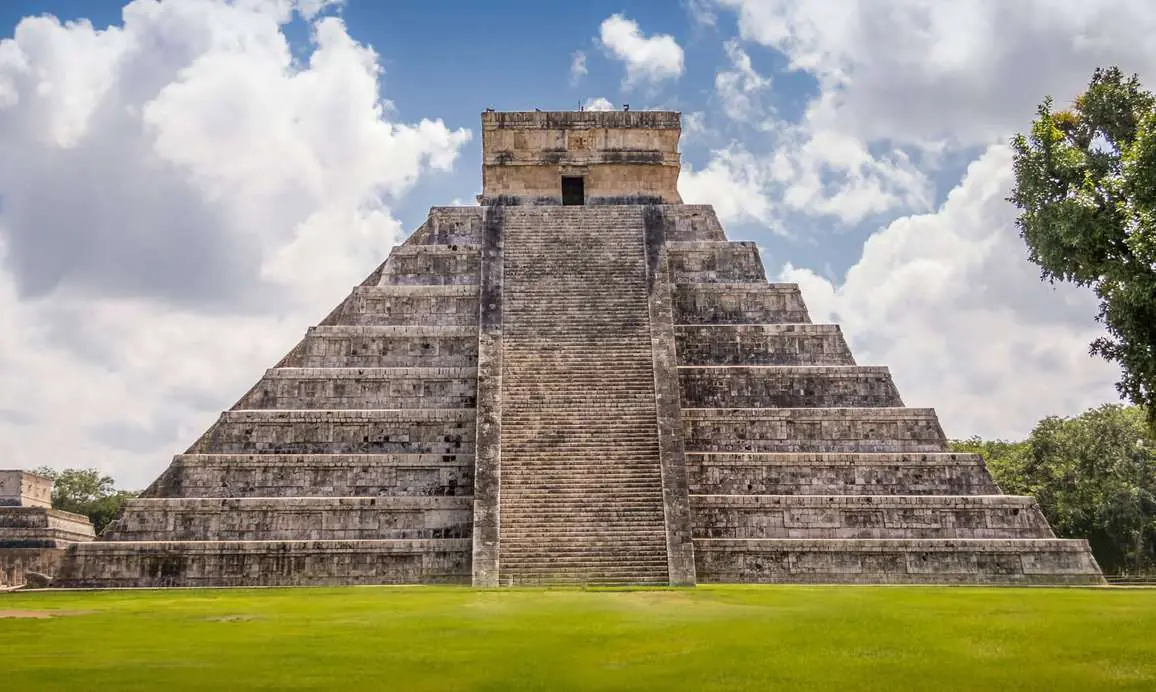
Two facts decide how this day feels, and neither is the one most packing lists lead with. First: there is no dress code at Chichen Itza, no rule to satisfy, nothing an outfit can fail. Second: since April 2026 there IS a bag question, and it catches nearly everyone, reports conflict on whether backpacks and large bags are barred at the entrance or simply checked, so the only safe plan is to pack as if a large bag will not pass. Add one more condition and the whole page follows from it: on this tour, nothing is handed to you, no kit list is completed by anyone else, so what you carry is what you have. What follows is the outfit, the shoes, the swim kit and the carry list, with every item labelled at its true grade: a verified rule where a rule exists, and honest advice, labelled advice, everywhere else. En español, la misma pregunta se busca como qué llevar a Chichén Itzá y cómo vestirse para Chichén Itzá, y la respuesta es esta misma lista.
A note on who is writing this: we run a shared Chichen Itza tour, and this page is written for every visitor, including travellers who will never book it. We are a young operator with a short record. Where the sources behind this page conflict, how much water, what bag storage costs, what the cenote's sunscreen position actually is, the conflict is printed, not smoothed over. And one boundary is stated now because it shapes every section: this page never claims the tour provides water, storage or anything else you would otherwise carry. Carry what you bring.
The whole page in four lines. Everything after this section is the evidence and the exceptions.
Light, loose, breathable clothing in light colours; a hat and sunglasses; broken-in closed-toe shoes with grip; swimwear under your clothes.
At least a litre of water per person (advice, not a rule), sunscreen for the ruins, MXN cash, phone and charger, all in a small waist pouch or cross-body bag.
A quick-dry towel, water shoes, a dry change of clothes and a wet bag. The life jacket is included in Ik Kil's admission; the towel is not provided.
Your backpack or large bag, since April 2026 the reports conflict on whether it passes the entrance, so plan as if it will not, plus drones, tripods, selfie sticks, and food and alcohol for inside the zone.
That is the kit. The sections below take each line in turn, starting with the question behind most of the searches that land here, because its answer is the opposite of what the internet implies.
No. There is no formal dress code at Chichen Itza. That verdict is stated in those terms because it is the finding, not a softening of one: no INAH visitor page states a dress code, none appeared in the research behind this page, and the most-cited dress-code guidance on the subject says plainly that there is no formal code: shorts, T-shirts and dresses are normal wear, and the site is not a religious building with an entry standard to meet. Both AI assistants consulted for this page agree with the verdict. You are dressing for heat and walking, not for a rule.
Why, then, does "dress code" dominate the searches? Because the phrase travels: visitors carry habits from churches, temples and formal sites elsewhere, and guide after guide repeats the question without ever quite answering it, some going further and inventing enforcement ("shirts and shoes expected", "swimwear must stay covered") that no source behind this page could tie to INAH or to any authority at the gate. Those claims are not published here, because they cannot be sourced. What people actually wear at the ruins is ordinary warm-weather clothing, shorts, loose trousers, T-shirts, dresses, hats, and the only standard your outfit will be judged by is the sun's.
One question in this family deserves a direct answer, because searchers ask it and almost nobody answers it: hats and sunglasses are allowed everywhere at Chichen Itza, and restricted nowhere. No source restricts them; they are recommended on every serious packing list. Wear the widest hat you own. The prohibitions that genuinely exist at the site, drones, tripods, professional gear, are a different subject with their own page, the site rules page; this page owns what you wear and carry, and on that subject the verdict stands: no code, no gate test, dress for the day.
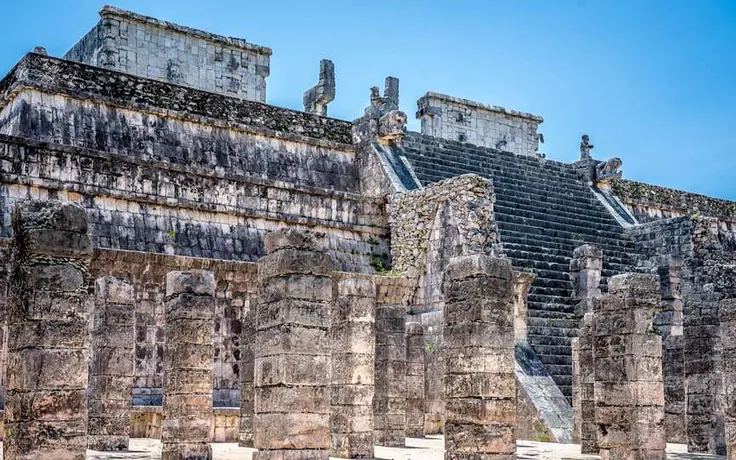
The Temple of the Warriors group. Most of the visit happens on open ground like this, the outfit is sun equipment first and clothing second.
The advice here is broad consensus across the guides behind this page, and it is labelled advice because that is what it is, no authority mandates a fabric. Wear light, loose, breathable clothing in light colours: cotton, linen or thin sports fabrics, in cuts that let air move. Light colours are not a fashion note; on open limestone under a Yucatan sun they are measurably the cooler choice, and the plaza offers long stretches with little between you and the sky. A lightweight long-sleeve layer is the one garment worth singling out: it doubles as sun protection for arms and shoulders through the middle of the day, and it is also the layer that keeps regular sunscreen out of Cenote Ik Kil's water later, section 7 explains why that matters.
What not to wear is the shorter list, and it is just as consistent: thick jeans, which hold heat and dry slowly if the rain finds you; heavy, dark fabrics, for the same reason in reverse; and heels, which meet gravel and uneven stone in section 4. Underneath whatever you choose, wear your swimwear, the day's second half is a cenote swim, the stop is timed, and arriving already dressed for the water is the difference between swimming and queueing for a changing room. That is the whole outfit: chosen for heat, sun and stone, in that order.
Of everything on this page, the shoes are the decision the day grades hardest. The ground at Chichen Itza is uneven limestone and gravel, the visit involves roughly 2–3 km of walking across it (an advice-grade figure, the distance your legs will report, not a surveyed route), and the swim stop adds 91 stone steps down to Ik Kil's water and back up them wet. The footwear that answers all three is the one every serious guide converges on: broken-in, closed-toe trainers or walking shoes with grip. Broken-in is load-bearing in that sentence, the site is a punishing place to learn what a new shoe does to a heel.
The one honest split in the sources belongs here rather than smoothed over: supportive sandals. Some guides accept a sturdy, strapped walking sandal as a reasonable choice in the heat; others hold the closed-toe line without exception. This page presents both and gives its verdict plainly: closed-toe is the safer choice, it protects against stubbed stone, loose gravel and the wet limestone at the cenote, but a genuinely supportive walking sandal is a defensible second, not a mistake. What is consistently advised against, with no split anywhere: flip-flops (no grip, no support, treacherous on wet steps), heels, and brand-new shoes of any kind. Choose the pair you have already walked a full day in. That is the whole test.
What you wear answers the weather; the ground answers the site, for the paths, shade and distances between structures, see the Chichen Itza visitor guide.
This section carries the page's two most-searched quantities, how much sunscreen, how much water, and it begins with the discipline both deserve: no authority fixes either number for Chichen Itza. There is no official water quantity and no official sunscreen standard for the site, and any page that prints one as a rule is dressing advice in a uniform. What follows is the advice itself, which is good advice, labelled as what it is.
Water: carry at least a litre per person, and more in the April–May heat peak. The sources behind this page conflict, figures from 1 litre to 2 litres circulate, and that conflict is exactly why the line is written as a floor rather than a prescription. Buy your water before you enter, at the entrance area, and do not count on buying inside the zone: sources directly contradict each other on whether anything is sold inside, so the only publishable version is the cautious one. And the framing this page set in its opening holds in full: carry what you bring, no claim is made here that water is provided to you at any point of the day.
Sun: a hat and sunglasses, unrestricted everywhere, as section 2 states, plus broad-spectrum sunscreen, applied before the ruins and reapplied through the day. Higher protection factors are the common recommendation in general sun guidance; that is general health advice, not a site rule, and no number is ever stated as one on this page. The one place sunscreen stops being simple is the cenote: at Ik Kil the position is genuinely unsettled, and section 7 states it in full rather than borrow a certainty nobody has earned. For the ruins themselves, the long-sleeve layer from section 3 plus sunscreen on what it does not cover is the complete system. Which month's sun you are dressing for is a separate question, owned by the best month to visit page.
Since April 2026, large bags and backpacks have been barred or restricted at the entrance at Chichen Itza, and the reports conflict on what the position is now. This is the single most consequential packing fact on this page, and the one most likely to catch you out, because the internet's older advice was written before any of it, and the newer reports do not agree with each other.
The status is graded honestly, because it cannot be graded any other way: INAH publishes no bag rule on any page found in this research, and the dated reports point in two directions. Several describe an outright ban from 21 April 2026: The Yucatán Times reported it on 23 April 2026, chichenitza.com reported reactivated security checks on 7 May 2026, and a September 2026 ticket guide still lists backpacks among the banned items. Against that, Cancun Trip Insider (updated 14 October 2026) reports that the outright ban lasted only 21–22 April 2026, imposed after the Teotihuacan shooting, and was then lifted, with bags allowed again but checked. Neither version can be settled from here, so neither is printed as settled; the full timeline is set out on the Chichen Itza rules page. The practical conclusion does not depend on which report is right: plan as if a large bag will not pass.
What passes instead is small and specific: a small waist pouch or small cross-body bag, enough for documents, money and phone, which is the carry this page's list is built around. Everything in section 12's checklist is sized to that reality. If you arrive carrying more, bag storage exists at the entrance, and here the reports conflict, so the conflict is the published fact: one operator describes the storage as free, with a numbered tag; one ticket guide describes a small fee. Neither version is printed here as settled, and you should rely on neither, arrive with the pouch and the question never arises.
The stale-advice warning, plainly: older guides still recommending a small daypack were written before April 2026 and are out of date. They were good advice when written; the entrance has moved on. The full prohibitions picture, what else is stopped, and how the rules are enforced, belongs to the site rules page; this page carries the one rule that rearranges your packing, and it rearranges it completely: pack for a pouch, not a pack.
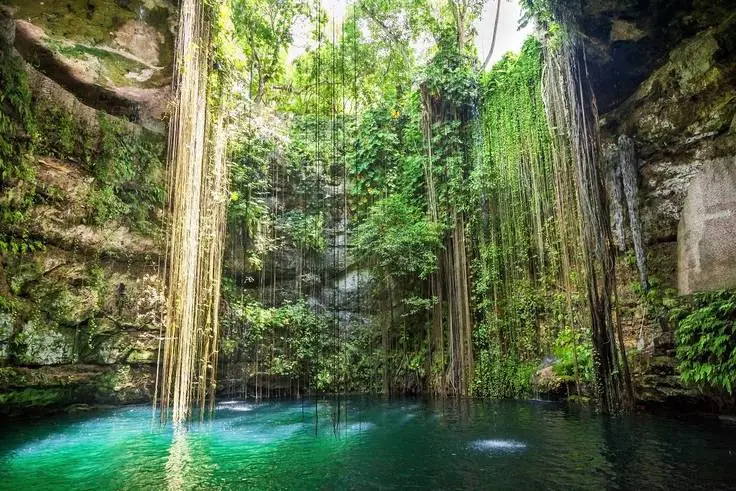
Cenote Ik Kil, about 3 km from the ruins. The swim kit below is short, but every item on it is one the cenote itself makes necessary.
The swim is the day's second half, and its kit starts the night before, with a decision: wear your swimwear under your clothes. Changing rooms exist at Ik Kil, that is confirmed, but a tour's swim stop is timed, so changing is the exception, not the plan. Arrive dressed for the water and the stop is all swimming. Around that decision, the kit is five items: a quick-dry towel, towels are not provided with general admission, so the one you bring is the one you have; water shoes, advised for the 91 steps down and the limestone entry at the bottom; a dry change of clothes for afterwards; a wet bag to keep the swimwear away from everything else; and the pouch discipline from section 6, which applies here exactly as at the ruins.
Two of Ik Kil's own arrangements simplify the list, and both come from the cenote's official position. A shower before swimming is required, that is settled, corroborated by the independent Ik Kil guide and both AI assistants consulted. And life jackets are mandatory in the water and are included in Ik Kil's own admission: the cenote's official site prices general admission at 240 MXN including the life jacket, a locker and parking, with the cenote open 9:00 AM–5:00 PM, 365 days. You do not pack a life jacket; the cenote's ticket already carries it.
Sunscreen at Ik Kil: the honest position. Do not wear regular sunscreen in Ik Kil's water. Beyond that line, certainty runs out, and this page says so instead of borrowing some: Ik Kil's official cenote page states no sunscreen rule at all; the independent Ik Kil guide (cenoteikkil.org, unaffiliated with the cenote) states that sunscreen and lotions are strictly banned in the water; and other advice hedges between "biodegradable only" and "none at all". Whether biodegradable sunscreen is permitted is not confirmed on the cenote's official channels, so the practical course is the one section 3 already built: cover up at the ruins with the long-sleeve layer and the hat, shower before you swim as required, and keep sunscreen out of the water entirely.
The cenote's full depth, the water, the facilities, the day around the swim, lives on the Chichen Itza and cenote tour page, and the swim itself is walked through step by step in the Cenote Ik Kil guide. This page owns only what goes in the pouch for it.
The base kit above serves all year. What changes with the calendar is three compact deltas, the calendar itself, month by month, belongs to the best month to visit page, and the hours within the day to the best time to arrive page; this section is only what each season adds to, or emphasises in, the bag.
| Season | The delta |
|---|---|
| Dry season, Nov–Apr | The base kit as written, plus a light layer for cool mornings, the early hours are the year's most comfortable, and the layer comes off by mid-morning. |
| Heat peak, Apr–May | Maximum water and sun emphasis: more than the one-litre floor per person, the widest hat, the long-sleeve layer doing full duty, and sunscreen reapplied without waiting to feel the burn. |
| Rainy season, Jun–Oct | Add a compact poncho or light rain jacket, lean hardest on grip in the shoes, wet limestone is the day's real hazard, and carry a waterproof pouch for phone and documents. The ruins stay open in ordinary rain; a wet hour is sheltered through, not a day lost. |
One dating note, printed because the sources divide on it: one competitor dates the rains from May. The settled position used across this site, the rainy season from June, stands, and May is packed for here as what its own numbers say it is: the heat peak, at the end of the dry pattern.
The children's kit is the adult kit in smaller sizes, plus three judgements that are this page's to make. The kit itself: their own water bottle, a hat, sunglasses, sunscreen, and broken-in closed-toe shoes, the same shoes verdict as section 4, with no children's exception, because the gravel does not make one either. Add, as advice, spare snacks, wipes and a change of clothes: the change earns its space twice over on a day that ends with a cenote swim.
The three judgements: first, a stroller is not recommended, the paths are uneven gravel, and a stroller turns the visit into a carrying exercise with wheels attached. Second, at Ik Kil, life jackets are mandatory for children too, and they are included in the cenote's admission exactly as for adults, nothing extra to pack or hire on that line. Third, the swimwear-under-clothes plan from section 7 matters more with children, not less: a timed swim stop and a changing-room queue are a poor combination, and arriving dressed for the water removes it. The sourcing behind this section is honestly thinner than the rest of the page, children's packing is advice almost everywhere it is written, and it is labelled accordingly: advice, from the shape of the day, not rules from any authority.
Three pockets' worth of kit, all of it advice-grade. Money: carry MXN cash, for tips, vendors and small purchases, because cards and ATMs are unreliable company on a day like this; the pouch from section 6 is sized for exactly this, and cash in pesos is the version of money that works everywhere the day goes. The settled fee facts themselves, including the entrance fee our tour price already includes, live on the tickets and entrance fee page.
Phone and camera: bring them, the site is photographed by everyone who visits, and bring a portable charger, because a full day of photos, maps and messages outlasts most batteries, and a waterproof pouch that serves the phone at the cenote and in the rainy season alike. One line of discipline closes the section: no camera or tripod permit price is stated anywhere on this page. Secondary sources conflict on the figure, and the rule depth, what gear passes, what needs permission, what is stopped outright, belongs to the site rules page. A price this page cannot settle is a price it will not print.
One line each, these are summaries, and the prohibitions themselves, with their enforcement, are set out in full on the site rules page.
Everything on this list has the same practical shape: none of it is needed for the day, all of it creates a problem at a gate or a stop, and the pouch-sized kit in the next section is what remains when it is all left behind.
The whole page as four lists. Copy them into your notes the night before; if every line is ticked, the day is packed.
The kit above is the kit for our shared tour exactly as for any visit, the day runs: pickup from your own hotel or point, Chichen Itza with the 697 MXN entrance fee included, the swim at Cenote Ik Kil, and a stop in Valladolid, then back to your pickup point. It costs $130 per adult and $115 per child (children up to age 12). Booking is by WhatsApp: your written confirmation comes first and restates the whole position, date, party, pickup point, total price, the advance and balance split, and the cancellation position for your date, and only then is the 30% advance paid to reserve, with the balance on the day of the tour. Cancellation is free up to 48 hours before the tour, with the advance refunded in full. Your exact pickup time is confirmed on WhatsApp the night before, the same evening this page's checklist is meant to be packed by.
One boundary, restated where it matters most: this page makes no claim that the tour provides water, storage or any other part of the kit, those arrangements are not confirmed, so they are not promised, and the honest packing assumption is the one in the hero: what you carry is what you have. We are a young operator with a short record; that is stated rather than dressed up. The tour from each pickup city is set out on its own page: the tour from Cancun and the tour from Tulum, with the Playa del Carmen, Riviera Maya and Merida pages linked from there. However you visit, the calculator prices our version of the day exactly.
The button below composes a WhatsApp message with this party and pickup city already written in.
Book on WhatsAppLight, loose, breathable clothing in light colours, cotton, linen or thin sports fabrics, with a hat and sunglasses. Wear broken-in closed-toe walking shoes with grip, and put swimwear on under your clothes for the Ik Kil stop. There is no dress code to satisfy; you are dressing for heat, sun and about 2–3 km of walking on uneven limestone and gravel.
No. There is no formal dress code at Chichen Itza: no INAH visitor page states one, and the most-cited dress-code guidance says plainly that there is none: shorts, T-shirts and dresses are normal wear, and the site is not a religious building. Dress for heat and walking, not for a rule. Anyone who tells you an outfit will be refused at the gate is repeating an unsourced claim.
Broken-in closed-toe trainers or walking shoes with grip. The ground is uneven limestone and gravel, the day involves about 2–3 km of walking, and Ik Kil adds 91 stone steps. Supportive sandals are a genuine split in the advice, some guides accept them, but closed-toe is the safer choice. Flip-flops, heels and brand-new shoes are consistently advised against.
Carry at least a litre per person, and more in the April–May heat peak. That is advice, not a rule: no authority fixes a water quantity for Chichen Itza, and published figures conflict, from 1 litre to 2 litres. Buy your water before you enter, at the entrance area, and do not count on buying inside the zone, sources contradict each other on whether anything is sold inside.
Plan as if a large bag will not pass, the reports conflict. Since April 2026, large bags and backpacks have been barred or restricted at the entrance: several dated reports describe an outright ban from 21 April 2026, while one October 2026 report (Cancun Trip Insider, updated 14 October 2026) says the outright ban lasted only two days, after which bags were allowed again but checked. INAH publishes no bag rule. What passes either way is a small waist pouch or small cross-body bag for documents, money and phone. Bag storage exists at the entrance; reports conflict on whether it is free or a small fee, so do not rely on either version. Older guides recommending a small daypack predate April 2026 and are stale.
Yes. Hats and sunglasses are recommended everywhere at Chichen Itza and restricted nowhere, no source restricts them, and this page answers the question directly because searchers ask it and few guides do. A wide-brim hat plus sunglasses is the cheapest comfort on the site.
Swimwear (worn under your clothes), a quick-dry towel, towels are not provided with general admission, water shoes for the 91 steps and the limestone entry, a dry change of clothes and a wet bag for afterwards. A shower before swimming is required. Life jackets are mandatory in the water and are included in Ik Kil's own admission, which also includes a locker and parking.
Do not wear regular sunscreen in Ik Kil's water. Ik Kil's official cenote page states no sunscreen rule at all; the independent Ik Kil guide states that sunscreen and lotions are strictly banned in the water, and other advice hedges between 'biodegradable only' and 'none at all'. Whether biodegradable sunscreen is permitted is not confirmed on the cenote's official channels, so the safe course is to keep sunscreen out of the water and rely on shade, a hat and a long-sleeve layer at the ruins instead.
Yes, changing rooms exist at Cenote Ik Kil. But a tour's swim stop is timed, so the plan is to arrive already wearing your swimwear under your clothes and treat changing as the exception, not the plan. Bring a dry change for afterwards and a wet bag for the swimwear.
The same kit in children's sizes: their own water bottle, a hat, sunglasses, sunscreen, and broken-in closed-toe shoes. A stroller is not recommended, the paths are uneven gravel. At Ik Kil, life jackets are mandatory for children too, and they are included in the cenote's admission. Spare snacks, wipes and a change of clothes are worth the space, as advice.
Lleve ropa ligera y holgada de colores claros, sombrero y gafas de sol, y calzado cerrado y cómodo con buen agarre. Traiga al menos un litro de agua por persona, traje de baño debajo de la ropa para el Cenote Ik Kil, una toalla de secado rápido y una bolsa pequeña de cintura o cruzada: desde abril de 2026, los informes sobre las mochilas y los bolsos grandes en la entrada se contradicen, así que planifique como si un bolso grande no pasara la entrada. No hay un código de vestimenta formal en Chichén Itzá.
Leave behind: drones; tripods and professional camera gear; backpacks and large bags, plan as if a large bag will not pass the entrance; selfie sticks; food and alcohol inside the zone; and single-use plastic. Each of these is a one-line summary here, the prohibitions themselves, and how they are enforced, are set out on the site rules page.
Your kit is settled: no dress code to satisfy, a pouch instead of a backpack, swimwear under your clothes and a towel of your own. If your date is chosen, send us your date, your party and your pickup city, and you will get the written confirmation first: price, pickup point, advance and balance, cancellation position, before any money moves. Your exact pickup time is confirmed on WhatsApp the night before, pack the checklist that evening and the morning takes care of itself.
$130 per adult · $115 per child to age 12 · 697 MXN entrance fee included · free cancellation up to 48 hours before the tour.