Questions About the Sacred Cenote
Can you swim in the Sacred Cenote at Chichen Itza?
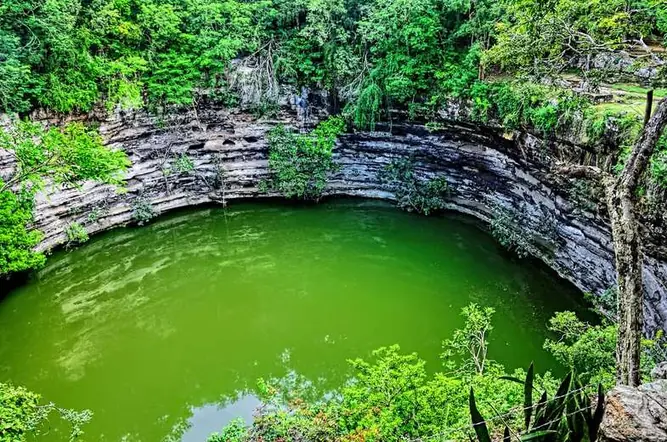
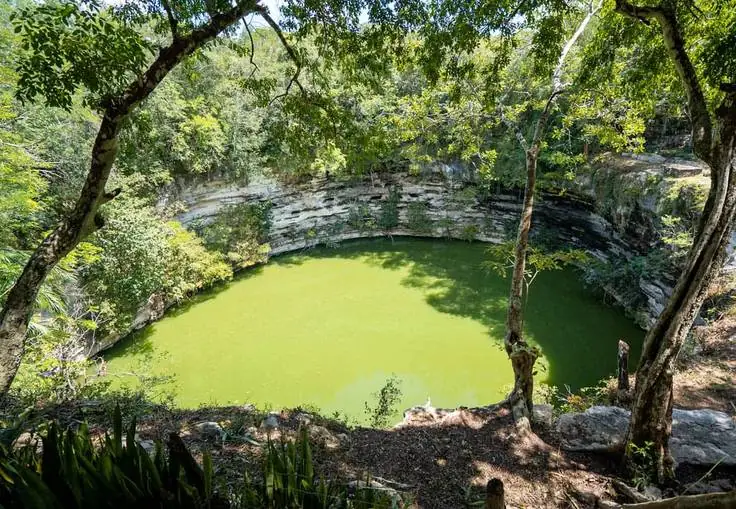
No. Swimming, diving, wading and any descent into the Sacred Cenote are prohibited. Two reasons are verified: the water and its sediment are a protected archaeological deposit, with unrecovered offerings still in the mud, and the cenote is physically inaccessible, sheer limestone walls of about 22–27 m with no stairs or way down. The cenote you swim in on a Chichen Itza day is Cenote Ik Kil, about 3 km away.
Is the Sacred Cenote the same as Cenote Ik Kil?
No. The Sacred Cenote is inside the archaeological site, at the end of Sacbé 1 about 300 m north of El Castillo, and it is viewing-only. Ik Kil is a separate swimming cenote about 3 km from the ruins, with no offering story attached. The sacrifice accounts and the recovered offerings belong to the Sacred Cenote; the swimsuit photos belong to Ik Kil.
How deep is the Sacred Cenote?
The water itself is up to 13.50 m deep (INAH). The confusion comes from three different measurements: the water surface sits about 22 m below the rim by INAH's guide figure, with an older measurement giving about 27 m, and the often-quoted 40 m is the total drop, rim plus water, not the water depth.
How far is the Sacred Cenote from El Castillo?
About 300 m north, along Sacbé 1 (Calzada 1), the figure given by Arqueología Mexicana and an INAH guide. It is the last stop on INAH's official long visitor route, and the walk is part of the 25–40 minutes most visitors spend on the stop, rim time included.
Were people really sacrificed in the Sacred Cenote?
Human remains were genuinely recovered from the cenote, and they include men, women and children of different ages (Price, Tiesler & Freiwald 2019). Some show signs of ritual processing; others preserve no cause of death, and some may have died before being placed in the water. So the honest answer is: people were deposited in the cenote, ritual killing is part of the evidence for some of them, and no exact total of the dead has ever been published.
Were the victims virgins?
That story is not supported by the evidence. The recovered remains include men, women and children of different ages, not only young women. The sacrificed virgins or maidens version comes from colonial-era retelling and early assumptions about the cenote, and modern analysis of the remains does not back it.
Where are the Sacred Cenote artifacts now?
Most of Edward Thompson's dredged material is held by Harvard's Peabody Museum, which by its own accounting still holds more than 3,000 offerings. A partial return reached Mexico's Museo Nacional de Antropología in 1959, and the on-site Gran Museo de Chichén Itzá has a dedicated Sacred Cenote gallery. No source verifies which specific objects are on public display at any given time, so this page names collections, not promised exhibits.
How long do you need at the Sacred Cenote?
About 10–15 minutes at the rim, and 25–40 minutes including the walk from the main plaza (yucatan.guide). It is the end point of INAH's long visitor route, which INAH estimates at about 2 hours for the whole route. Go early in the visit if you can, the walk is exposed and the viewing areas are quieter before the midday groups arrive.
Is the Sacred Cenote included in the Chichen Itza ticket?
Yes. The Sacred Cenote is inside the archaeological zone and there is no separate ticket for it, it is covered by the standard Chichen Itza entry, and it cannot be visited apart from the site. On our shared tour, the 697 MXN entrance fee is included in the $130 price.
¿Qué es el Cenote Sagrado de Chichén Itzá?
Es el cenote ceremonial dentro de la zona arqueológica, al final del Sacbé 1, unos 300 m al norte de El Castillo. Mide unos 60 m de diámetro y su agua alcanza 13.50 m de profundidad. Era el lugar de ofrendas de la ciudad, ligado a Chaac y a la lluvia; hoy solo se observa desde el borde, está prohibido nadar o bajar. El cenote donde se nada cerca de Chichén Itzá es Ik Kil, a unos 3 km.
Did scientists find a cenote under the El Castillo pyramid?
Yes, in 2015, geophysics detected a small cenote beneath El Castillo. It is a different, hidden feature, not the Sacred Cenote: the Sacred Cenote is the open sinkhole at the end of Sacbé 1, about 300 m north of the pyramid.
Is the Sacred Cenote worth visiting?
Yes, if you go in knowing what it is: a vast, still, green-water sinkhole seen from its rim, a place to stand and take in the weight of the story, not an activity. It takes only 10–15 minutes at the rim, on a route you are already walking, and it is the one stop at Chichen Itza where the evidence is still being argued about. If you want to swim, that is Ik Kil, about 3 km away.