Lesser-Known Structures at Chichen Itza
Beyond El Castillo and the ball court stands a second Chichen Itza: a Puuc palace district in the south, a tomb-pyramid and a working cenote in the north, and a whole reservation-only sector holding the site’s only full Long Count date. This is the guide to that quieter city.
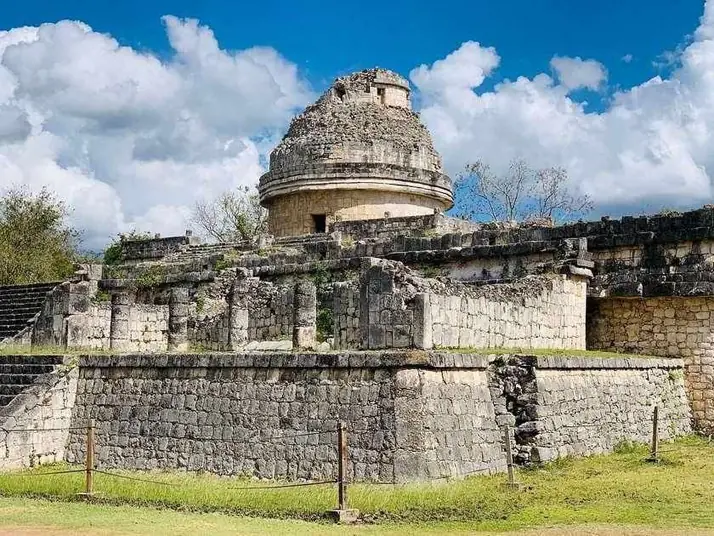
We run the shared Chichen Itza tour described near the end of this page. We are a new operator with a short track record. Access statements for Chichen Viejo follow the official INAH position in the sources at the foot of this page, not travel-blog reports.
The Chichen Itza Beyond the Postcards
Every visitor photographs the same five buildings. But the city holds whole districts the standard route skims: a Puuc palace complex the Spanish mistook for a convent, a little church-facaded temple smothered in rain-god masks, a house with the writing on its walls, a red-painted room with a dated glyph band, the tomb-pyramid of a high priest, a modest cenote that kept the city alive, and, across the southern scrub, an entire second sector that opened to visitors only in the 2020s and still takes reservations only. These are the lesser-known structures of Chichen Itza, and they are not lesser in interest: the oldest firmly dated carving at the site is here, the southern city here predates the famous plaza, and the walking that finds them is the quiet half of the ruins.
The famous five keep their own guides: El Castillo, the Great Ball Court, the Warriors, El Caracol and the platforms group. This page is their supporting cast, structured the way you would actually walk it: the southern group first, then the northern outliers, then Chichen Viejo.
Las Monjas and La Iglesia: The Nunnery That Never Housed a Nun
Las Monjas, "the Nuns", is a multi-level Puuc range complex in the southern group, named by Spanish colonial observers who thought its warren of small rooms looked like a convent. It was nothing of the kind: it is a palace and administrative complex of the earlier city, built in stages across the 6th to 10th centuries, its eastern wing carrying stone-mosaic facades and carved lintels whose glyphs name a lord called Kakupakal. Stand in front of the east wing and read it as the southern city's government house, because that is the current scholarly reading, and the convent story dissolves.
Just east of it stands La Iglesia, "the Church", the same misunderstanding in miniature: a small, richly carved temple whose facade is a dense Puuc mosaic of Chaac rain-god masks, with bacab figures, the old men who hold up the sky, worked into its corners. It is one of the most ornamented small buildings at Chichen and one of the most photographed of the southern group, precisely because its carving survives at reading distance. The pair belong to the older city described on the history page, and the route that walks them in sequence is set out in Inside Chichen Itza.
Akab Dzib and Casa Colorada: Writing on the Walls, Red on the Rooms
Akab Dzib, "dark writing" or "writing in the dark" in Yucatec Maya, is a long, low range structure of the southern group, about 6 m high, 50 m long and 15 m deep in the published figures, with seven doorways in its western facade. Its name comes from its carved lintels, dense with glyphs and figures that early visitors found hard to read in its shadowed rooms. An earlier name for the building, Wa(k)wak Puh Ak Na, is recorded in the literature. INAH completed a restoration of the structure in 2007, and it stands today as one of the best places at Chichen to see a Puuc palace-range at domestic rather than monumental scale.
Casa Colorada, the Red House, also called Chichanchob, takes its name from the band of red paint that survives inside its main chamber. Inside runs a glyph band that dates the building to 869 CE, one of the few firm dates anywhere at Chichen, which makes this modest house a chronology anchor for the whole southern city. It is a short walk from Akab Dzib, and together the two buildings give the southern group its documentary character: this is the district where Chichen wrote things down.
The Osario and Cenote Xtoloc: The North's Quiet Corners
The Osario, the High Priest's Grave, is a stepped tomb-pyramid in the northern group, structurally a smaller cousin of El Castillo, with serpent balustrades and a shaft descending from its summit temple into a burial chamber below. Its depth as a monument, the burials, the offerings, the shaft itself, is covered inside the platforms and Osario guide, which owns it; here it is placed, because a walking route that strings the northern outliers together passes it between the ball court platforms and the road to Xtoloc.
Cenote Xtoloc, the iguana's cenote, is the city's second well, south-east of the great plaza: the working water supply of ancient Chichen, where the Sacred Cenote was its ceremonial one. A small temple stands at its rim. Almost every visitor walks within a few hundred metres of it without knowing, on the way between the Osario group and the southern district, and stopping costs ten minutes. What a cenote is, and why a city of this size needed two inside its walls, is defined on the what is a cenote page; the Sacred Cenote itself has the full guide.
Chichen Viejo: The Sector You Book Separately
South of the main zone lies Chichen Viejo, "Old Chichen", known to archaeologists as the Initial Series group after its famous lintel: an elite residential and ceremonial compound of palaces, temples and carved lintels, set apart from the public circuits. Its lintel carries the site's only full Long Count Initial Series date, 10.2.9.1.9, converting to 30 July 878 CE under the standard correlation, with the scholarly caveat, recorded by Mesoweb, that the lintel stone was reset and the date is not in its original context. Around it stand the Temple of the Owls (dated around 870), the Temple of the Three Lintels (871) and the Temple of the Four Lintels (881), a dated cluster that anchors the city's 9th-century history.
Access, stated carefully. Travel blogs disagree flatly about Chichen Viejo: some call it closed, some walk in and write as if it were open. The settled programme record for this site is the official one: Chichen Viejo is a separate, reservation-only sector, visited on a circuit of about 2.5 hours, on the days INAH's 2026 sheet specifies (Fridays and Saturdays, with Thursdays added in that sheet), and the reservation includes no guide. Confirm the current arrangement with INAH before planning around it; do not rely on a blog's visit report, including an enthusiastic one.
For most visitors Chichen Viejo is a fact to know rather than a place to go: it explains why the southern scrub is fenced, why the site's one hard date sits off the main route, and how much of the city the standard circuit never enters. If you do arrange it, it is a second visit's centrepiece, done at walking pace with the lintel dates as its plot.
How to Walk the Lesser-Known Chichen: A Route in Passages
The southern group is one walk, and it is the walk most visitors never take. From the great plaza, the path south passes the Osario group, drops by Cenote Xtoloc, and reaches the southern district, where Las Monjas and La Iglesia stand together, with Akab Dzib and Casa Colorada in the same neighbourhood and El Caracol rising over all of it. Allow the time honestly: the standard two to three hours on site covers the northern monuments well and the southern group briefly; a visitor who cares about this page's buildings should plan toward the longer end, start early, and put the south in the cool of the morning rather than as an afterthought at noon. The full route, with distances, shade and sequencing against the crowds, is the Inside guide's job, and it does it building by building; this page's job is to make sure you know the buildings are there before you choose your route.
One expectation to set: lesser-known does not mean empty. Las Monjas appears on many guided routes, and the southern paths carry a steady flow by mid-morning. What you get in the south is not solitude but depth: the older city, the dated carvings, and the residential scale of Maya architecture, at a pace the northern plaza rarely allows.
See Both Cities in One Day: The Shared Tour
Our shared day trip combines Chichen Itza, a swim at Cenote Ik Kil, and a stop in Valladolid. It costs $130 per adult and $115 per child up to age 12, including the 697 MXN Chichen Itza entrance fee. We pick you up at your own hotel or pickup point and confirm the exact time on WhatsApp the night before. A 30% advance reserves your place, with the balance due on the day of the tour. Cancellation is free up to 48 hours before the tour, and the advance is refunded in full. We are a new operator, and we believe in saying so plainly.
City pages: Chichen Itza tour from Cancun · from Tulum · from Playa del Carmen
Price calculator
The Chichen Itza entrance fee of 697 MXN is included in these prices, so there is nothing extra to pay at the gate for entry.
Lesser-Known Structures: Questions, Answered
What is Las Monjas at Chichen Itza?
A multi-level Puuc palace and administrative complex in the southern group, built across the 6th to 10th centuries. Spanish observers named it "the Nuns" because its many small rooms suggested a convent; its carved lintels name a lord called Kakupakal, and the current reading is a government and palace complex of the earlier city.
What is Akab Dzib?
A low Puuc range structure, about 50 m long with seven western doorways, whose name means "dark writing" after its glyph-covered lintels. INAH completed its restoration in 2007. It shows the palace scale of the southern city, in contrast to the monumental northern core.
Can you visit Chichen Viejo?
Only as a separate, reservation-only visit under INAH’s current arrangement, on a circuit of about 2.5 hours; the reservation includes no guide. INAH’s 2026 sheet lists Fridays and Saturdays, with Thursdays added. Confirm the current position with INAH before planning, because travel blogs contradict each other on this.
What is the oldest dated carving at Chichen Itza?
The Chichen Viejo lintel reading 10.2.9.1.9 in the Long Count, converting to 30 July 878 CE: the site’s only full Initial Series date. Scholars note the lintel was reset, so the date is not in its original context; it is printed here with that caveat.
What is Casa Colorada?
The Red House, or Chichanchob: a southern-group building named for the red paint surviving inside its main chamber. A glyph band inside dates it to 869 CE, one of the few firm dates at the site and a chronology anchor for the southern city.
What is Cenote Xtoloc?
The second cenote inside the archaeological zone, south-east of the great plaza: the working water supply of the ancient city, where the Sacred Cenote was the ceremonial well. A small temple stands at its rim, and it takes about ten minutes to visit.
Is the Osario covered on this page?
It is placed here, on the walking route, but its depth home is the platforms and Osario guide, which covers its tomb shaft, burials and serpent balustrades in full. One owner per subject is this site’s rule.
How long do the lesser-known structures take to see?
The southern group, Las Monjas, La Iglesia, Akab Dzib, Casa Colorada and El Caracol, fits inside the standard two to three hours on site if it is planned rather than left over, ideally in the morning. Chichen Viejo is separate: about 2.5 hours, by reservation.
Check Your Date on WhatsApp
Booking opens on WhatsApp: that is where your date is checked, your pickup point is set, and your exact pickup time is confirmed the night before the tour. Send one message with:
- Your tour date
- Your pickup city and hotel or pickup point
- How many adults and children (to age 12)
$130 per adult · $115 per child · 697 MXN entrance fee included · 30% advance to reserve · free cancellation up to 48 hours before.
Start with your date
One tap opens the conversation. Prices above are the full per-person prices: the entrance fee is already in them.