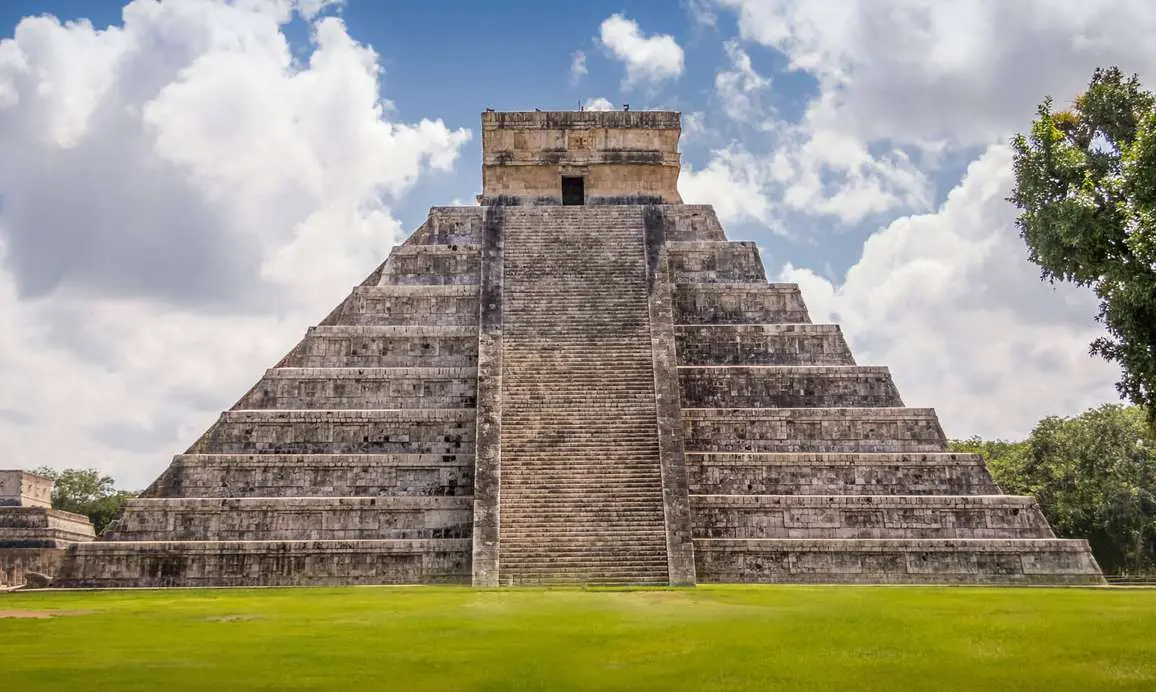
Driving to Chichen Itza: Routes, Tolls, Parking and Rental-Car Guide
Driving is the most flexible way to reach Chichen Itza: you set the departure, you can claim the quiet 8:00 AM opening, and the road home is yours. It is also the most mispriced way in print. The internet's favourite toll figure, "532 pesos", is a route total that one guide turned into a per-booth charge and an AI overview then copied. This page prices every route the way the road actually charges it: from the official SCT tariff schedule, effective 13/04/2026, segment by segment, with every figure carrying its grade in words, including the tolls where the honest answer is "reported, not settled" and the one shortcut toll nobody has priced at all.
A note on who is writing this: we run a shared Chichen Itza tour, and this page compares driving against it honestly, including the cases where driving wins. We are a new operator with a short record. Where a figure on this page comes from the official tariff schedule or CULTUR itself, it says so; where it is a reported range or a labelled example, it says that too, and where no verified figure exists, a representative rental rate, a deposit range, a fuel cost, this page publishes the blank rather than fill it.
The Five Routes at a Glance
Five starting points, five different drives, and five different toll stories, because the 180D charges by segment, not by journey. Distances and drive times below are the settled ranges from each origin's own transport guide, repeated here at comparison depth; the toll column carries its grade in words, because on this page a number without its evidence is worth nothing. Every DIY drive also meets the 697 MXN entrance fee per person at the gate: the full fee breakdown lives on the tickets and entrance fee page.
| Origin | Route | Distance | Drive time | Tolls one-way, graded | The return note |
|---|---|---|---|---|---|
| Cancun | 180D toll road (cuota) the whole way | ~200 km | ~2.5–3 hours | Official schedule 532 MXN one-way, 1,064 MXN round trip, two segments on the SCT tariff schedule (13/04/2026). | The longest drive home of the five. Quintana Roo runs one hour ahead of Yucatán, leave by Yucatán's clock, in daylight. |
| Playa del Carmen | 305D north, joining the 180D | ~180 km | ~2h15–2h30 | Reported: check live Traveller reports cluster at ~440–474 MXN one-way. No official route total is published here because none was verified. | Same time-zone hour as Cancun: the gate's Yucatán clock reads one hour earlier than your dashboard. |
| Tulum | 109 via Cobá, then the 180 Libre | ~150–153 km | ~2h–2h15 | Toll-free 0 MXN on the standard route. An optional 180D shortcut exists; its toll is unpriced in any source we could check. | The shortest distance, on the slowest class of road, libre driving, with towns and topes, and the same one-hour time-zone trap. |
| Merida | 180D toll road (cuota) | ~120–128 km | ~1h28–1h45 | Reported: no pair fare Guides report 136–143 MXN. The official schedule publishes no Mérida–Pisté pair fare, so no single figure is settled. | The easiest return of the five: same state, same time zone, the shortest cuota drive. |
| Valladolid | 180 Libre (free road) | ~40–45 km | ~35–50 minutes | Free 0 MXN on the libre. The 180D segment costs 105 MXN (SCT schedule) and saves only 5–10 minutes. | A short hop, the return constraint here is not distance but daylight and the filling car park in the morning. |
Each origin's full transport picture, buses, trains, colectivos and the tour from that city, sits on its own page: from Cancun, from Playa del Carmen, from Tulum, from Merida and from Valladolid. This page owns only the driving layer they share.
How the Tolls Actually Work
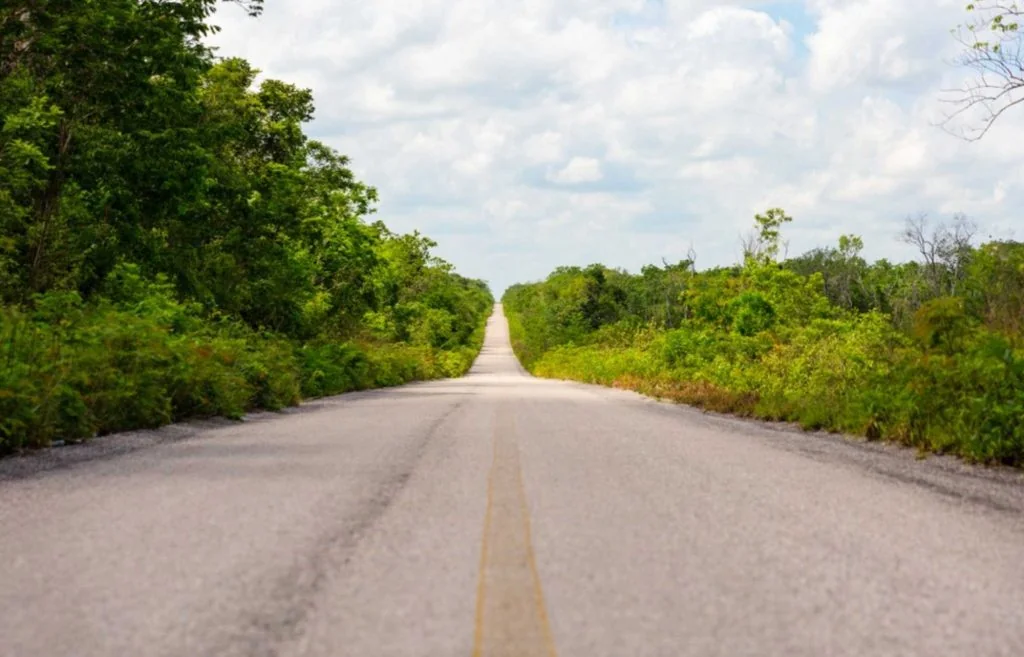
The 180D cuota. Its price is not one number per road: it is a list of priced segments, and your total depends on which of them your journey uses.
Almost every toll argument about this drive dissolves once you see the mechanism: the 180D is priced by segments. The official SCT tariff schedule for the Mérida–Cancún concession, effective 13/04/2026, prices stretches of road, not whole journeys, and a driver pays for the segments their route actually covers. Here is the schedule's own segment list for cars, the evidence everything else on this page is built from:
| SCT segment | Car toll (MXN) | What it is |
|---|---|---|
| Valladolid–Cancún | 427 | The long eastern stretch of the 180D, the largest single segment on the schedule. |
| Pisté–Valladolid | 105 | The short hop between the ruins' exit town and Valladolid. |
| Kantunil–Pisté | 143 | The western approach to the ruins from the Merida side. |
| Kantunil–Valladolid | 248 | Kantunil through Pisté to Valladolid, note it equals 143 + 105, the segment arithmetic working as designed. |
| Mérida–Cancún, full route | 675 | The whole concession end to end, the ceiling figure, useful for checking any total quoted to you. |
Now the Cancun total explains itself: a Cancun driver bound for the ruins covers Valladolid–Cancún (427) plus Pisté–Valladolid (105): 427 + 105 = 532 MXN one-way, 1,064 MXN for the round trip. That is grade-A arithmetic straight off the dated schedule, and it is also why the same road costs different totals from different origins: each origin's journey is a different bundle of segments.
The "532 pesos per toll booth" claim is false. It appears in a ranking safety guide, and Google's AI Overview copied it verbatim, so the error now sits in the two places travellers trust most. Read the schedule above: the largest single segment on it is 427 MXN. No booth on this road charges 532 MXN; 532 is the whole one-way total from Cancun. Anyone budgeting per-booth at 532 is roughly doubling their toll money on bad information: correcting exactly this is why this page exists.
The mechanics at the booth are simpler than the pricing, and stricter: casetas take cash pesos. Card readers exist but often fail, so the working rule is to carry small bills and exact change in pesos and never let a card be the plan. There is no ATM at the toll plazas to rescue an empty wallet; CULTUR lists an ATM among the site's own services (08:00–20:00), but that is inside the destination, after every booth is behind you. Sort the cash before you leave your origin.
The Toll From Your Origin
Cancun: 532 MXN one-way, from the schedule itself
The strongest toll evidence on this page. The SCT tariff schedule (13/04/2026) prices the two segments a Cancun driver uses at 427 and 105 MXN; added, they give 532 MXN one-way and 1,064 MXN round trip. If a source quotes you anything else for this route, and especially if it quotes 532 per booth, it is not reading the schedule. The full route picture, including the Sunday-only direct bus and the train, is on the Cancun transport guide.
Playa del Carmen: a reported cluster of about 440–474 MXN
Playa's drive joins the toll system partway along, and no official route total for it was verified, so this page publishes what the evidence actually is: traveller reports clustering at about 440–474 MXN one-way, with 440 MXN supported by two independent accounts (one of them an 880 MXN round trip) and 474 MXN from a 2024 forum breakdown. Treat the range as reported and check live before you drive. Two warnings ride with it: the 344 MXN figure in older material is a single segment's price, not the route total, and a booth-by-booth split of this toll that circulates via the AI answers rests on a third-party toll site, the total may sit inside the range, but no split is presented here as official, because it is not.
Playa's version of this drive has its own toll pattern; the drive from Playa del Carmen is covered inside that city's full getting-there guide.
Merida: reported at 136–143 MXN, and here is why no single figure is settled
Merida guides report 136 MXN (the best-supported figure, in guides from January 2025 and June 2026) and 143 MXN. The 143 has a suspicious pedigree: it is exactly the schedule's Kantunil–Pisté segment price, and it is also what the concession's plaza arithmetic produces (the 675 MXN full route minus Cancun's 532 equals 143). That equality may describe how the booths collect it, but the official schedule publishes no Mérida–Pisté pair fare, so this page prints the honest form: reported at 136–143 MXN; no published pair fare exists. And a clean rejection, because it is circulating: anyone quoting you 105 MXN from Merida is quoting the Pisté–Valladolid segment, a different stretch of road, moved onto the wrong route.
From Merida the drive is the shortest on this page; the drive from Merida sits inside the capital's complete getting-there breakdown.
Tulum: the standard route is toll-free; the shortcut is unpriced
Tulum's normal drive, the 109 via Cobá, then the 180 Libre, carries no toll at all, confirmed across multiple pages. There is also an optional shortcut that joins the 180D; about its toll, honesty requires a sentence most pages will not print: it is unpriced in any source we could check. Both AI answers guess a figure for it; a guess is not a price, so this page publishes none. If you take the shortcut, carry cash and treat whatever the booth asks as the first verified data point: the Tulum transport guide covers the route choice in full.
Valladolid: free by libre, 105 MXN by cuota
The simplest toll story of the five: the 180 Libre from Valladolid is free, and the 180D alternative is the Pisté–Valladolid segment at 105 MXN, straight off the SCT schedule. What that 105 buys is only 5–10 minutes on a hop of about forty, which is why the libre is the default on the Valladolid transport guide, and the cuota a matter of taste in road surface rather than time.
Cuota or Libre?
Every origin on this page offers the same underlying choice, and it is a choice of character, not just price. The 180D cuota is the engineered road: dual carriageway, well maintained, patrolled, and, the detail drivers feel most, no speed bumps. The libre roads are the older free roads that thread through towns: slower speeds, potholes, and unmarked topes (speed bumps) that arrive without warning signs and punish a driver who meets one at pace. The cuota buys speed, surface and calm; the libre buys a zero in the toll column and a slower, more attentive drive.
| 180D cuota | Libre (free road) | |
|---|---|---|
| Cost | Tolls by segment: see your origin above | Free |
| Surface & pace | Well maintained, fast, no topes | Towns, unmarked topes, potholes, slower speeds |
| Presence | Patrolled | You share the road with town traffic, buses and local life |
| Best for | Long hauls (Cancun, Merida), the return leg, any drive against the daylight | Short hops and relaxed mornings with time in hand |
When is the libre genuinely the right choice, rather than a false economy? Three cases stand up. The Valladolid hop: forty-odd kilometres where the cuota saves 5–10 minutes: the libre is simply the road. The ruins-to-Valladolid leg: plenty of drivers tour the site, then take the short free road into Valladolid for the evening, and the hop is libre-shaped by nature. And the Tulum route, where the free road via Cobá is not the budget alternative but the standard route itself. The libre is the wrong choice when the day has already spent your margin: a late start, a tired driver, or a return that only just makes daylight: those are the drives the cuota exists for.
Parking at Pisté
Parking is where this page can retire another long-running muddle, because the official source has now been read directly: CULTUR Yucatán's own Chichen Itza page (2026) prices its official lot at 124 MXN per car or van, 150 MXN per Sprinter and 200 MXN per minibus or bus. That is the official rate, cited to the body that runs the site. The 60, 80 and 120 MXN figures that fill the origin guides are older prices, or the prices of the private lots near Pisté, not the official lot's current charge. Private lots set their own amounts; one guide's range for them runs to roughly 200 MXN, published here as exactly that and no more.
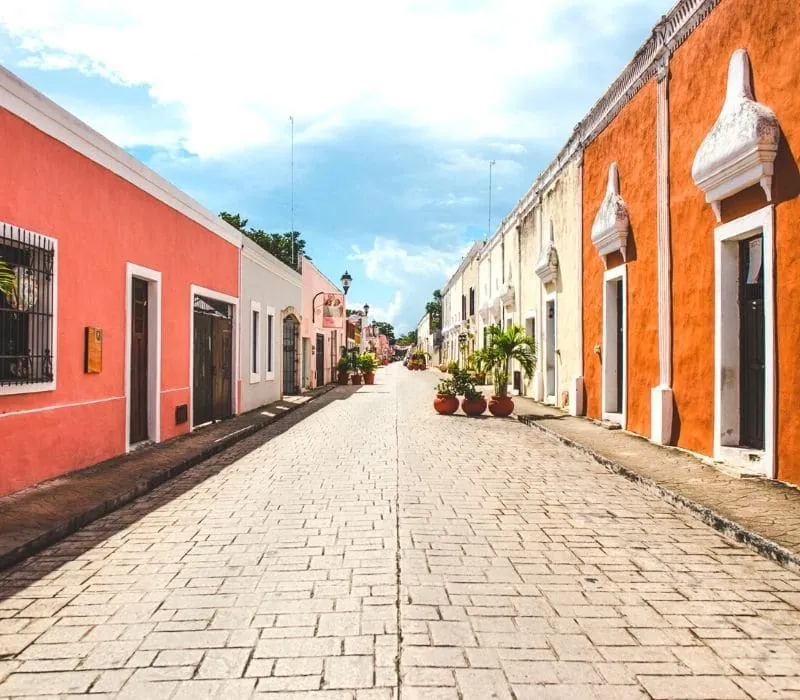
Valladolid, minutes east of Pisté. Drivers pass it on the 180D; the exit for the ruins is signed for Pisté.
The arrival sequence is short and worth knowing before the morning of the drive: leave the 180D at the Pisté exit, follow the signs through the village to the official entrance, and park in the official lot, pay there, in cash, at the 124 MXN rate above rather than stopping at the first waved-at space a private lot offers. Then the operational fact that shapes the whole morning: the lot fills by mid-morning, as the coastal buses and the day's drivers arrive together. An early driver parks at the entrance and walks in at the 8:00 AM opening; a late one parks where there is room. That, more than any toll saving, is the argument for the early departure.
Full site depth, what to see first, the order of the monuments, the rules inside, lives on the Chichen Itza visitor guide; this page's job ends at the gate.
Renting the Car: The Real Price
Start with the number that is not a price: rental ads for this region run teaser rates of $1–5 a day. No car changes hands for that. The teaser exists before the one charge Mexican law does not let anyone skip, and understanding that charge is most of understanding rental pricing here.
Third-party liability (TPL) insurance is legally mandatory in Mexico. Cover from your home country does not satisfy it, and neither does your credit card's rental benefit: the mandatory Mexican liability policy has to be part of the rental itself, priced into the contract by the rental company. There is a consequence behind the rule that guides state plainly: after an accident, police may hold the car until the insurer pays, which is why the insurance is not an optional extra to decline at the desk, however the desk presents it. One widely read 2026 guide puts the realistic all-in average at $45–60 a day once the mandatory cover is inside the price (Everything Playa, 2026); an older guide's $65 a day with full insurance dates from 2020 and is stale. Both are guide figures, published here as attributed guide figures, not quotes.
The second shock is the deposit, and its mechanism is at least logical: the hold is the company's protection against everything the insurance leaves uncovered, so the deposit shrinks as the protection package you buy grows. Supplier-policy examples reported to us show the shape, labelled here as examples, not as a market survey, because they were not independently opened: Enterprise Mexico holds quoted at 10,000 MXN without Total Protection, falling to 4,000 and 2,000 MXN with higher packages; an Avis economy example at 30,000 MXN. Your hold will be its own number, which is precisely why it must be asked for, in writing, before you book, and checked against your card's limit.
The rental instruction this page stands behind: get two numbers in writing before you book: the all-in day price with the mandatory liability insurance inside it, and the exact deposit hold. And an honest blank, stated rather than filled: no verified representative daily rate, TPL per-day price, deposit range or fuel cost exists for November 2026, the AI answers decline to verify them too, so this page publishes none. Any page that hands you a single tidy "cost of renting a car for Chichen Itza" figure is inventing the tidiness.
Drive or Tour? The Real Cost
Here is the comparison built the only honest way it can be built: from graded parts. Every line in the driving column carries the evidence grade this page has already established; the one line that cannot be graded is left visibly unpriced rather than quietly estimated.
| Cost line | Driving yourself | The shared tour |
|---|---|---|
| Entrance | 697 MXN per person, paid at the gate | Included in the price |
| Tolls | By origin, graded: Cancun 1,064 MXN round trip (SCT schedule); Playa ~440–474 one-way reported; Merida 136–143 reported; Tulum and Valladolid 0 on the free routes | None: no car, no casetas |
| Parking | 124 MXN at the official CULTUR lot | None |
| Rental + fuel | Unpriced: honestly Add your rental's all-in day rate and your fuel. No honest single figure exists for either. | None |
| The day itself | Chichen Itza on your own schedule; Valladolid and the cenote are separate stops you arrange and pay for yourself | Chichen Itza + the Cenote Ik Kil swim + the Valladolid stop, in one price |
| Price | The sum of the lines above, it is yours to total | $130 per adult, $115 per child to age 12 |
The worked floor, Cancun, two adults: round-trip tolls 1,064 MXN + official parking 124 MXN + entrance for two at 697 MXN each (1,394 MXN) = 2,582 MXN, before the car itself exists in the maths. The rental's all-in day rate and the fuel go on top of that floor, at whatever figures your written quote gives you. Against it, the tour prices the same two adults at $260 all-in: entrance included, pickup from your own hotel or point with the exact time confirmed on WhatsApp the night before, a 30% advance to reserve with the balance on the day, and free cancellation up to 48 hours before the tour.
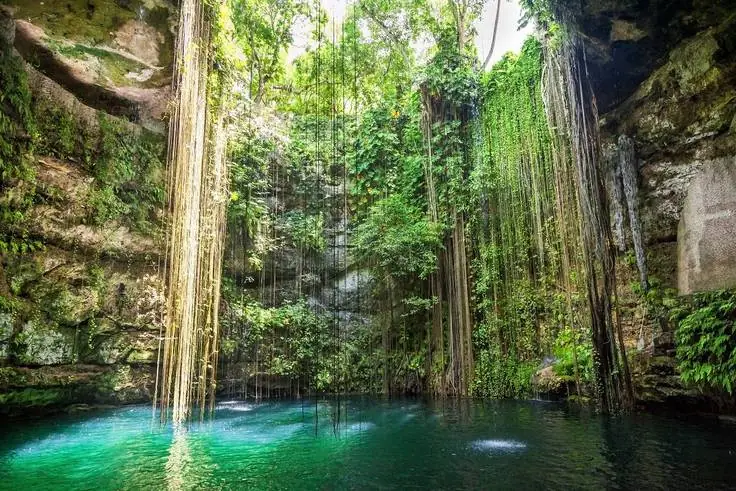
Cenote Ik Kil, about 3 km from the ruins, a stop the driving day arranges separately, and the tour's day includes.
The party-size reading is the honest shape of the decision: driving's costs are mostly fixed per car, tolls, parking, the rental, while entrance is the only per-person line, and the tour prices purely per person. So the maths tilts toward the car as the party grows and toward the tour for a couple, and it tilts further once you price your own time: the driver works the whole day, in both directions, while everyone on the tour is a passenger. Neither column is the answer for everyone. This page's job is that both columns now contain only numbers that can be traced. If neither column fits, no car, but no tour either, the third way is the bus: the ADO bus to Chichen Itza runs the same corridor, and its page prices that option from the same evidence-first position.
And if you would rather be driven, the passenger’s guide to the drive covers what the hours on this road feel like from the back seat.
Road Safety, Without the Guarantee
This section is guidance, written the way the guides give it: it is not, and no page can make it, a promise about your drive. The conditions themselves are consistent across sources. The 180D cuota is well maintained and patrolled, with no topes. The libre roads run through towns with unmarked speed bumps, potholes and slower speeds: the bumps are the signature hazard, because an unmarked tope met at highway pace damages cars and days alike; on libre roads, drive at the speed the road in front of you justifies, not the speed the last stretch allowed.
Checkpoints are a normal part of these routes. Legitimate police and military checkpoints exist, and the correct response is procedural, not anxious: slow down, stop if waved to, and have the documents ready: your driving licence, the rental contract, and the insurance papers. A driver who can hand over the full set without a glovebox excavation passes through in moments. Keep the set together, in the car, for the whole day.
- Fuel up before the highway stretches: the long cuota runs are not lined with stations, and a low tank converts a simple drive into an itinerary.
- Expect spotty rural mobile coverage: download what you need (maps, bookings, this page's numbers) before you leave, rather than discovering the dead zones at a junction.
- Emergencies: 911. For roadside assistance, the Green Angels answer on 078, save both numbers before you set off, while saving is easy.
That is the whole of the evidenced guidance. Claims that circulate only in forums, roadside scams with named scripts, exact speeds at which a tope damages a car, are not published here as facts, because forum repetition is not verification.
Night Driving and the Daylight Return
The guide consensus on the return leg is unusually united: do not drive back after dark. The reasons repeat across sources: unlit roads, potholes you cannot see in time, and animals on the road, and they apply with most force to the libre roads, but the consensus is stated for the drive generally. One published guide (Travel Yucatan) dissents from it. This page publishes the consensus with the dissent noted, because both are true facts about the guidance landscape, and then passes on the consensus, because the cost of following it is an earlier departure and the cost of ignoring it is not symmetrical.
So plan the day backwards from daylight. The fixed points are the site's: last entry is 4:00 PM, and the visit ends at the 5:00 PM close. From there, your leave-by time is your origin's drive time counted back from sunset, with margin, stated in words rather than false precision, because sunset moves through the year and so does traffic. Then the trap that catches coastal drivers specifically: Quintana Roo runs one hour ahead of Yucatán. Your Cancun, Playa or Tulum clock reads an hour later than the gate's clock, wonderful on the way out (the 8:00 AM opening is 9:00 AM by your dashboard), treacherous on the way back if you let your home clock talk you into a later departure than the Yucatán light allows. Merida and Valladolid drivers share the site's clock and dodge the trap entirely.
The daylight rule, per origin: from Valladolid, the short hop forgives almost any afternoon departure. From Merida, an end-of-visit departure still lands you home in light for most of the year. From Tulum, count the libre's slower pace, not the distance. From Playa del Carmen and Cancun, treat a full day at the ruins as the plan that already includes an afternoon departure, the longest drives get the least forgiving arithmetic, and the time-zone hour is not your friend on the way home.
Arriving at Pisté: The Morning Plan
Every drive on this page converges on the same last segment: the Pisté exit, the signs through the village, the official entrance and its lot. The morning that makes the whole drive pay is built around two settled times: the site opens at 8:00 AM and last entry is 4:00 PM, and one operational fact from the parking section: the lot and the entrance are at their calmest in the first hour, before the coastal buses roll in around mid-morning.
Worked backwards, the plan writes itself. To be parked and at the gate for the opening: Valladolid drivers leave around 7:00 AM; Merida drivers around 6:15–6:30; Tulum drivers before 6:00, on the slower free road; Playa and Cancun drivers earliest of all, and Cancun and Playa drivers should do that subtraction in Yucatán time, remembering their dashboard is an hour ahead of the gate. None of that requires heroics; it requires the alarm set the night before and the toll cash already in the car. What you do inside the gate, in what order, and for how long, is the depth of the visitor guide, drivers who also want the train's version of the region will find it in the Tren Maya guide.
The Tour, for the Days You'd Rather Not Drive
Our shared tour runs the full day in one price: pickup from your own hotel or point, Chichen Itza with the 697 MXN entrance fee included, a swim at Cenote Ik Kil, and a stop in Valladolid, then back to your pickup point. It costs $130 per adult and $115 per child (children up to age 12). Booking is by WhatsApp: your written confirmation comes first and restates the whole position: date, party, pickup point, total price, the advance and balance split, and the cancellation position for your date, and only then is the 30% advance paid to reserve, with the balance on the day of the tour. Cancellation is free up to 48 hours before the tour, with the advance refunded in full. Your exact pickup time is confirmed on WhatsApp the night before.
We are a new operator with a short record of reviews; that is stated here rather than dressed up. The tour days from each pickup city are set out on the tour from Cancun and the tour from Merida, with the Tulum, Playa del Carmen and Riviera Maya days linked from those pages. If the maths on this page says drive: drive, with our toll table in the glovebox. If it says tour, the calculator prices your party exactly.
Price it for your party
The button below composes a WhatsApp message with this party and pickup city already written in.
Book on WhatsAppDriving to Chichen Itza: Questions
Is it worth driving to Chichen Itza?
For many travellers, yes: driving is the most flexible way to reach the ruins: you set the departure, you can be at the gate for the 8:00 AM opening, and you stop where you like on the way back. The honest cost is that driving is also the most mispriced way in print. Before you decide, price the whole day from evidence: tolls by origin (532 MXN one-way from Cancun on the official SCT tariff schedule of 13/04/2026, a reported 440–474 MXN from Playa del Carmen, a reported 136–143 MXN from Merida, and free on the Tulum and Valladolid routes), the official parking charge of 124 MXN per car (CULTUR Yucatán, 2026), the 697 MXN entrance fee per person, and your rental car's all-in day rate plus fuel, the one line no honest single figure exists for. If that total plus the driving still beats a tour for your party, drive.
How much are the tolls to Chichen Itza?
It depends where you start, because the 180D is priced by segments on the official SCT tariff schedule (effective 13/04/2026). From Cancun the one-way toll is 532 MXN: the Valladolid–Cancún segment of 427 MXN plus the Pisté–Valladolid segment of 105 MXN, so 1,064 MXN round trip. From Playa del Carmen, traveller reports cluster at about 440–474 MXN one-way; check live. From Merida, guides report 136–143 MXN, but the official schedule publishes no Mérida–Pisté pair fare, so treat that range as reported, not settled. From Tulum the Cobá and 180 Libre route is toll-free, and from Valladolid the 180 Libre is free while the 180D segment costs 105 MXN. Pay in cash pesos.
Is the 532-peso toll charged per toll booth?
No, and this is the single most repeated error about driving to Chichen Itza. The 532 MXN from Cancun is the one-way total for the whole route: two segments on the official SCT tariff schedule (effective 13/04/2026), Valladolid–Cancún at 427 MXN plus Pisté–Valladolid at 105 MXN. The largest single segment anywhere on that schedule is 427 MXN, so no booth on this road charges 532 MXN. A ranking safety guide printed '532 per booth' and the error was copied into Google's AI Overview; it is wrong in both places. Budget 532 MXN each way from Cancun, 1,064 MXN for the round trip.
How much is parking at Chichen Itza?
The official CULTUR lot charges 124 MXN per car or van, 150 MXN per Sprinter and 200 MXN per minibus or bus, the rates on CULTUR Yucatán's own Chichen Itza page (2026). The 60, 80 and 120 MXN figures still circulating in guides are older prices or private-lot prices. Private lots near Pisté set their own charges; one guide's range runs to roughly 200 MXN. Use the official lot, follow the signs from the Pisté exit to the official entrance, and bring cash, the lot fills by mid-morning, so an early arrival parks easiest.
Can I pay the tolls to Chichen Itza by card?
Do not rely on it. The casetas on these routes take cash pesos, and card readers at the booths often fail. Carry small bills and exact change for each booth, in pesos, and do not plan around a card working. There is no ATM to rescue you at the toll plazas themselves; CULTUR lists an ATM among the site's own services (08:00–20:00), but that is at the ruins, after the tolls are already behind you. The working rule for the whole drive: tolls and parking in cash pesos, arranged before you leave your origin.
Is it safe to drive to Chichen Itza?
The 180D toll road is well maintained and patrolled, with no speed bumps, the guides' consistent description, and the route most drivers take. The free libre roads are a different character: towns, unmarked speed bumps (topes), potholes and slower speeds. Legitimate police and military checkpoints exist on these routes; keep your driving licence, rental contract and insurance documents ready to show. For emergencies dial 911, and the Green Angels road-assistance service answers on 078. This is guidance, not a guarantee: fuel up before the long highway stretches, expect patchy rural mobile coverage, and plan the return in daylight.
Can I drive back from Chichen Itza at night?
The guide consensus is no: do not drive back after dark. The reasons given are consistent: unlit roads, potholes you cannot see in time, and animals on the road, and one published guide dissents from that consensus, which this page notes rather than hides; the consensus is still the advice we pass on. Plan the day backwards from daylight instead: last entry to the site is 4:00 PM, and if you are based in Quintana Roo, remember that state runs one hour ahead of Yucatán, so the clock on your dashboard and the clock at the gate disagree by an hour. Leave the ruins with daylight to spare for your origin.
Do I need Mexican insurance to rent a car for Chichen Itza?
Yes. Third-party liability insurance is legally mandatory in Mexico, and cover from your home country or your credit card does not satisfy that requirement: the mandatory Mexican liability policy has to be part of the rental. This is why the headline rental price is never the real one: the advertised teaser rate exists before the mandatory insurance is added. There is a harder consequence guides warn about: after an accident, police may hold the car until the insurer pays. Get the all-in price, with the mandatory insurance inside it, in writing before you book: this page publishes no representative insurance price, because none is verified for November 2026.
Why is the rental car deposit so high?
Because the deposit is the rental company's protection against everything the insurance does not cover, and it shrinks as the protection package you buy grows. Supplier-policy examples reported to us illustrate the mechanism: Enterprise Mexico holds were quoted at 10,000 MXN without Total Protection and at 4,000 or 2,000 MXN with higher packages, and an Avis economy example at 30,000 MXN. Those are labelled examples from supplier policies, not a verified market range: no representative deposit range for November 2026 is published here, because none was verified. Ask for your exact hold amount in writing before you book, and make sure your card's limit can carry it.
Is the free road to Chichen Itza worth taking?
Sometimes, it depends on the origin. From Valladolid the 180 Libre is the obvious choice: free, direct, and the 180D alternative saves only 5–10 minutes for its 105 MXN segment toll. From Tulum the free route via Cobá is the standard route and costs nothing. From Cancun or Merida the trade is real money against real time and comfort: the libre means towns, unmarked speed bumps and slower speeds, while the cuota is faster, patrolled and bump-free. If you are driving back tired or against the daylight, the toll road earns its price; on a relaxed morning with time in hand, the libre is a legitimate saving.
¿Cuánto cuestan las casetas para llegar a Chichén Itzá?
Depende del punto de partida, porque la 180D se cobra por tramos según la tarifa oficial de la SCT (vigente desde el 13/04/2026). Desde Cancún el peaje de ida es de 532 MXN: el tramo Valladolid–Cancún de 427 MXN más el tramo Pisté–Valladolid de 105 MXN; en total, 1,064 MXN ida y vuelta. Desde Playa del Carmen, los reportes de viajeros se agrupan entre 440 y 474 MXN por sentido, verifica el monto vigente. Desde Mérida, las guías reportan entre 136 y 143 MXN, pero la tarifa oficial no publica un precio para el par Mérida–Pisté. Desde Tulum la ruta por Cobá y la 180 libre no tiene peaje, y desde Valladolid la libre es gratuita; el tramo de la 180D cuesta 105 MXN. Paga en efectivo, en pesos, con billetes pequeños.
Is driving or a tour cheaper for a family visiting Chichen Itza?
Work it from the graded parts, not from a headline. Take a Cancun family of two adults and two children. Driving's floor for that family, before the car itself, is 3,976 MXN: round-trip tolls of 1,064 MXN, official parking of 124 MXN, and entrance at 697 MXN per person for four, and the rental's all-in day rate and fuel still have to be added on top. Our shared tour prices the same family at $490 all-in: two adults at $130 and two children at $115, with the entrance fee included for everyone, hotel pickup, a 30% advance to reserve and free cancellation up to 48 hours before. Driving's fixed costs spread across the car, so a bigger party tilts the maths toward the car; a couple tilts it toward the tour. Run your own party through both columns on this page: every figure in the driving column carries its source and grade.
Skip the Drive Entirely
You now know the drive cold: the segments, the cash, the deposit, the daylight rule. If the honest total still says drive, this page has done its job. If it says the day would be better spent as a passenger, picked up at your own door, entrance fee inside the price, the cenote and Valladolid already in the day, and a driver whose problem the dark road home is, send us your date, your party and your pickup city, and you will get the written confirmation first: price, pickup point, advance and balance, cancellation position, before any money moves.
$130 per adult · $115 per child to age 12 · 697 MXN entrance fee included · free cancellation up to 48 hours before the tour.