Chichen Itza Facts: The City, Checked Fact by Fact
Chichen Itza is a ruined Maya city in Yucatan, Mexico, famous for a pyramid built as a calendar, the largest ball court in Mesoamerica, and two honours that are constantly confused with each other. Here are its facts, each stated once, with the contested ones labelled instead of hidden.
We run the shared Chichen Itza tour described near the end of this page. We are a new operator with a short track record. The facts here come from the published sources named at the foot of the page, and where those sources disagree, the page prints the disagreement.
What Is Chichen Itza?
Chichen Itza is a ruined Maya city in Yucatan, Mexico: one of the largest urban centres the Maya ever built, and for several centuries the dominant city of the northern Maya lowlands. It was a political capital, a ceremonial centre and a trading hub at once, organised around its pyramids, ball courts, colonnades and two great natural wells. Today it is an archaeological zone administered by INAH, Mexico's most visited ancient site, and the centrepiece of most Yucatan itineraries. Its position is pinned down on the location and map page; its story is told on the history page. This page is the layer between: the facts, stated once each, with the contested ones labelled contested.
It is not a single pyramid. El Castillo is the famous building, but the city holds hundreds of structures across several square kilometres: 13 ball courts have been identified, whole districts of palaces and temples stand south of the famous plaza, and a separate sector, Chichen Viejo, is open only by reservation. Most visitors see the ceremonial core in two to three hours, which is a fraction of the city that was here.
Quick Facts: The Table
| Fact | The settled answer |
|---|---|
| What it is | A ruined Maya city and archaeological zone in Tinum, Yucatan, Mexico |
| Built by | The Maya; the Itza are the people the city is named for (depth: who built Chichen Itza) |
| When | Settled by the 6th century CE; monumental peak roughly 9th to 12th centuries (full timeline on the history page) |
| The name means | "At the mouth of the well of the Itza" (chi = mouth/edge, chen = well, Itza = the people) |
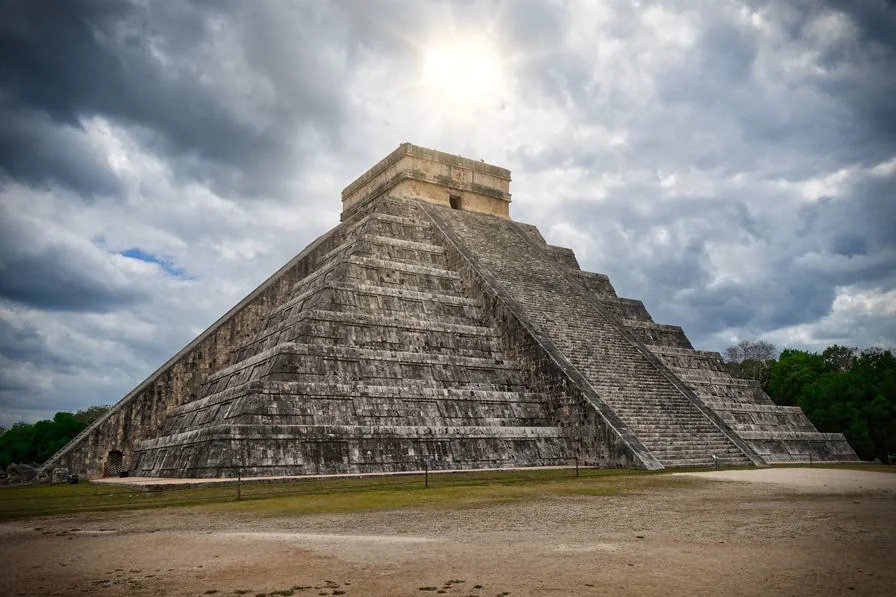
| Most famous building | El Castillo, the Temple of Kukulkan: about 30 m tall in total (24 m pyramid body + 6 m temple, INAH) |
| World Heritage | UNESCO World Heritage Site since 1988, listed as the "Pre-Hispanic City of Chichen-Itza" |
| New7Wonders | Named one of the New7Wonders of the World in 2007, in a private foundation's worldwide vote (not a UNESCO title) |
| Visitors | 2,182,034 in 2025 (INAH's monthly counts for the year, summed) |
| Climbing | Climbing the monuments is prohibited; El Castillo has been closed to climbing since the 2000s |
| The wells | Two great cenotes inside the zone: the Sacred Cenote (ceremonial, no swimming) and Cenote Xtoloc |
Every row of that table has a page of its own somewhere on this site, linked as you read. A fact table is a map, not the territory: the two rows people most often get wrong, the UNESCO title and the 2007 vote, are separated in full on the New7Wonders page, because they were awarded by different bodies, nineteen years apart, for different reasons.
The Name: Meaning and Pronunciation
Chichen Itza is Yucatec Maya: chi, mouth or edge; chen, a well; and Itza, the name of the people. INAH renders it "the city at the edge of the well of the Itzaes", and the well it means first is the Sacred Cenote, the huge natural sinkhole at the north end of the site that gave the city water and its gods a doorway. Spanish spelling writes it Chichén Itzá; the accents mark stress, not a different place, and the common misspelling "Chitzen Itza" is just a misspelling.
Pronunciation: chee-CHEN eet-SAH, roughly, with the stress on the second syllable of each word. You will hear several local variants in Yucatan, and none of them will cause a misunderstanding: taxi drivers, guides and hotel desks all recognise every version, including the misspelling on a booking voucher.
The people in the name, the Itza, were a Maya group whose own later history runs far beyond this city, to a last independent Maya kingdom on Lake Peten Itza that held out until 1697. That story belongs to the Itza page; here it is enough to hold the fact that the city is named for its builders and its well at the same time, which is the whole of Chichen Itza in one name.
Why Chichen Itza Is Famous, and Why It Matters
The fame has four layers, and they are worth separating because they answer different questions. First, scale and preservation: few Maya cities keep so much standing architecture in one walkable core. Second, the buildings themselves: a pyramid engineered as a calendar in stone, the largest ball court in Mesoamerica, an observatory, and whole colonnaded districts. Third, the honours: UNESCO inscription in 1988 and the 2007 New7Wonders vote made it, for much of the world, the single symbol of pre-Hispanic Mexico. Fourth, the evidence: its carved lintels carry the site's only full Long Count date (878 CE), its Sacred Cenote yielded a famous archive of offerings, and a 2024 genetic study of burials near the site reshaped what is known about its ritual life.
Why it matters, beyond fame: Chichen Itza is the best surviving classroom for the moment two Mesoamerican worlds met. Its earlier districts are built in the Puuc Maya style of the northern hills; its later monumental core carries styles and imagery shared with central Mexico. Whether that meeting was conquest, migration or exchange is a genuine scholarly argument, adjudicated in full on the Toltec influence page. The facts page position is the one the evidence supports without the argument: the city is Maya, the influences are real, and the mechanism is debated.
It also matters as a living place, not only a ruin. The towns around it, Piste first among them, depend on it; Maya communities across Yucatan are its cultural heirs; and INAH's counts make it the most visited archaeological zone in Mexico, with more than two million visitors in 2025 alone.
Size, Scale and Population
The visitor core is compact, about 2.5 km end to end, but the ancient city was not: the mapped urban zone spreads over several square kilometres of platforms, causeways and house mounds, most of it unexcavated under scrub. El Castillo, the centrepiece, stands about 30 m tall in total and roughly 55 m to a side at the base (published base figures vary slightly; the conflicts are printed on its own guide). The Great Ball Court measures about 168 by 70 m, the largest in Mesoamerica, and it is one of 13 ball courts identified at the site.
How many people lived here? Estimates for the peak population vary widely in the literature, from the tens of thousands upward, and no census stone survives to settle it. The honest fact is the range and the reason: archaeologists infer population from house-mound counts across a city whose suburbs are still being mapped, so any single confident number you read elsewhere is a choice, not a measurement. What is not in doubt is the rank: by the 10th century this was one of the largest cities in the Maya world and the dominant power of the northern lowlands.
Under El Castillo there is a further fact, labelled with its evidence grade: in 2015 a UNAM team reported detecting a water-filled cavity beneath the pyramid by electrical resistivity tomography. It has never been seen directly, its exact form is uncertain, and the responsible statement is the one the researchers themselves made: instruments indicate a cenote-like cavity down there. It is a preliminary finding, printed here as one.
Facts People Repeat That Need a Label
"Thousands of skeletons and 4,000 artifacts came out of the Sacred Cenote." The dramatic counts that circulate (4,000+ objects, around 200 skeletons) trace to a single uncited competitor page and are amplified from there. The citable record is the Peabody Museum's: more than 3,000 offerings remain in its care from Edward Thompson's 1904 to 1910 dredging. Human remains in the cenote were men, women and children, not a single category of victim. The evidence is set out on the Sacred Cenote guide.
"A 2024 study proved child sacrifice in the Sacred Cenote." The 2024 Nature study analysed burials from a chultun (an underground cistern) near the Sacred Cenote, not from the cenote itself: 64 boys, including twin pairs, dated across roughly AD 500 to 900. It is a major finding about ritual at Chichen Itza; it is not a finding about what is in the cenote's water. The distinction is kept everywhere on this site, including the sacrifice evidence page.
"UNESCO chose it as one of the seven wonders." No. UNESCO inscribed Chichen Itza as a World Heritage Site in 1988 and publicly distanced itself from the 2007 New7Wonders vote, which was a private foundation's poll. Both honours are real; they are not the same honour.
"The pyramid has exactly 365 steps, proving it is a calendar." The restored stairways give 91 steps on each of four sides, 364, plus the top platform, which the popular count calls the 365th. The arithmetic is real; that the count was designed as a calendar is an interpretation scholars discuss, not a proven fact, and the El Castillo guide prints both sides.
Chichen Itza for Students: The Short Version
For a worksheet, a classroom or a curious ten-year-old, the city reduces to five sentences. Chichen Itza was a great Maya city in Mexico, built around two natural wells in a land with no rivers. Its people built a pyramid, El Castillo, whose stairways add up, with the top platform, to the 365 days of the solar year. They played a ball game in the largest court in ancient America, watched the planets from a round observatory, and made offerings, including gold and jade, in their Sacred Cenote. The city faded as a capital about 800 years ago but stayed a holy place, and its ruins were explored, drawn and finally protected in the modern era. In 1988 it became a UNESCO World Heritage Site, and in 2007 the world voted it one of the New7Wonders. Everything on this page above those five sentences is the same story with the evidence left in; the family version of an actual visit is the Chichen Itza with kids guide.
See the Facts Standing Up: The Shared Tour
Our shared day trip combines Chichen Itza, a swim at Cenote Ik Kil, and a stop in Valladolid. The price is $130 per adult and $115 per child up to age 12, including the 697 MXN Chichen Itza entrance fee. We pick you up at your hotel or pickup point and confirm the exact time on WhatsApp the night before. To reserve, pay a 30% advance and settle the balance on the tour day. Cancellation is free up to 48 hours before the tour, with the advance refunded in full. We are a new operator, and we say so plainly.
City pages: Chichen Itza tour from Cancun · from Tulum · from Playa del Carmen
Price calculator
These prices include the 697 MXN Chichen Itza entrance fee, so there is nothing extra to pay at the gate for entry.
Chichen Itza Facts: Questions, Answered
What is Chichen Itza?
A ruined Maya city in Yucatan, Mexico: a political, ceremonial and trading capital of the northern Maya lowlands, now an archaeological zone administered by INAH. El Castillo, its famous pyramid, is one building in a city of hundreds of structures.
What does Chichen Itza mean?
In Yucatec Maya: at the mouth of the well of the Itza. Chi is mouth or edge, chen is a well, and Itza is the name of the people the city is named for. The well it refers to first is the Sacred Cenote.
How do you pronounce Chichen Itza?
Roughly chee-CHEN eet-SAH, with the stress on the second syllable of each word. Local variants exist and every version, including the common Chitzen Itza misspelling, is understood locally.
Why is Chichen Itza famous?
For the scale and preservation of its architecture, for El Castillo and the largest ball court in Mesoamerica, for its UNESCO World Heritage inscription in 1988, and for being voted one of the New7Wonders of the World in 2007.
Why is Chichen Itza important?
It is the best surviving evidence of the meeting between the Maya world and central Mexican styles, a major archive of inscriptions and offerings, and a living cultural landmark for the Maya communities of Yucatan. UNESCO inscribed it in 1988 for that outstanding value.
Is Chichen Itza a UNESCO site or one of the seven wonders?
Both, but they are different honours. UNESCO made it a World Heritage Site in 1988. The New7Wonders title came from a private foundation’s worldwide vote in 2007, which UNESCO publicly distanced itself from.
How old is Chichen Itza?
The city was settled by the 6th century CE and its great monuments rose mainly between the 9th and 12th centuries, so the famous buildings are roughly 900 to 1,200 years old. The full dated sequence is on the history page.
How many people visit Chichen Itza?
INAH counted 2,182,034 visitors in 2025, making it the most visited archaeological zone in Mexico. July was the busiest month of that year and October the quietest.
Check Your Date on WhatsApp
Booking opens on WhatsApp: that is where your date is checked, your pickup point is set, and your exact pickup time is confirmed the night before the tour. Send one message with:
- Your tour date
- Your pickup city and hotel or pickup point
- How many adults and children (to age 12)
$130 per adult · $115 per child · 697 MXN entrance fee included · 30% advance to reserve · free cancellation up to 48 hours before.
Start with your date
One tap opens the conversation. Prices above are the full per-person prices: the entrance fee is already in them.