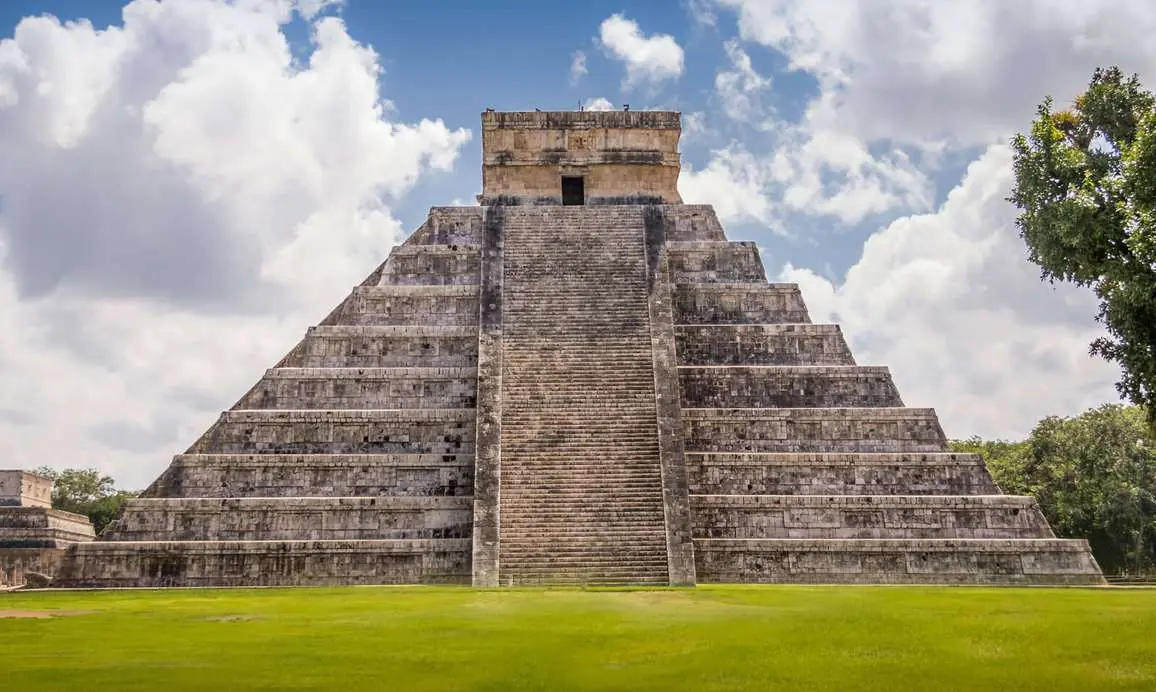
Chichén Itzá holds two famous honours that are constantly confused: an expert inscription from 1988 and a public vote from 2007. They came from different institutions, were decided by completely different methods, and only one of them is UNESCO's. This page separates the two: who ran the vote, how it worked, how solid its famous vote total really is, and what the title changed on the ground.
New-operator disclosure: this site is run by a young tour operator with a short record. The history on this page is sourced from UNESCO, the New7Wonders Foundation and contemporaneous reporting, and every contested figure is labelled with its source.
Almost every misunderstanding about Chichén Itzá's titles comes from treating these two lines as one. They are not the same honour at different dates: they are different kinds of honour, awarded by different bodies, for different reasons.
| UNESCO World Heritage | New7Wonder of the World | |
|---|---|---|
| Who awarded it | The World Heritage Committee, through UNESCO's World Heritage Centre | The New7Wonders Foundation, a private foundation based in Zurich |
| When | 1988 | Announced 7 July 2007 |
| How chosen | Expert evaluation against published cultural criteria | A global public vote by internet and telephone/SMS, after an expert panel cut the field to 21 finalists |
| Official name / form | “Pre-Hispanic City of Chichen-Itza”, World Heritage List dossier 483 | One of seven winners, announced as an unranked group |
| What it grants | International recognition inside the World Heritage framework, with the conservation commitments that come with listing | A popularity title and a licence-able brand for tourism promotion |
| What it does not grant | It does not make UNESCO the site's manager: INAH administers Chichén Itzá | No UNESCO status, funding, protection or obligations, and it changes nothing about the 1988 inscription |
Keep this table in mind and the rest of the page falls into place: whenever you see the 2007 title credited to UNESCO anywhere, you are looking at the confusion this page exists to correct.
The selection was a funnel, not a single ballot. According to the New7Wonders Foundation's own project history, roughly 200 sites were nominated worldwide; an expert panel cut that field to 77 candidates on 1 January 2006, and then to 21 finalists; the public vote among those 21 produced the seven winners. The middle step, the cut to 77, is the one tour copy most often skips, and it matters: the finalists the public voted on had already been filtered by experts, not by votes.
Voting was by internet and by telephone/SMS. The winners were announced on 7 July 2007, 07/07/07, at a ceremony in Lisbon's Estádio da Luz, as AP reported that day. The seven were announced as a group, with no ranking among them.
The campaign was a private initiative organised by the New7Wonders Foundation, founded in 2001 in Zurich by Bernard Weber, a Swiss-born Canadian filmmaker. That outline comes from the Foundation's own project history and is corroborated by AP and CBS reporting from 2007.
You will see three different start years attached to the campaign, and all three appear in the sources, which is why this page gives no single launch year. AP reported a 1999 conception and launch; UNESCO's statement describes the campaign as “launched in 2000”; the Foundation itself was founded in 2001. Each date belongs to a different step, and collapsing them into one year misstates the record.
By its own account, the Foundation is funded entirely by licensing, commercial partnerships, TV rights and campaign services, with no public subsidies, and its commercial side licenses the New7Wonders brand to winners' tourism organisations. It is a campaigning and licensing organisation, not a heritage body, and it neither owns nor manages Chichén Itzá.
“More than 100 million votes”
That is the New7Wonders Foundation's claim for the whole campaign. AP reported “approximately 100 million”, attributing the figure to the organiser. Treat it exactly that way: an organiser's claim, reported as such, not an audited count.
Three cautions belong with the number wherever it is used. First, no independent audit of the total exists. Second, votes are not voters: the organiser acknowledged there was no foolproof mechanism against repeat voting, as AP and CBS reported, so “100 million votes” must never be rewritten as 100 million people. Third, no per-site totals or rankings were ever published: the seven winners were announced as an unranked group, so the honest answer to “how many votes did Chichén get?” is that it was never released, by anyone, ever.
The seven announced in Lisbon on 7 July 2007 were:
The other fourteen finalists Chichén was voted against included the Acropolis, the Alhambra, Angkor Wat, the Eiffel Tower, Hagia Sophia, Kiyomizu-dera, the Kremlin and St Basil's, the Moai of Easter Island, Neuschwanstein, the Statue of Liberty, Stonehenge, the Sydney Opera House and Timbuktu. Mexico's place in the list is exactly one of seven, no more, and no less: the winners were published as a group, and any ordering of them you see elsewhere is presentation, not a result.
The Great Pyramid was one of the 21 finalists, and then it was removed from the competitive vote after Egyptian objections, with officials calling a contest for the pyramids “absurd”, and granted honorary status instead, as AP and CBS reported. So all three versions you may have read are wrong: Giza did not lose, was not voted out, and did not finish in any ranked position below the seven. It was taken out of the competition and honoured separately.
There is a logic to it: the Great Pyramid is the only survivor of the ancient Seven Wonders. A public vote on whether it still counted as a wonder was, in the Egyptian view, a question that did not need asking.
Chichén's win was not passive. Contemporary reporting, the Washington Post in March 2007 and Mexican press coverage, records government and tourism promotion behind the bid, including SMS voting drives urging Mexicans to vote by text message. A later report noted Coca-Cola cans carrying the campaign in Mexico.
The morning after is part of the record too. A 2009 IPS report, headlined “Chichen Itza Win Falls Flat”, recorded local disappointment that the expected benefits of the title had not yet arrived. Both halves belong on this page: the campaign was real and organised, and the payoff locals had been led to expect was slower than the promotion implied.
No, and UNESCO said so itself, in writing, two days after the announcement. Its statement of 9 July 2007 records that UNESCO was invited to support the project on several occasions and:
“…decided not to collaborate with Mr. Weber.”
The statement explains that World Heritage listing is decided by committee “according to rigorous scientific and technical criteria”, and describes the 2007 list as:
“…the result of a private undertaking, reflecting only the opinions of those with access to the Internet and not the entire world.”
It concludes that the initiative “cannot, in any significant and sustainable manner, contribute to the preservation of sites selected by this public.” These are UNESCO's own words, from its statement of 9 July 2007 (whc.unesco.org/en/news/352), not a paraphrase of them.
The confusion this statement was answering is still live in commercial copy: tour sites still print lines calling Chichén “one of the New 7 Wonders of the World, according to UNESCO.” That attribution is false. UNESCO awarded Chichén a different, earlier honour, the subject of the next section, and publicly declined any part in this one.
Chichén Itzá was inscribed on the World Heritage List in 1988 as the “Pre-Hispanic City of Chichen-Itza” (dossier 483), under cultural criteria (i), (ii) and (iii). In the World Heritage Centre's terms:
That is the honour with institutional weight behind it, and it predates the vote by nineteen years. For what the inscription means for visiting the site itself, see the Chichen Itza Visitor Guide.
One more list to keep separate. The original Seven Wonders were a Hellenistic-era traveller's list: the Great Pyramid of Giza, the Hanging Gardens of Babylon, the Statue of Zeus at Olympia, the Temple of Artemis at Ephesus, the Mausoleum at Halicarnassus, the Colossus of Rhodes and the Lighthouse of Alexandria. Of those seven, only Giza still stands. Chichén Itzá, founded many centuries after that list was written, is on neither the ancient list nor any UNESCO “wonders” list, because no such UNESCO list exists. Its “wonder” title is the 2007 one, and its UNESCO honour is World Heritage listing. Two true statements; no third one is needed.
The most careful contemporaneous account is the 2009 Global Issues / IPS report: the site averaged about 1.2 million visitors a year before the vote and drew about 1.5 million in 2008. Yucatán's state tourism programme credited the promotion around the selection with the rise, and that framing matters. Tourism officials attributing a rise to the campaign is a publishable fact; claiming the vote by itself caused the rise would go beyond what the sources show, so this page does not claim it.
Later totals, reported from INAH figures and dated to their years, give the longer arc: 2.28 million visitors in 2019, 2.63 million in 2022, 2.33 million in 2023 and 2.25 million in 2024, with 2,182,034 recorded in 2025 in INAH's monthly dataset, the year-by-year figures are tracked in the best month to visit Chichen Itza guide. What did not change in 2007 is just as definite: INAH's management of the site and its legal status under federal jurisdiction were exactly the same the day after the Lisbon ceremony as the day before.
The 2007 vote was not the Foundation's last campaign. It went on to choose the New7Wonders of Nature, declared in 2011, and the New7Wonders Cities, declared in 2014, run on the same model: a private foundation, a public vote, and a brand licensed to the winners' tourism organisations. Chichén's title belongs to the first and most famous of the three campaigns.
Where does a visitor actually meet the New7Wonder title? In marketing: on tour pages like this one, in destination branding, in the first sentence of a thousand brochures. That is a real effect: the title is genuinely famous, and it genuinely shapes which sites travellers have heard of before they arrive.
Where does it never reach? The site's legal status, its protection, its management and its archaeology. None of those run through Zurich. Chichén Itzá is protected because it is a federal archaeological zone administered by INAH and a World Heritage site inscribed in 1988. The bottom line, with both facts standing: the ruins' significance is archaeological, recognised by UNESCO since 1988; the 2007 title is a popularity honour the world voted on. Neither cancels the other, and neither needs the other to be true.
The title attaches to the whole site, but one building carries it in every photograph, the pyramid that carries the title is El Castillo’s own guide.
Our shared Chichen Itza tour covers the ruins themselves, a swim at Cenote Ik Kil and a stop in Valladolid, with hotel pickup from your own pickup point: your exact time is confirmed on WhatsApp the night before. The price is $130 per adult and $115 per child up to age 12, and the 697 MXN Chichen Itza entrance fee is included. Reserve with a 30% advance; the balance is paid on the day of the tour, and cancellation is free up to 48 hours before the tour, with the advance refunded in full.
Pickup cities, in order: Cancun, Tulum, Playa del Carmen, Riviera Maya and Merida.
Free cancellation up to 48 hours before the tour: advance refunded in full. Inside 48 hours the advance is kept.
Booking opens on WhatsApp: tell us your date, your pickup city and how many adults and children, and we confirm your exact pickup time the night before the tour. A 30% advance reserves your seats; the balance is paid on the day, and cancellation is free up to 48 hours ahead.
Shared tour · $130 adult / $115 child · 697 MXN entrance fee included · Chichen Itza + Cenote Ik Kil + Valladolid